Bible Verses About Anxiety
If anxiety has been sitting on your chest lately, Scripture has something to say about it. God does not tell you to just stop worrying. He gives you somewhere to put the worry. The 15 verses below are some of the Bible's clearest words on anxiety, and each one comes with a plain-English explanation and a specific way to apply it today.
What Does the Bible Say About Anxiety?
The Bible does not treat anxiety like a character flaw. It treats it like a human experience that God takes seriously. From the Psalms to the words of Jesus to Paul's letters, Scripture is full of honest acknowledgments that life can feel overwhelming.
What you will find, again and again, is a pattern. God does not say "just get over it." He says "bring it to me." Philippians 4:6-7 tells you to bring every anxious thought to God in prayer. 1 Peter 5:7 says to throw your worries on Him because He cares about you. Psalm 55:22 says to cast your burdens on the Lord and He will hold you up. The language is active: cast, throw, bring, come. God wants your anxiety. He can handle it.
The other thing you will notice is that God almost always pairs the command with a promise. "Do not fear, for I am with you" (Isaiah 41:10). "Come to me... and I will give you rest" (Matthew 11:28). "My peace I give to you" (John 14:27). The Bible does not just tell you to stop being anxious. It gives you a reason to let go: God is already holding you.
15 Bible Verses About Anxiety
1. Philippians 4:6-7: "Trade Your Worry for Prayer"
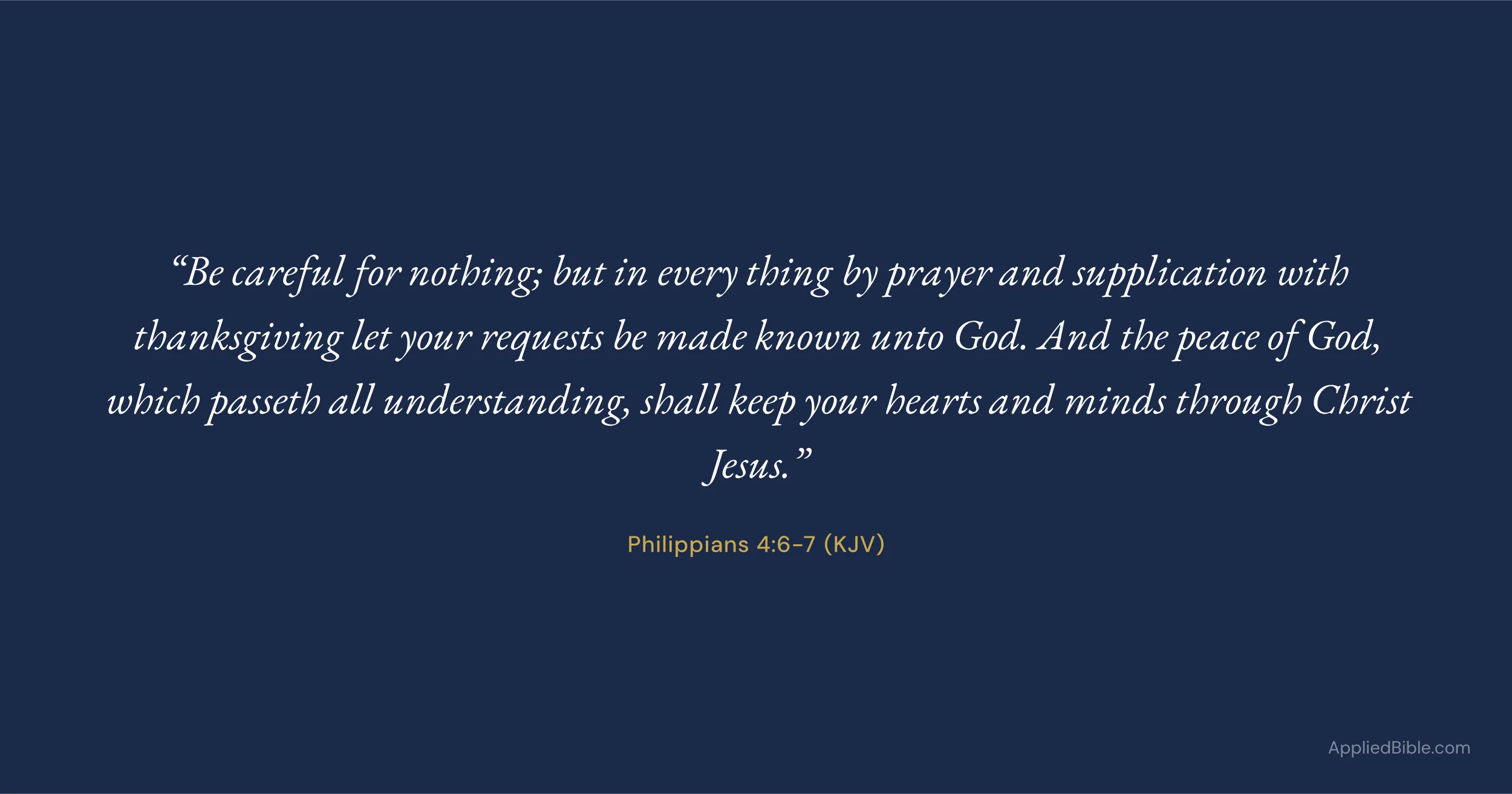
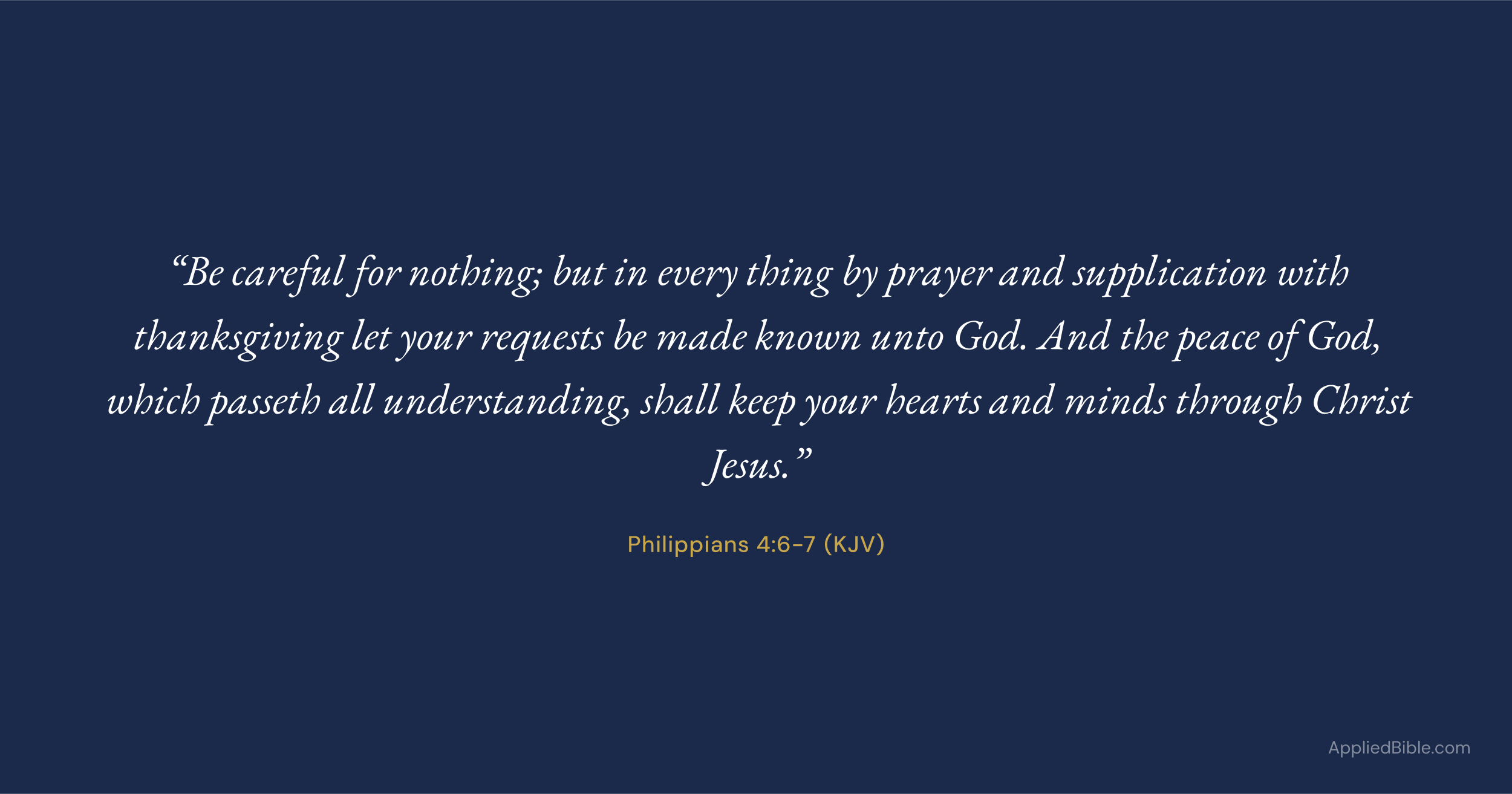
"Be careful for nothing; but in every thing by prayer and supplication with thanksgiving let your requests be made known unto God. And the peace of God, which passeth all understanding, shall keep your hearts and minds through Christ Jesus."
Philippians 4:6-7 (KJV)
What This Means: Paul is not saying "don't feel anxious." He is giving you something to do with your anxiety: bring it to God. Every single worry, big or small. And when you do, God's peace steps in to guard your heart like a sentry at the door.
How to Apply This: The next time anxious thoughts start spiraling, stop and pray out loud. Name the specific thing you are worried about. Thank God for one thing He has already done. Then let His peace do its work.
2. 1 Peter 5:7: "Cast Your Anxiety on God"
"Casting all your care upon him; for he careth for you."
1 Peter 5:7 (KJV)
What This Means: The word "casting" here means to throw something onto someone else, like tossing a heavy pack off your back. Peter says you can do that with every worry because God genuinely cares about what concerns you.
How to Apply This: Write down the thing that is weighing on you most right now. Then pray it over to God, out loud if you can. Leave it with Him. When the worry circles back, remind yourself: "I already gave that one to God."
3. Matthew 6:25-27: "Your Life Is Worth More Than Worry"
"Therefore I say unto you, Take no thought for your life, what ye shall eat, or what ye shall drink; nor yet for your body, what ye shall put on. Is not the life more than meat, and the body than raiment? Behold the fowls of the air: for they sow not, neither do they reap, nor gather into barns; yet your heavenly Father feedeth them. Are ye not much better than they? Which of you by taking thought can add one cubit unto his stature?"
Matthew 6:25-27 (KJV)
What This Means: Jesus points to birds and asks a simple question: if God feeds them, don't you think He will take care of you? Worry cannot add a single hour to your life. It is wasted energy on problems God has already promised to handle.
How to Apply This: Go outside and look at something God made: a tree, the sky, a bird. Let it remind you that the same God who sustains creation is sustaining you right now, even when it does not feel like it.
4. Isaiah 41:10: "God Is With You, Do Not Fear"
"Fear thou not; for I am with thee: be not dismayed; for I am thy God: I will strengthen thee; yea, I will help thee; yea, I will uphold thee with the right hand of my righteousness."
Isaiah 41:10 (KJV)
What This Means: God speaks directly here with five stacked promises: I am with you. I am your God. I will strengthen you. I will help you. I will hold you up. Five commitments for the moments when fear is louder than faith.
How to Apply This: Pick one of the five promises in this verse and write it on a sticky note. Put it where you will see it first thing in the morning. Let it be the first voice you hear before anxiety gets a word in.
5. Psalm 55:22: "Give Your Burdens to God"
"Cast thy burden upon the LORD, and he shall sustain thee: he shall never suffer the righteous to be moved."
Psalm 55:22 (KJV)
What This Means: David knew what it felt like to carry more than he could handle. His advice is blunt: throw your burden on God. He will sustain you. He will not let you fall.
How to Apply This: Before bed tonight, tell God the heaviest thing on your mind. Picture yourself setting it down at His feet. He is strong enough to carry what you were never meant to hold.
6. Psalm 94:19: "God's Comfort Calms the Storm Inside"
"In the multitude of my thoughts within me thy comforts delight my soul."
Psalm 94:19 (KJV)
What This Means: The psalmist is honest about having a flood of anxious thoughts. But in the middle of that flood, God's comfort brought delight to his soul. Anxiety and comfort can exist at the same time when God is in the room.
How to Apply This: You do not have to wait for the anxious thoughts to stop before you experience comfort. Open your Bible or play a worship song right in the middle of the anxiety. Let God's comfort meet you where you are.
7. Proverbs 12:25: "A Good Word Lifts a Heavy Heart"
"Heaviness in the heart of man maketh it stoop: but a good word maketh it glad."
Proverbs 12:25 (KJV)
What This Means: Solomon observed something we all know is true: worry makes the heart heavy. But a kind word has the power to lift it. Sometimes the remedy for anxiety is not a new strategy. It is a conversation with someone who cares.
How to Apply This: Text or call someone you trust today and be honest about what is weighing on you. Then do the same for someone else. A good word goes both ways.
8. Matthew 11:28-30: "Come to Jesus When You Are Worn Out"
"Come unto me, all ye that labour and are heavy laden, and I will give you rest. Take my yoke upon you, and learn of me; for I am meek and lowly in heart: and ye shall find rest unto your souls. For my yoke is easy, and my burden is light."
Matthew 11:28-30 (KJV)
What This Means: Jesus is not offering a lecture. He is offering rest. "Come to me" is the invitation. He does not say "figure it out first" or "clean up your life." He says come as you are and find rest for your soul.
How to Apply This: If you are exhausted from trying to manage your anxiety alone, stop trying harder. Sit down, close your eyes, and say out loud: "Jesus, I'm tired. I'm coming to you." That is all it takes.
9. John 14:27: "The Peace Jesus Gives Is Different"
"Peace I leave with you, my peace I give unto you: not as the world giveth, give I unto you. Let not your heart be troubled, neither let it be afraid."
John 14:27 (KJV)
What This Means: The peace Jesus offers is not the kind the world offers. The world says peace comes when the problems go away. Jesus says peace comes in the middle of the problems, because He is with you in them.
How to Apply This: Stop waiting for your circumstances to change before you feel at peace. Ask Jesus for His peace right now, in the middle of whatever is making you anxious. His peace does not depend on your situation.
10. Romans 8:28: "God Works Even the Hard Stuff for Good"
"And we know that all things work together for good to them that love God, to them who are the called according to his purpose."
Romans 8:28 (KJV)
What This Means: This verse does not say everything is good. It says God works everything together for good for those who love Him. That includes the hard seasons, the losses, and the things that make no sense right now.
How to Apply This: Think of one situation causing you anxiety. Ask God to show you, even in a small way, how He might be working in it. You may not see the full picture yet, but He is not done.
11. 2 Timothy 1:7: "God Gave You Power, Not Fear"
"For God hath not given us the spirit of fear; but of power, and of love, and of a sound mind."
2 Timothy 1:7 (KJV)
What This Means: Paul reminds Timothy that fear does not come from God. What God gives is power, love, and a sound mind. If you are a believer, you already have access to all three. Fear may be loud, but it is not from your Father.
How to Apply This: When fear shows up, say this verse out loud. Replace the lie ("I can't handle this") with the truth ("God gave me power, love, and a sound mind"). Repeat it as many times as it takes.
12. Isaiah 26:3: "Perfect Peace for the Focused Mind"
"Thou wilt keep him in perfect peace, whose mind is stayed on thee: because he trusteth in thee."
Isaiah 26:3 (KJV)
What This Means: The key word here is "stayed." It means fixed, anchored, locked in. God promises perfect peace to the person whose mind is focused on Him rather than on the thing causing the anxiety.
How to Apply This: Set a timer on your phone for three specific times today. When it goes off, pause and redirect your thoughts to God for 60 seconds. Train your mind to stay on Him instead of your worries.
13. Psalm 23:4: "You Are Not Walking Through This Alone"
"Yea, though I walk through the valley of the shadow of death, I will fear no evil: for thou art with me; thy rod and thy staff they comfort me."
Psalm 23:4 (KJV)
What This Means: David did not say "if" he walked through the valley. He said "though." Hard seasons will come. But even in the darkest stretch, God is with you. His rod protects you. His staff guides you. You are not alone.
How to Apply This: If you are in a dark season right now, say this out loud: "God is with me in this." You do not have to pretend the valley is not real. Just remember who is walking through it beside you.
14. Joshua 1:9: "Be Strong and Courageous"
"Have not I commanded thee? Be strong and of a good courage; be not afraid, neither be thou dismayed: for the LORD thy God is with thee whithersoever thou goest."
Joshua 1:9 (KJV)
What This Means: God gave this command to Joshua right before he led Israel into unknown territory. The instruction was not "don't feel scared." It was "be courageous anyway, because I am with you wherever you go."
How to Apply This: Courage is not the absence of anxiety. It is doing the next right thing even when you are afraid. What is one thing you have been avoiding because of worry? Take one small step toward it today.
15. Psalm 34:4: "God Answered When I Called"
"I sought the LORD, and he heard me, and delivered me from all my fears."
Psalm 34:4 (KJV)
What This Means: David is speaking from experience. He sought God, God heard him, and God delivered him from all his fears. Not some of them. All of them. This is a testimony, not a theory.
How to Apply This: Write down one fear that has been following you. Bring it to God and ask Him to deliver you from it. Then watch for how He answers. It may not be instant, but He is faithful.
How to Apply These Verses When You Feel Anxious
When anxiety hits you at 2am
You know the feeling. Your eyes open in the dark and your brain starts running through every worst-case scenario it can find. Keep a Bible or a verse card on your nightstand. When the thoughts start, read one verse out loud. Speaking Scripture into the dark takes the power out of the anxious thoughts. Start with Psalm 94:19 or Isaiah 26:3.
When you are overwhelmed by a situation you cannot control
Some anxiety comes from things you have no power to change: a diagnosis, a loved one's choices, a job you might lose. In those moments, Matthew 6:25-27 is the verse to hold. Jesus is not telling you the situation does not matter. He is telling you that worry will not fix it, but your Father in heaven already sees it and is working.
When anxiety is affecting your daily life
If anxious thoughts are constant and interfering with your ability to function, please hear this: seeking help is not a lack of faith. God works through counselors, doctors, and medication just as surely as He works through prayer. Use these verses alongside professional support, not as a replacement for it. Philippians 4:6-7 and prayer are powerful, and so is a good therapist.
When encouraging someone else who is struggling
Sometimes the best thing you can do for an anxious friend is share one verse and say, "I've been praying this for you." Proverbs 12:25 says a good word lifts a heavy heart. Send a text. Write a note. You do not need to have all the answers. Just be present and point them toward the God who does.
Frequently Asked Questions
Does the Bible say anxiety is a sin?
No. The Bible never calls anxiety a sin. Jesus Himself experienced deep distress in the Garden of Gethsemane (Luke 22:44), and many of the Psalms are raw expressions of worry and fear. What the Bible does say is that you do not have to stay stuck in anxiety. God invites you to bring your worries to Him and receive His peace in return.
What is the best Bible verse for anxiety?
Philippians 4:6-7 is often considered the most direct Bible verse about anxiety. Paul writes: "Be careful for nothing; but in every thing by prayer and supplication with thanksgiving let your requests be made known unto God." It gives you a clear action step (pray with thanksgiving) and a clear promise (God's peace will guard your heart).
How do I stop feeling anxious according to the Bible?
The Bible's approach to anxiety is not "stop feeling it." It is "bring it to God." Philippians 4:6-7 says to bring every worry to God in prayer. 1 Peter 5:7 says to cast your cares on Him. The pattern across Scripture is active surrender: you hand your anxiety to God, and He gives you peace in return.
Can prayer really help with anxiety?
Yes. Philippians 4:6-7 connects prayer directly to peace: when you bring your requests to God with thanksgiving, His peace guards your heart and mind. Prayer does not always remove the situation causing anxiety, but it changes your posture toward it. You move from carrying the weight alone to sharing it with a God who cares about you (1 Peter 5:7).
Try This Today
- ✓ Pick the one verse from this list that hit you the hardest. Write it out by hand on a card or sticky note.
- ✓ Put it somewhere you will see it tomorrow morning: your bathroom mirror, your coffee maker, your steering wheel.
- ✓ Every time you see it, read it out loud. Do this for seven days and see what changes.