15 Bible Verses About Courage
Biblical courage is not the absence of fear. It is the choice to trust and obey God while fear is present. These 15 verses show where real courage comes from, and give you something specific to do when the fear is louder than the faith.
What Does the Bible Say About Courage?
The most repeated command in the Bible is some form of "fear not" or "be strong and courageous." God said it to Joshua three times in the same chapter (Joshua 1:6, 7, 9), which tells you something: courage requires repetition. You do not just decide to be brave once and then coast. You choose it again each time fear returns.
2 Timothy 1:7 makes the source clear: God has not given you a spirit of fear. What He gave is power, love, and a sound mind. When you trace your fear back to its source, it is not coming from God's Spirit. It may be coming from the enemy, from circumstances, from past wounds. But not from Him. That distinction matters.
Acts 4:13 shows what produces visible courage in ordinary people: time with Jesus. The religious leaders could not explain Peter and John's boldness except by the fact that they had been with Jesus. That path is still open. Courage is often a byproduct of proximity to God.
15 Bible Verses About Courage
1. Joshua 1:9: "Courage Is Commanded Because God Is With You"
"Have not I commanded thee? Be strong and of a good courage; be not afraid, neither be thou dismayed: for the LORD thy God is with thee whithersoever thou goest."
Joshua 1:9 (KJV)
What This Means: God says this to Joshua on the eve of one of the most daunting assignments in the Old Testament: leading a nation across the Jordan into enemy territory. The command to be courageous is not 'feel brave.' It is rooted in the reason: the LORD thy God is with thee wherever you go. Courage here is not the absence of fear. It is obedience in the presence of fear, sustained by the knowledge of God's company.
How to Apply This: Before you face what you are afraid of today, say this verse out loud. Say the whole thing, especially the second half. The courage commanded is connected to the presence promised. Let the presence be what you stand on.
2. Deuteronomy 31:6: "God Does Not Fail or Forsake"
"Be strong and of a good courage, fear not, nor be afraid of them: for the LORD thy God, he it is that doth go with thee; he will not fail thee, nor forsake thee."
Deuteronomy 31:6 (KJV)
What This Means: Moses says this to the entire nation before Joshua takes over. He will not fail you. He will not forsake you. These two negatives make the positive case. Whatever you are afraid of, you are not facing it alone. God does not abandon His people in the middle of hard things. He goes with them into it. That is the foundation of courage for anyone in the family of God.
How to Apply This: Name the one thing you are most afraid of right now. Write next to it: 'He will not fail me. He will not forsake me.' That is not denial of the fear. That is the truth that changes what the fear can do to you.
3. Psalm 27:1: "God's Presence Removes the Ground Fear Stands On"
"The LORD is my light and my salvation; whom shall I fear? the LORD is the strength of my life; of whom shall I be afraid?"
Psalm 27:1 (KJV)
What This Means: David asks two rhetorical questions. The expected answer is no one. If God is your light, your salvation, and the strength of your life, then who has the authority to make you afraid? Not no one in the sense that nothing difficult will happen, but no one in the sense that no one has the final word over your life. Fear cannot survive that answer for long.
How to Apply This: Ask David's question about your specific fear today: if the LORD is my light and my salvation, whom shall I fear in this situation? Name who or what you are afraid of. Then hold it next to the LORD as your light and salvation and see which is bigger.
4. Isaiah 41:10: "God Strengthens and Upholds You Personally"
"Fear thou not; for I am with thee: be not dismayed; for I am thy God: I will strengthen thee; yea, I will help thee; yea, I will uphold thee with the right hand of my righteousness."
Isaiah 41:10 (KJV)
What This Means: Three times God says 'I will': strengthen, help, uphold. The repetition is intentional reassurance. The right hand of His righteousness is the hand of power and covenant faithfulness. This is not a general spiritual platitude. It is a specific promise of active divine support. He is not a distant cheering section. He is the one holding you up.
How to Apply This: Which of the three promises do you need most today: strength, help, or upholding? Ask God specifically for that one. Then take the next step in what you have been afraid to do, knowing which hand is under you.
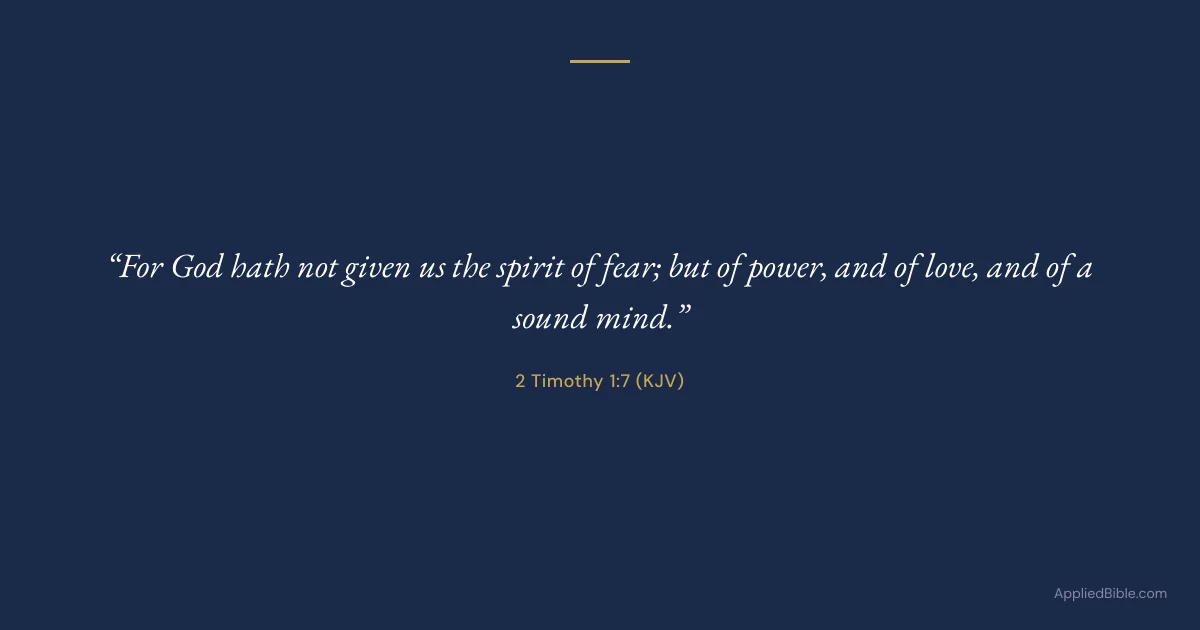
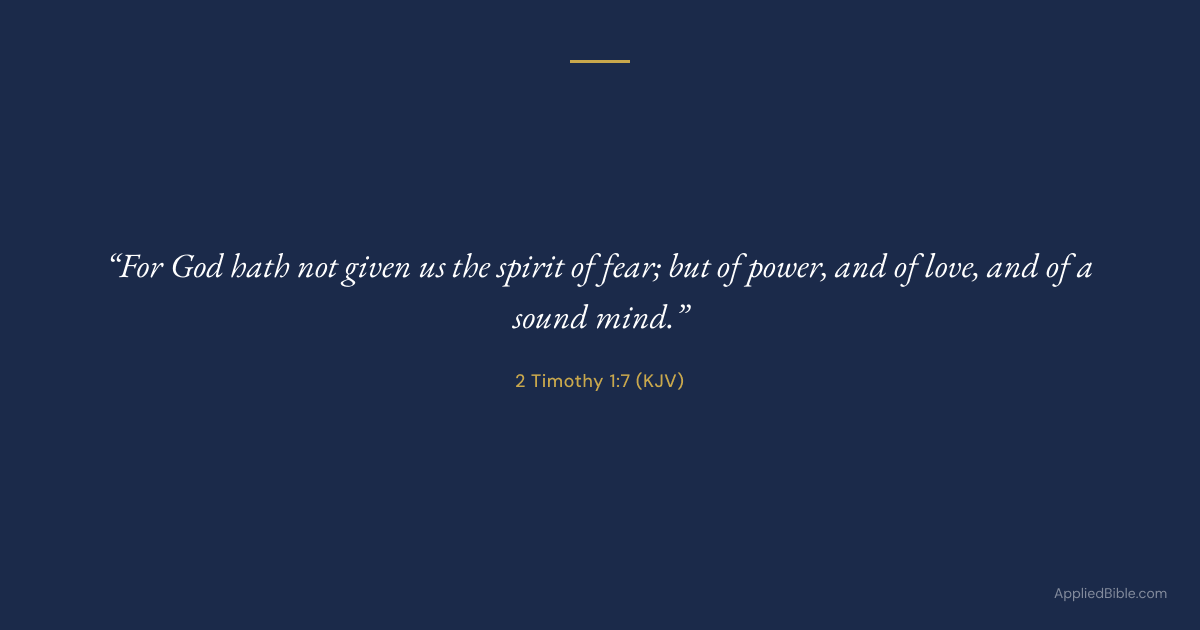
5. 2 Timothy 1:7: "The Spirit in You Is Not a Spirit of Fear"
"For God hath not given us the spirit of fear; but of power, and of love, and of a sound mind."
2 Timothy 1:7 (KJV)
What This Means: Paul says this to Timothy, who seems to have been naturally timid. The spirit of fear does not come from God. What God gave is power, love, and a sound mind. That last phrase, a sound mind, means sound judgment, discipline, self-control. Fear makes you irrational. The Spirit of God gives you clarity, love that casts out fear, and the power to act. Check the source of your fear before you obey it.
How to Apply This: When fear is driving a decision today, ask: is this coming from God's Spirit? Power, love, and sound judgment say one thing. Paralysis, panic, and withdrawal say another. Let the Spirit's character be the diagnostic.
6. 1 Corinthians 16:13: "Courage Is Something You Stand In, Not Just Feel"
"Watch ye, stand fast in the faith, quit you like men, be strong."
1 Corinthians 16:13 (KJV)
What This Means: Paul is closing one of his most doctrinally rich letters with this four-part charge: watch, stand fast in the faith, act courageously, be strong. Quit you like men is an old English way of saying 'conduct yourselves courageously.' This is not passive. It is an active posture, a decision about how you will show up. Courage is not something that happens to you. It is something you stand in.
How to Apply This: Before a hard conversation or difficult situation today, stand up physically for a moment. Say Paul's charge: 'I will be watchful. I will stand fast. I will act with courage. I will be strong.' The physical posture is not superstition. It is preparation.
7. Psalm 56:3: "Fear and Faith Can Coexist"
"What time I am afraid, I will trust in thee."
Psalm 56:3 (KJV)
What This Means: David does not say he stopped being afraid. He says when he is afraid, he will trust. The word what time means at the moment of fear, inside the fear, not after it passes. This is one of the most honest verses about courage in Scripture: it does not pretend fear is gone. It describes what you do with fear when it arrives. You choose trust in the same moment.
How to Apply This: The next time fear arrives, say this verse in real time: 'What time I am afraid, I will trust in thee.' You are allowed to be afraid. The question is what you do at that moment. This verse gives you a four-word answer: I will trust thee.
8. Proverbs 28:1: "The Righteous Have a Boldness That Cannot Be Explained by Circumstances"
"The wicked flee when no man pursueth: but the righteous are bold as a lion."
Proverbs 28:1 (KJV)
What This Means: The contrast is striking: the wicked are afraid even when no one is chasing them. The righteous are bold as a lion. The difference is not personality or temperament. It is the security that comes from being right with God. When your standing before God is settled, fear loses its grip. You do not have to run from things that God has not sent to destroy you.
How to Apply This: Is there something you have been running from or avoiding even though no one is actually threatening you? Name it. Then ask: am I afraid of this because it is genuinely dangerous, or because I have not let God settle my security? Let His righteous standing be yours.
9. Romans 8:31: "If God Is for You, Who Can Be Against You?"
"What shall we then say to these things? If God be for us, who can be against us?"
Romans 8:31 (KJV)
What This Means: Paul asks a rhetorical question after a long passage about God's love and purposes. If God is on your side, and He is, then who has the power to ultimately stop you? Not the person who opposes you. Not the circumstance that seems to shut every door. Not even your own failure. God being for you is not a guarantee of ease. It is a guarantee of victory in the ultimate sense.
How to Apply This: Name one person, situation, or force that you feel is against you right now. Then ask Paul's question honestly: if God is for me, who is this against me? You are not dismissing the difficulty. You are sizing it against the right reference point.
10. John 16:33: "Courage Is Possible Because Jesus Has Already Won"
"These things I have spoken unto you, that in me ye might have peace. In the world ye shall have tribulation: but be of good cheer; I have overcome the world."
John 16:33 (KJV)
What This Means: Jesus does not promise that the world will be easy. He promises tribulation. And then He says: be of good cheer. The reason is not that the trouble is not real. It is that He has overcome the world. Past tense. The victory is already secured. You are not fighting for victory. You are fighting from it. That changes everything about how courage operates.
How to Apply This: Write this verse on a card or sticky note for this week: 'In the world ye shall have tribulation: but be of good cheer; I have overcome the world.' Put it somewhere you will see it before the difficulty hits, not after.
11. Acts 4:13: "Time With Jesus Produces Visible Courage"
"Now when they saw the boldness of Peter and John, and perceived that they were unlearned and ignorant men, they marvelled; and they took knowledge of them, that they had been with Jesus."
Acts 4:13 (KJV)
What This Means: The religious leaders were astonished by the boldness of Peter and John, ordinary fishermen with no formal education. What explained it? They had been with Jesus. Time with Jesus produced visible courage in people who had no other explanation for it. That same transformation is available today. Courage is often a byproduct of proximity.
How to Apply This: When did you last spend unhurried time with Jesus, not rushed Bible reading or a quick prayer before bed, but actual time in His presence? The boldness the disciples had came from being with Him. Make time for that today.
12. Ephesians 6:10: "The Strength for Courage Comes From the Lord, Not From Yourself"
"Finally, my brethren, be strong in the Lord, and in the power of his might."
Ephesians 6:10 (KJV)
What This Means: Paul does not say be strong in your own resolve or your natural temperament. He says be strong in the Lord, and in the power of His might. The strength for courage is not self-generated. It is sourced in God. This means courage is always available, because the source never runs dry. What runs dry is your own supply. The instruction is to draw from the right well.
How to Apply This: Before the thing you are afraid of today, pray this: 'Lord, I am not trying to be strong in myself. I am drawing on your strength right now.' Then act. Not because you feel ready, because you have chosen the right source.
13. Psalm 31:24: "Courage and Hope Are Connected"
"Be of good courage, and he shall strengthen your heart, all ye that hope in the LORD."
Psalm 31:24 (KJV)
What This Means: David connects courage with hope in the LORD. This is not wishful thinking. It is the settled confidence of someone who knows who God is and what He has done. The person whose hope is in the LORD has a reason for courage that cannot be taken away. God's faithfulness is the ground of that hope, and that hope is what makes the heart strong.
How to Apply This: Write down one specific hope you have in God right now. Something you are trusting Him for. Let that hope be the reason for courage today in the thing you have been afraid to face.
14. Hebrews 13:6: "God as Your Helper Makes You Fearless of Human Opinion"
"So that we may boldly say, The Lord is my helper, and I will not fear what man shall do unto me."
Hebrews 13:6 (KJV)
What This Means: This verse addresses a very specific kind of fear: what others will think of you, what they will do to you, what they will say about you. The author says we can boldly declare: the Lord is my helper. I will not fear what man can do. When God is your helper, human opposition loses its final power. People can harm your reputation, your comfort, even your body. They cannot harm what God has done for you.
How to Apply This: Is there something you are afraid to do or say because of what people will think? Name it. Then say out loud: 'The Lord is my helper. I will not fear what man shall do unto me.' Then do the thing you have been holding back on.
15. Daniel 10:19: "God's Word Directly Strengthens the Fearful"
"And said, O man greatly beloved, fear not: peace be unto thee, be strong, yea, be strong. And when he had spoken unto me, I was strengthened, and said, Let my lord speak; for thou hast strengthened me."
Daniel 10:19 (KJV)
What This Means: Daniel was terrified when the angel appeared to him. The angel's response was not to dismiss the fear but to speak directly to it: O man greatly beloved, fear not. And then Daniel records: when he had spoken, I was strengthened. The word from God did not just comfort. It literally produced strength in him. This is what the word of God does when you receive it. It strengthens you in the act of receiving it.
How to Apply This: Find a verse today that speaks directly to what you are afraid of. Read it out loud twice, slowly. Let Daniel's testimony be yours: the word being spoken produces strength. Receive it.
How to Apply These Verses When Fear Is Loudest
When you are about to face something that scares you
Say Joshua 1:9 out loud before you go in. The whole verse, including the reason: the LORD thy God is with thee whithersoever thou goest. Let the presence be the foundation of the courage, not your emotional state. That is exactly how Joshua used it.
When fear is paralyzing you from taking a step
Psalm 56:3 is the most practical verse for this: what time I am afraid, I will trust in thee. You do not wait for the fear to pass before you act. You act in the same moment you are afraid, choosing trust at that exact point. Fear does not have to stop. It just does not get the final vote.
When you are afraid of what people will think or do
Hebrews 13:6 is direct: the Lord is my helper, I will not fear what man shall do unto me. People can affect your circumstances, your reputation, your comfort. They cannot affect what God has done for you. Let that be where your security lives.
When courage has run out and it is time to be refilled
Acts 4:13 shows the pattern: time with Jesus produces boldness. Spend unhurried time in His presence today. Not rushed devotions. Actual time. The disciples came away bold. So can you.
Frequently Asked Questions
What does the Bible say about being afraid?
The Bible never says fear itself is wrong. It tells you what to do when you do. Psalm 56:3 says 'what time I am afraid, I will trust in thee,' acknowledging fear while directing you to trust inside it. Isaiah 41:10 says 'fear thou not,' but then gives the reason: God is with you, He will strengthen and uphold you. Fear itself is a natural response. The biblical instruction is not to eliminate the feeling but to choose trust in the presence of it.
Where does courage come from according to the Bible?
Several sources are named. Joshua 1:9 says courage is rooted in God's presence with you wherever you go. 2 Timothy 1:7 says God's Spirit is a spirit of power and love and sound judgment, not fear. Ephesians 6:10 says you draw strength from the Lord, not from yourself. Acts 4:13 shows that time with Jesus produces visible boldness. Biblical courage is not generated through self-talk or willpower. It comes from knowing who God is, staying close to Him, and drawing on what He provides.
What is the difference between courage and fearlessness?
Fearlessness means having no fear. Courage means acting despite fear. The Bible consistently portrays courageous people who were afraid: Joshua needed three commands to be strong and courageous (Joshua 1:6, 7, 9). David wrote 'what time I am afraid, I will trust' (Psalm 56:3). Daniel was terrified by the angel and had to be strengthened before he could speak (Daniel 10:15-19). Biblical courage is not the absence of fear. It is the choice to trust and obey God in the presence of fear.
How do you pray for courage?
Pray specifically for what you need in the situation you are facing. Ephesians 6:10 suggests asking for strength in the Lord. James 1:5 says you can ask for wisdom about what to do. Isaiah 41:10 gives you the words of God's own promise to claim in prayer: I will strengthen you, I will help you, I will uphold you. You can also pray Acts 4:13's pattern: ask to spend real time with Jesus, because it was time with Him that produced visible boldness in the disciples.
Try This Today
- ✓ Say Joshua 1:9 out loud right now, including the reason at the end. Say it again tonight before you sleep. God said it three times to Joshua for a reason.
- ✓ Name one thing you have been avoiding because of fear. Write it down, then write next to it: 'The LORD thy God is with me here.' Take one small step toward it today.
- ✓ Spend 10 unrushed minutes with Jesus today. No agenda. Just presence. Acts 4:13 is your evidence that this is where courage comes from.