15 Bible Verses About Depression
Depression is not a new problem. Long before anyone had clinical language for it, people in the Bible sat in darkness and wondered if God could see them. Elijah asked to die. David wrote about a horrible pit and miry clay. The Psalms are full of people who could not feel God's presence and said so out loud. The Bible does not tell you to just be strong. It tells you where to bring the heaviness.
What Does the Bible Say About Depression?
The word "depression" does not appear in Scripture, but the experience does, in detail. Psalm 42 describes a soul cast down and disquieted. Psalm 40 describes a horrible pit and miry clay. Elijah collapsed under a tree after his greatest victory and asked God to take his life (1 Kings 19:4). Jeremiah sat in the rubble of Jerusalem and wrote Lamentations.
What is consistent across all of it is that God did not respond to these people with a lecture. He sent an angel with food. He answered David's cry. He spoke gently to Elijah and then asked him twice: "What are you doing here?" God met people in their depression with presence and practical care.
If you are in a dark season right now, these verses are not platitudes. They are the testimony of people who were in the same pit and found that God's compassions still did not fail them. Lamentations 3:22-23 was written from inside the worst possible circumstances. The truth holds in the dark.
15 Bible Verses About Depression
1. Psalm 42:11: "Talking to Your Own Soul When It Is Cast Down"
"Why art thou cast down, O my soul? and why art thou disquieted within me? hope thou in God: for I shall yet praise him, who is the health of my countenance, and my God."
Psalm 42:11 (KJV)
What This Means: The Psalmist is doing something remarkable here: talking honestly to his own soul rather than pretending everything is fine. He names what he feels (cast down, disquieted) and then speaks truth over himself anyway. This is not denial. It is choosing a direction in the middle of the darkness.
How to Apply This: Write down the thing your soul feels most weighted by today. Then beneath it, write: 'I shall yet praise him.' You do not have to feel it. Write it as a declaration that the praise is coming, even when it is not here yet.
2. Psalm 34:17: "God Hears You Even When You Can Only Cry"
"The righteous cry, and the LORD heareth, and delivereth them out of all their troubles."
Psalm 34:17 (KJV)
What This Means: The righteous here are not people who have it together. They are people who cry out. David says that is enough. God hears the cry, not the polished prayer and not the theology. If all you can do right now is say 'God, I am not okay,' that counts.
How to Apply This: Pray the most honest prayer you have today. Do not dress it up. No 'I know you have a plan' until you mean it. Just tell God exactly where you are. That is the cry this verse describes.
3. Isaiah 41:10: "God Promises to Uphold You When You Cannot Stand"
"Fear thou not; for I am with thee: be not dismayed; for I am thy God: I will strengthen thee; yea, I will help thee; yea, I will uphold thee with the right hand of my righteousness."
Isaiah 41:10 (KJV)
What This Means: Three promises in one verse: strengthen, help, uphold. The word 'uphold' means God is holding you from falling, which means He already knows you might not be able to stand on your own. This is not a verse for people who are fine. It is a verse for people who are not.
How to Apply This: Read this verse slowly and notice which word hits hardest: strengthen, help, or uphold. Pray that one word back to God today: 'Lord, uphold me today.' That is a complete prayer.
4. Matthew 11:28: "Jesus Invites You to Come as You Are"
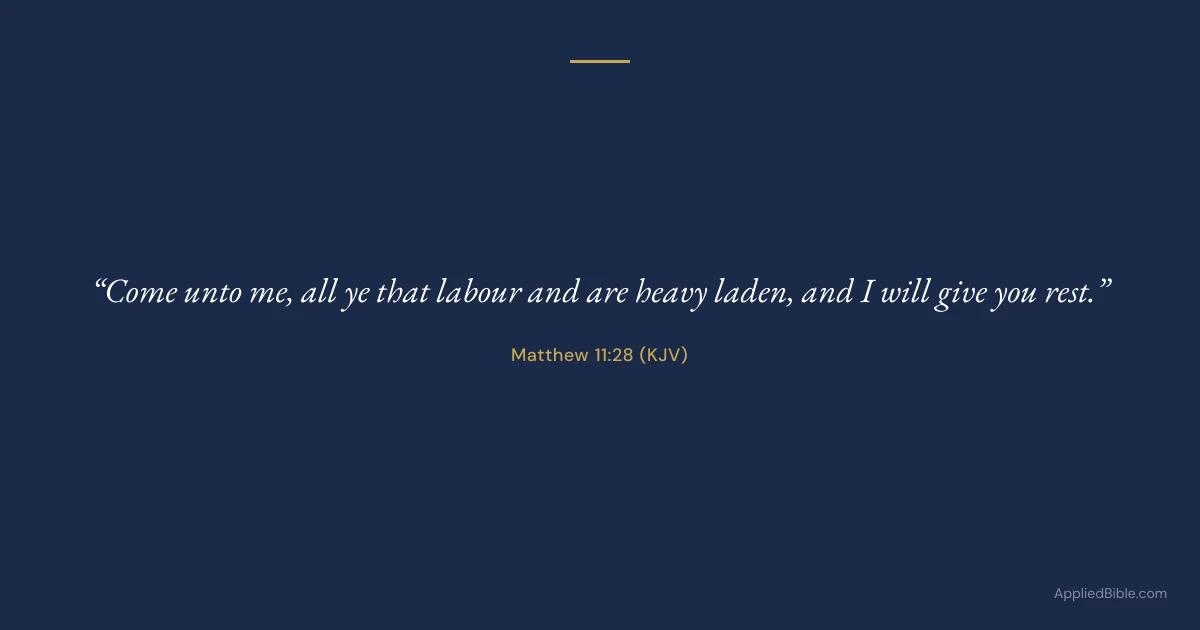
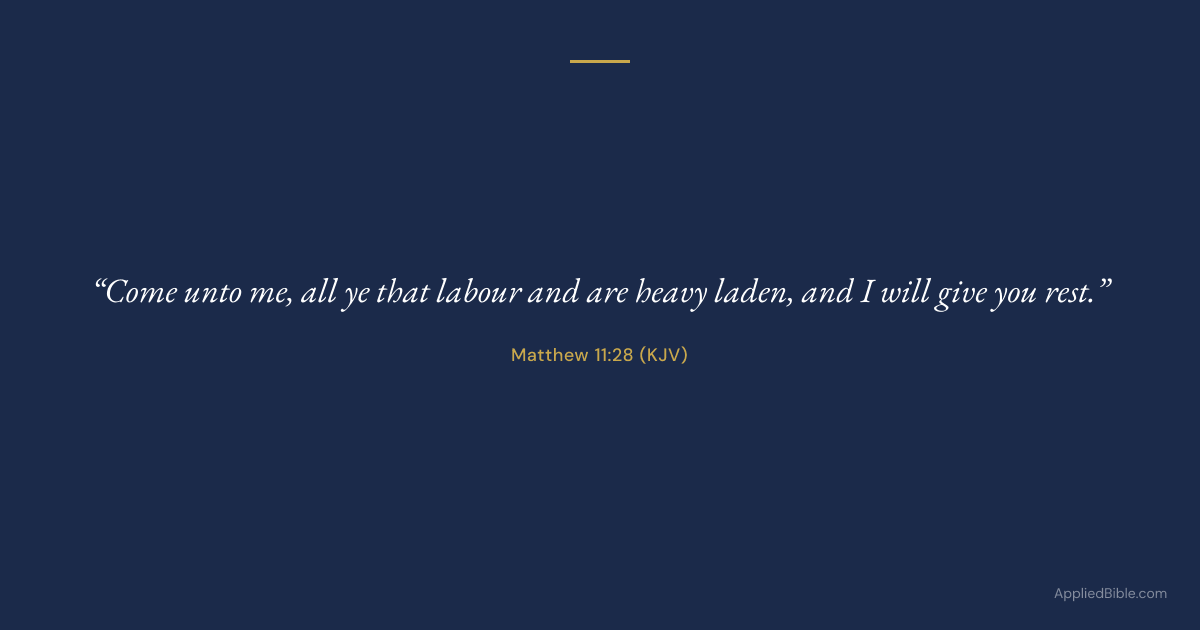
"Come unto me, all ye that labour and are heavy laden, and I will give you rest."
Matthew 11:28 (KJV)
What This Means: Jesus is not asking you to get better before you come to Him. He is asking you to come right now, exactly as you are, heavy and exhausted and carrying whatever it is. The invitation is to the burdened, not to the recovered.
How to Apply This: Depression can make it feel like God is far away or uninterested. Take this verse literally: Jesus said come. Say it out loud today: 'Jesus, I am coming. I am heavy. I am here.'
5. 1 Kings 19:5: "God Meets You With Practical Care, Not a Lecture"
"And as he lay and slept under a juniper tree, behold, then an angel touched him, and said unto him, Arise and eat."
1 Kings 19:5 (KJV)
What This Means: Elijah had just done something extraordinary, and then collapsed under a tree, asking to die. God's response was not a rebuke. An angel touched him and told him to eat. God met the physical need first. Depression lives in the body as much as the soul, and God knows that.
How to Apply This: Today, do one physical thing for yourself that is simple: eat something, drink water, take a ten-minute walk outside. These are not spiritual exercises. They are what the angel told Elijah to do. God cares about your body in its depleted state.
6. Psalm 40:1-2: "God Lifts People Out of the Pit"
"I waited patiently for the LORD; and he inclined unto me, and heard my cry. He brought me up also out of an horrible pit, out of the miry clay, and set my feet upon a rock, and established my goings."
Psalm 40:1-2 (KJV)
What This Means: David used 'horrible pit' and 'miry clay' to describe where he was. These are not polite metaphors. Depression can feel like being stuck in mud at the bottom of a hole. David says God reached down, pulled him out, and gave him solid ground to stand on. He did it for David. He can do it for you.
How to Apply This: Write down one thing you are still waiting on God for in this dark season. Then write beneath it: 'He heard my cry.' It is not weakness to still be waiting. David waited. Put this somewhere you can see it.
7. Romans 15:13: "God Can Fill You With Joy and Peace Even Now"
"Now the God of hope fill you with all joy and peace in believing, that ye may abound in hope, through the power of the Holy Ghost."
Romans 15:13 (KJV)
What This Means: Paul calls God 'the God of hope,' not the God who expects you to manufacture hope on your own. This is a prayer asking God to do the filling because the person cannot do it themselves. Depression drains joy and peace. God is the source that can refill what is empty.
How to Apply This: Pray Romans 15:13 as a prayer today: 'God of hope, fill me with joy and peace in believing. I need you to do the filling right now because I do not have it on my own.' That is what this verse is for.
8. Lamentations 3:22-23: "New Mercies Are Waiting Tomorrow Morning"
"It is of the LORD's mercies that we are not consumed, because his compassions fail not. They are new every morning: great is thy faithfulness."
Lamentations 3:22-23 (KJV)
What This Means: Jeremiah wrote this in the rubble of total disaster. His conclusion, earned in the hardest possible circumstances, was that God's mercies do not run out. They reset every morning. Depression can make it feel like God has withdrawn. Jeremiah says the mercies are still coming. Tomorrow morning, a new supply.
How to Apply This: Before you go to sleep tonight, say: 'New mercies are coming tomorrow.' In the morning, before you check your phone, say it again. This is not positive thinking. It is claiming a promise Jeremiah made from the middle of his own suffering.
9. Psalm 30:2: "God Heals When We Cry Out to Him"
"O LORD my God, I cried unto thee, and thou hast healed me."
Psalm 30:2 (KJV)
What This Means: David wrote this as testimony. He cried. God healed. The sequence matters: the cry came first, then the healing. You do not have to be healed before you cry out. The cry is what opens the door.
How to Apply This: Tell God specifically what you want to be healed from. Not 'make me feel better' but name the exact thing: depression, numbness, the inability to care about anything. Tell God precisely what you are asking Him to heal.
10. 2 Corinthians 4:8-9: "Cast Down Does Not Mean Destroyed"
"We are troubled on every side, yet not distressed; we are perplexed, but not in despair; Persecuted, but not forsaken; cast down, but not destroyed;"
2 Corinthians 4:8-9 (KJV)
What This Means: Paul makes a distinction that matters: cast down is not the same as destroyed. You can be knocked flat and still not be finished. You can be in despair and still not be forsaken. The darkness you are in right now is not the end of your story.
How to Apply This: Write down how you feel in a left column: troubled, perplexed, cast down. In a right column, write Paul's matching truth: not distressed, not in despair, not destroyed. Depression lies. This verse tells the truth.
11. Psalm 43:5: "Speak Truth Over Yourself When You Cannot Feel It"
"Why art thou cast down, O my soul? and why art thou disquieted within me? hope in God: for I shall yet praise him, who is the health of my countenance, and my God."
Psalm 43:5 (KJV)
What This Means: Psalm 42 and 43 both end with this same refrain, which suggests the writer had to say it more than once to get through the hard day. Repeating truth over yourself is not weakness. It is how you survive the darkness. 'I shall yet praise him' is a future-tense promise made in a present-tense pit.
How to Apply This: If one reading is not enough today, say this verse twice: morning and night. You are not faking it. You are doing what the Psalmist did: speaking truth over a soul that has gone quiet.
12. Proverbs 12:25: "A Kind Word Has Real Power to Lift a Heavy Heart"
"Heaviness in the heart of man maketh it stoop: but a good word maketh it glad."
Proverbs 12:25 (KJV)
What This Means: Solomon noticed something true long before modern medicine had words for it: heaviness in the heart bends a person over. And a good word can lift it. Sometimes the most spiritual thing you can do is let someone in, or be the one who speaks a kind word to someone who is stooped.
How to Apply This: Tell one person today that you are struggling. Not everything, just enough to let someone in. Carrying things in private makes them heavier. A good word costs nothing. Solomon says it makes the heart glad.
13. Isaiah 43:2: "God Walks Through the Hard Season With You"
"When thou passest through the waters, I will be with thee; and through the rivers, they shall not overflow thee: when thou walkest through the fire, thou shalt not be burned; neither shall the flame kindle upon thee."
Isaiah 43:2 (KJV)
What This Means: God does not promise to prevent the waters. He promises to be present in them. Depression can feel like being underwater with no way to the surface. God says: I am in the water with you. It will not overflow you. You will come through.
How to Apply This: Write 'I will be with thee' somewhere you will see it today. When the heaviness hits, say it: God is in this with me. Not watching. Not waiting for me to get better. In it.
14. Psalm 16:8: "Setting God Before You Is a Daily Practice"
"I have set the LORD always before me: because he is at my right hand, I shall not be moved."
Psalm 16:8 (KJV)
What This Means: David says he set the Lord before him, not that God appeared on His own. David chose to position God at the center of his focus. The result: I shall not be moved. Depression can knock you off center. This is the daily practice that keeps you from being knocked all the way down.
How to Apply This: Tomorrow morning, before you pick up your phone or check anything, say Psalm 16:8 out loud. Set God before you intentionally. It is a daily decision, not a one-time fix.
15. Romans 8:38-39: "Depression Cannot Separate You From God's Love"
"For I am persuaded, that neither death, nor life, nor angels, nor principalities, nor powers, nor things present, nor things to come, Nor height, nor depth, nor any other creature, shall be able to separate us from the love of God, which is in Christ Jesus our Lord."
Romans 8:38-39 (KJV)
What This Means: Paul's list includes 'things present,' which is the depression sitting on you today. It cannot separate you from God's love. Depression lies about this constantly. It tells you God is far away, that you have done something wrong, that you are outside His care. Paul says that is not possible.
How to Apply This: After 'nor any other creature,' add your own words: 'not my depression, not my exhaustion, not the days I could not get out of bed.' Say it out loud. Paul was persuaded. You can be too.
How to Apply These Verses When Depression Is Heavy
When depression makes the basics feel impossible
Some days just getting out of bed is everything you have. On those days, do not try to do more than the next small thing. This is what God told Elijah through the angel: arise and eat. Not preach, not pray for an hour, not get it together. Arise and eat. Psalm 34:17 says God hears the cry. You do not have to articulate a theology. A groan counts. "God, help" counts. That is enough to start.
When you wonder if God can see where you are
Psalm 40:1-2 says God "inclined unto me and heard my cry." He bent toward David in his pit. He brought him out of the miry clay and set his feet on solid ground. That is not a metaphor for a mildly difficult situation. It is a description of someone in the deep end who got pulled out. If you feel invisible, read this verse and know: God sees exactly where you are.
When depression has gone on for a long time
Long-lasting depression wears down the belief that things can change. Lamentations 3:22-23 was written by a man in extended suffering who still said: His mercies are new every morning. Not new once. Every morning. If you have been in the dark for a long time, you have not exhausted God's compassion. Each morning brings a fresh supply. You have not missed it.
A note about professional help
God works through mental health professionals just as surely as through prayer. If depression is interfering with your ability to function, please reach out for support. Using both faith and professional care is not a lack of trust in God. The angel told Elijah to rest and eat. Seek care for your whole self. These verses are powerful alongside professional support.
Frequently Asked Questions
Is depression a sin?
Depression is not a sin. It is a condition. Elijah, one of the most powerful prophets in the Bible, collapsed under a tree and asked God to let him die (1 Kings 19:4). David described being in a 'horrible pit' in language that maps onto what we now call depression. The Bible never condemns the depressed person. God's response to Elijah was not a rebuke. It was an angel with food and water.
What is the best Bible verse for depression?
Psalm 42:11 is the most honest because it names both the darkness and the response: 'Why art thou cast down, O my soul?' followed by 'hope thou in God: for I shall yet praise him.' It gives you permission to name what you feel and then speak truth over it. Matthew 11:28 is also particularly direct: Jesus invites the burdened and heavy-laden to come to Him exactly as they are.
Can you have faith and still be depressed?
Yes. Faith and depression can coexist. Jeremiah, the author of Lamentations, wrote 'great is thy faithfulness' from the ruins of a destroyed city. Paul wrote about being 'cast down, but not destroyed' from real experience. Depression is not evidence of weak faith. It is a condition that requires care, spiritual, physical, relational, and often professional.
When should I seek professional help for depression?
God works through doctors and counselors the same way He works through prayer. If depression is interfering with your ability to function, eat, sleep, or care for yourself or others, please reach out to a mental health professional. These verses are powerful alongside professional support, not instead of it. The angel told Elijah to eat and rest. Taking care of your body and mind is part of caring for your whole self.
Try This Today
- ✓ Pick the one verse that described where you are most accurately. Write it out by hand.
- ✓ Put it somewhere you will see it first thing tomorrow: your bathroom mirror, nightstand, or phone lock screen.
- ✓ When the heaviness hits today, read it out loud. Speaking it matters. Do this for seven days.