15 Bible Verses About Faith
Faith is one of the most talked-about words in Christianity and one of the most misunderstood. It is not the absence of doubt. It is not a feeling you maintain by trying hard enough. The Bible defines it precisely, shows you how it grows, and makes clear that even a small amount of the real thing is more powerful than a lot of performance. These 15 verses cover what faith actually is and what to do with it.
What Does the Bible Say About Faith?
Hebrews 11:1 gives the most precise definition in Scripture: faith is the substance of things hoped for and the evidence of things not seen. It is not certainty. It is not a feeling. It is a way of treating God's promises as real and moving accordingly.
Romans 10:17 tells you exactly how faith grows: by hearing the word of God. Not by trying harder, not by suppressing doubt, not by more willpower. The path to stronger faith runs directly through Scripture.
Mark 9:24 gives you permission to bring both your faith and your doubts at the same time: "Lord, I believe; help thou mine unbelief." The father did not have to resolve his doubts before Jesus responded. His honest prayer was enough. That same door is open to you today.
15 Bible Verses About Faith
1. Hebrews 11:1: "Faith Is Not Feeling Certain. It Is Acting on What You Cannot See."
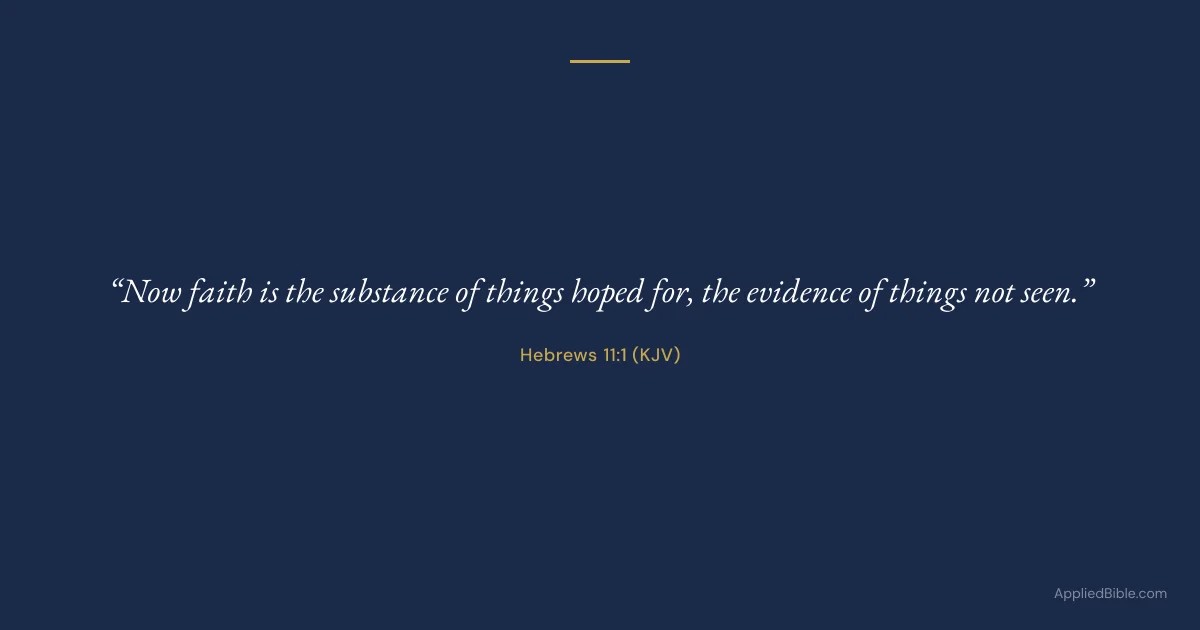
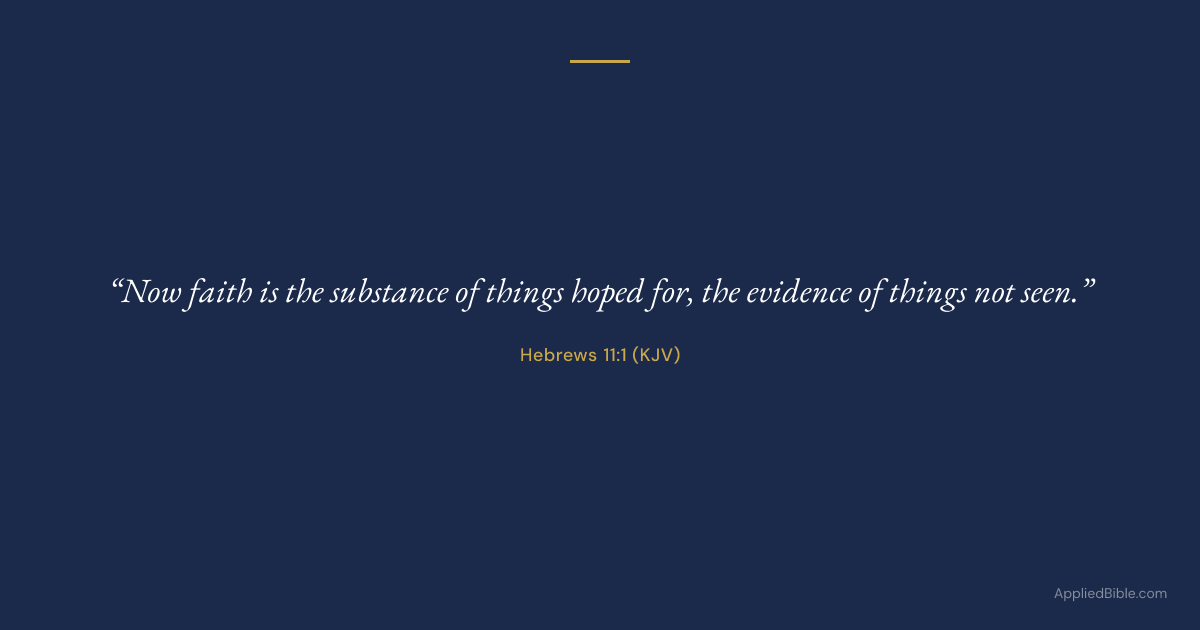
"Now faith is the substance of things hoped for, the evidence of things not seen."
Hebrews 11:1 (KJV)
What This Means: The writer of Hebrews gives the most precise definition of faith in Scripture. It is not confidence that everything will go well. It is treating things you hope for as real substance, and taking what you cannot see as actual evidence. Faith is a way of moving through life, not just a feeling you have on good days.
How to Apply This: Name one thing you are hoping God will do in your life. Write it down as if it is already on its way, not 'I hope this happens' but 'God is working on this.' This is not wishful thinking. This is what faith looks like written down.
2. Romans 10:17: "Faith Grows by Hearing the Word of God"
"So then faith cometh by hearing, and hearing by the word of God."
Romans 10:17 (KJV)
What This Means: Paul does not say faith comes by trying harder or deciding to believe more. It comes by hearing. Specifically, by hearing the word of God. The most direct way to grow your faith is to put more of God's word into your ears and your mind. It is a practical process, not a mystical one.
How to Apply This: Pick one short passage of Scripture and read it out loud every day for one week. Not silently. Out loud. Romans 10:17 says faith comes by hearing. Give your ears something to hear.
3. 2 Corinthians 5:7: "Walking by Faith Means Moving Without a Full View of the Path"
"(For we walk by faith, not by sight:)"
2 Corinthians 5:7 (KJV)
What This Means: This verse is almost parenthetical, which makes it easy to skip. But what Paul is describing is how Christians navigate life daily: not by what can be seen and verified, but by trust in what God has said. Walking by faith is not one decision. It is a daily posture toward everything uncertain.
How to Apply This: Think of one decision where you have been waiting for more information before you trust God. What would it look like to take one step forward today based on what you already know to be true about Him, rather than waiting for more clarity?
4. Matthew 17:20: "Small Faith Is Still Real Faith"
"And Jesus said unto them, Because of your unbelief: for verily I say unto you, If ye have faith as a grain of mustard seed, ye shall say unto this mountain, Remove hence to yonder place; and it shall remove; and nothing shall be impossible unto you."
Matthew 17:20 (KJV)
What This Means: Jesus is not talking about the quantity of faith but about its quality. A mustard seed is genuinely small, but it is real. It is alive. Pretend faith does not move mountains. Small but genuine faith does. If your faith today is the size of a seed, that is enough to work with.
How to Apply This: Stop comparing your faith to someone else's. Ask one honest question: is what I have, however small, real? If the honest answer is yes, even a little, plant it. Pray from where you actually are, not from where you wish you were.
5. Hebrews 11:6: "Coming to God Is Already an Act of Faith"
"But without faith it is impossible to please him: for he that cometh to God must believe that he is, and that he is a rewarder of them that diligently seek him."
Hebrews 11:6 (KJV)
What This Means: The minimum faith required to come to God is this: believe He exists and that He rewards those who seek Him. You do not have to have everything figured out. You do not need every doubt resolved first. The invitation is simply to come. The coming itself is the faith.
How to Apply This: If you have been waiting until your faith is stronger before you pray or read Scripture or attend church, stop waiting. Come as you are. Seeking is the first act of faith. God rewards those who diligently seek Him, not those who arrived already certain.
6. James 2:17: "Faith That Does Not Move You Is Not Alive"
"Even so faith, if it hath not works, is dead, being alone."
James 2:17 (KJV)
What This Means: James is not saying works earn salvation. He is saying living faith produces action. If you say you trust God but your behavior does not change at all, James says something worth checking: is that faith alive? Real faith moves people. It changes what they do with what they believe.
How to Apply This: Name one thing you say you believe about God. Then ask: is there any evidence of it in your actions this week? Not as a measure of your worth, but as a diagnostic. Faith shows up in what you do with what you say you believe.
7. Ephesians 2:8-9: "Faith Is the Gift, Not the Achievement"
"For by grace are ye saved through faith; and that not of yourselves: it is the gift of God: Not of works, lest any man should boast."
Ephesians 2:8-9 (KJV)
What This Means: Paul makes clear that faith itself is not something you manufacture. It is given. Salvation comes through grace by faith, and even that faith is a gift from God, not an achievement you worked up. This removes all boasting. It also removes the pressure to produce what only God can give.
How to Apply This: If you have been trying to earn more faith through more effort, stop and ask God to give it to you instead. Pray it simply: 'God, I cannot manufacture this on my own. Give me what only you can give.'
8. Galatians 2:20: "The Life of Faith Is Christ Living in You"
"I am crucified with Christ: nevertheless I live; yet not I, but Christ liveth in me: and the life which I now live in the flesh I live by the faith of the Son of God, who loved me, and gave himself for me."
Galatians 2:20 (KJV)
What This Means: Paul says the life he lives is by the faith of the Son of God, not just faith in Him. It is the most intimate possible faith: Christ living in Paul, Paul living by Christ's faith. This is not mere belief in a set of facts. It is a life transformed from the inside out.
How to Apply This: Read this verse and put your own name in it: 'I am crucified with Christ. Nevertheless I live. Christ liveth in me.' Say it out loud. This is not just Paul's testimony. It is yours if you are in Christ.
9. Romans 1:17: "The Just Shall Live by Faith, Not by Performance"
"For therein is the righteousness of God revealed from faith to faith: as it is written, The just shall live by faith."
Romans 1:17 (KJV)
What This Means: The just shall live by faith was the verse that launched the Reformation. It means righteousness before God is received by faith, not earned by performance. 'From faith to faith' suggests faith is not a destination you arrive at. It is the road you travel, one step of trust at a time.
How to Apply This: If you have been measuring your spiritual standing by how well you are doing, read this verse and let it land: righteousness is received, not achieved. Your standing before God is by faith in Christ. That does not change based on how today is going.
10. 1 Corinthians 16:13: "Hold Your Ground When Pressure Pushes Against Your Faith"
"Watch ye, stand fast in the faith, quit you like men, be strong."
1 Corinthians 16:13 (KJV)
What This Means: Paul gives four commands in a row: watch, stand, act with courage, be strong. The faith he is talking about is not passive. It is something you hold onto when pressure tries to take it from you. Standing fast requires that something is pushing against you. The instruction assumes difficulty.
How to Apply This: Name one place in your life right now where your faith is under pressure. Then do what Paul says: stand. Not advance, not fix it. Hold your ground in what you know to be true. That is what faith looks like under fire.
11. Mark 9:24: "You Can Bring Both Your Faith and Your Doubts to Jesus"
"And straightway the father of the child cried out, and said with tears, Lord, I believe; help thou mine unbelief."
Mark 9:24 (KJV)
What This Means: This is one of the most honest prayers in Scripture. The father did not wait until he had resolved his doubts before coming to Jesus. He brought them along: I believe, and I also do not fully believe. Both are true. Help me. Jesus healed the child. He did not disqualify the father for his honesty.
How to Apply This: If you have doubts alongside your faith, bring them to Jesus the way this father did. Say it out loud: 'Lord, I believe. Help my unbelief.' You are not disqualified for your doubts. You are invited to bring them.
12. Proverbs 3:5-6: "Faith Means Trusting God's Character More Than Your Analysis"
"Trust in the LORD with all thine heart; and lean not unto thine own understanding. In all thy ways acknowledge him, and he shall direct thy paths."
Proverbs 3:5-6 (KJV)
What This Means: Solomon identifies the root problem of weak faith: leaning on your own understanding. When you try to analyze every angle before you trust God, you are trusting your mind more than His character. Faith chooses God's character over your ability to figure things out.
How to Apply This: Identify one situation where you have been trying to understand every detail before you trust God with it. Give yourself one day where you pray instead of analyze. Just one day. See what shifts.
13. Matthew 21:22: "Believing Prayer Is Asking With an Open Hand"
"And all things, whatsoever ye shall ask in prayer, believing, ye shall receive."
Matthew 21:22 (KJV)
What This Means: Believing here is the posture of coming to God confident not that you will get exactly what you specified, but that God is able and that He hears. Believing prayer is prayer that actually expects God to answer, not prayer you say to check a box.
How to Apply This: Take one prayer you have been saying but not really believing. Name it. Then ask: what would it look like to pray this while actually expecting God to move? Pray it that way once today.
14. Hebrews 12:2: "Jesus Is the Origin and Destination of Your Faith"
"Looking unto Jesus the author and finisher of our faith; who for the joy that was set before him endured the cross, despising the shame, and is set down at the right hand of the throne of God."
Hebrews 12:2 (KJV)
What This Means: Faith does not start with you and it does not end with you. Jesus is the author, meaning the one who originated your faith, and the finisher, meaning the one who will complete it. You are not responsible for generating faith from scratch or maintaining it by willpower. He is the source.
How to Apply This: When faith feels thin, look at Jesus rather than at your own faith level. Ask: what do I know to be true about who Jesus is? Anchor there. He authored your faith. He will finish it.
15. 1 Peter 1:7: "Hard Seasons Are Where Faith Is Tested and Refined"
"That the trial of your faith, being much more precious than of gold that perisheth, though it be tried with fire, might be found unto praise and honour and glory at the appearing of Jesus Christ:"
1 Peter 1:7 (KJV)
What This Means: Peter says faith tried by fire is more precious than gold. The difficulty is not a sign that your faith is failing. It may be the sign that it is being refined. Gold does not become pure without heat. The hard season you are in may be the one that proves what your faith is actually made of.
How to Apply This: Name the hardest thing you are walking through right now. Write above it: 'This is being used to refine my faith.' You do not have to like it. But you can trust the One who is doing the refining.
How to Apply These Verses When Faith Feels Hard
When your faith feels too small
Matthew 17:20 says faith the size of a mustard seed can move mountains. The question Jesus asks is not how much you have but whether what you have is real. A small but genuine seed is enough to start. Stop measuring your faith against someone else's. Bring what you actually have and plant it.
When you have doubts alongside your faith
Mark 9:24 is the verse for this. The father brought his doubts directly to Jesus: "help thou mine unbelief." Jesus did not turn him away. Doubt is not the opposite of faith. It is the thing you bring to God along with the faith you do have. Honest prayer beats polished prayer every time.
When faith needs to show up in your actions
James 2:17 is direct: faith without works is dead. This is not about earning salvation. It is about living faith producing evidence. If you want to know whether your faith is alive, look at what it is moving you to do. Real faith changes how you spend your time, your money, and your energy.
When building faith over the long term
Romans 10:17 gives you the method: hear the word of God. Consistently. This means regular Scripture reading, not just crisis reading. Faith built on a steady diet of God's word is the kind that stands when the hard season comes. Hebrews 12:2 adds the anchor: keep looking to Jesus, who authored your faith and will finish it.
Frequently Asked Questions
What is faith according to the Bible?
Hebrews 11:1 gives the clearest definition: 'faith is the substance of things hoped for, the evidence of things not seen.' Biblical faith is not blind optimism or certainty that everything will go well. It is treating what God has promised as real, and living as if what you cannot see is evidence enough. It is a posture toward God's character, not a feeling that comes and goes.
How do you grow your faith?
Romans 10:17 says faith comes by hearing the word of God. The most direct way to grow faith is to put more Scripture in front of you: read it, hear it, memorize it, say it out loud. Faith also grows through experience. Each time you trust God with something small and see Him respond, the next step of trust gets easier. Growth is gradual and built through repeated small acts of trust.
What does 'faith the size of a mustard seed' mean?
In Matthew 17:20, Jesus says faith the size of a mustard seed can move mountains. The mustard seed was known as the smallest seed in the region. Jesus is not setting a low bar. He is pointing out that size is not what matters. A mustard seed is genuinely small, but it is alive and real. What Jesus contrasts with it is unbelief, which is no faith at all. Small living faith is infinitely more powerful than no faith.
What is the difference between faith and works?
Ephesians 2:8-9 says we are saved by grace through faith, not of works. James 2:17 says faith without works is dead. These are not contradictions. Salvation is received by faith alone, not earned by behavior. But genuine living faith produces action. Works are the evidence that faith is alive, not the cause of salvation. Faith saves. Works prove the faith is real.
Try This Today
- ✓ Pick one verse from this list that defines something you want your faith to look like. Write it out by hand.
- ✓ Read it out loud every morning for one week. Romans 10:17 says faith comes by hearing.
- ✓ At the end of the week, write down one way you acted differently because of that verse.