15 Bible Verses About Fear
Fear has a way of making itself sound like wisdom. It tells you all the things that could go wrong, all the reasons to hold back, all the ways this could end badly. But the Bible has a different word for fear, spoken hundreds of times across both testaments: fear not. Not because there is nothing to be afraid of, but because of who is with you.
What Does the Bible Say About Fear?
Fear is one of the most addressed topics in all of Scripture. The phrase "fear not" or "do not be afraid" appears more than any other command in the Bible. God is clearly aware that fear is a constant reality for His people, and He speaks to it repeatedly, personally, and directly.
What Scripture does not say is that brave people do not feel afraid. Psalm 56:3 is honest about this: "What time I am afraid, I will trust in thee." David is not claiming fearlessness. He is describing a choice made in the middle of fear. Joshua 1:9 is a command, not a feeling: be strong and courageous, God is with you wherever you go.
The New Testament adds a crucial dimension. 2 Timothy 1:7 says God did not give us a spirit of fear, but of power, love, and a sound mind. And 1 John 4:18 says perfect love casts out fear. The more deeply you understand God's love for you, the less room fear has to operate. Fear shrinks not through more courage but through more of God.
15 Bible Verses About Fear
1. 2 Timothy 1:7: "Fear Does Not Come from God"
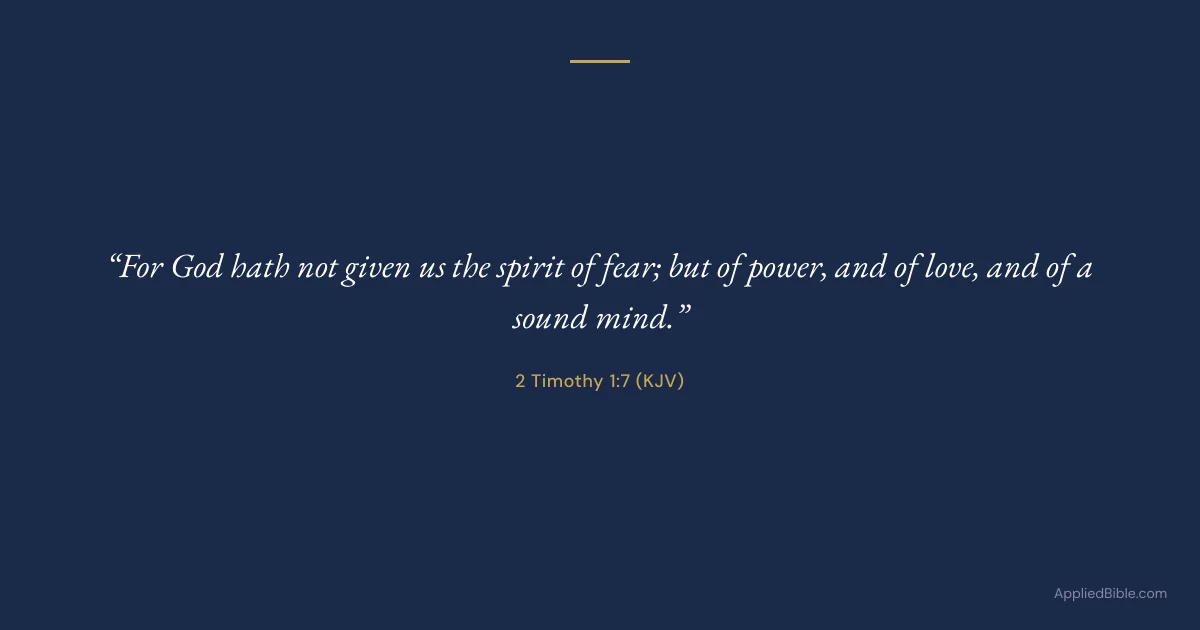
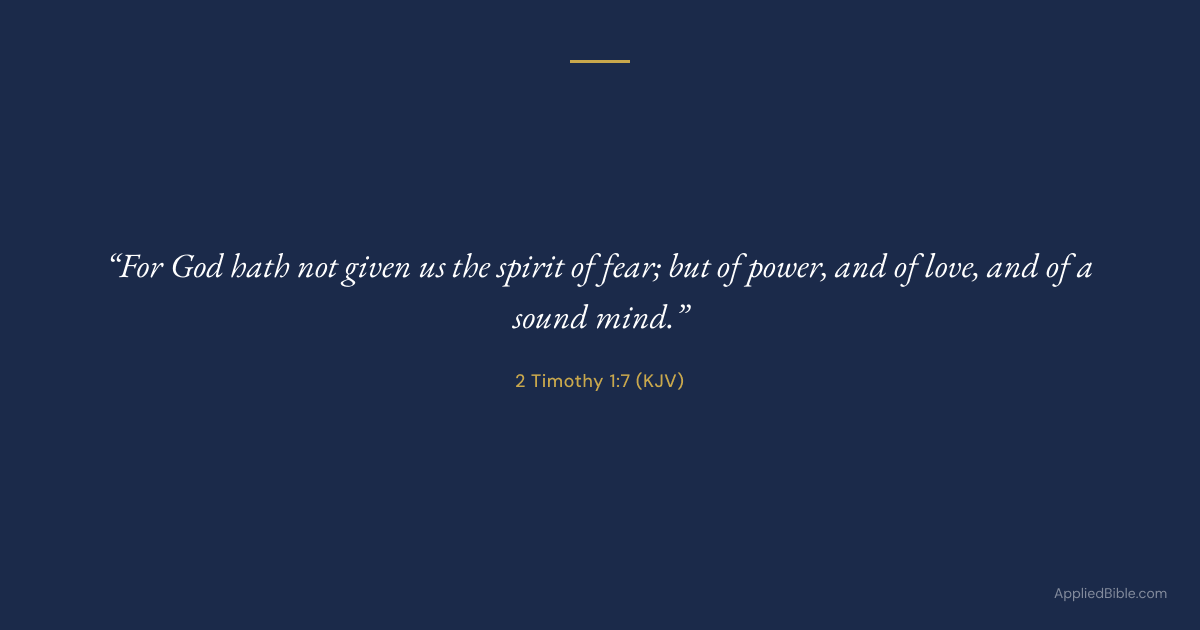
"For God hath not given us the spirit of fear; but of power, and of love, and of a sound mind."
2 Timothy 1:7 (KJV)
What This Means: Paul makes a clear distinction: fear is not from God. What God gives is power, love, and a sound mind. All three. If you are a believer, you already have access to these. Fear may be loud, but it is not your inheritance.
How to Apply This: When fear shows up today, say this verse out loud. Replace the lie with the truth: 'God gave me power, love, and a sound mind. Fear is not from Him.' Say it as many times as you need to.
2. Isaiah 41:10: "Five Promises for When Fear Is Louder Than Faith"
"Fear thou not; for I am with thee: be not dismayed; for I am thy God: I will strengthen thee; yea, I will help thee; yea, I will uphold thee with the right hand of my righteousness."
Isaiah 41:10 (KJV)
What This Means: God does not offer one reassurance here. He stacks five promises back to back: I am with you. I am your God. I will strengthen you. I will help you. I will uphold you. Five commitments for the moment when fear feels overwhelming.
How to Apply This: Write out all five promises on a card. When fear hits, read them slowly, one at a time, and let each one settle before you move to the next.
3. Psalm 34:4: "God Delivers from Every Fear"
"I sought the LORD, and he heard me, and delivered me from all my fears."
Psalm 34:4 (KJV)
What This Means: David is speaking from experience, not theory. He sought God, God heard him, and God delivered him from all his fears. Not some of them. All of them. This is a testimony you can borrow until it becomes your own.
How to Apply This: Write down one fear that has been following you. Bring it to God and ask Him to deliver you from it. Then watch for how He answers. It may not be instant, but He is faithful.
4. Psalm 27:1: "Who Is There Left to Fear?"
"The LORD is my light and my salvation; whom shall I fear? the LORD is the strength of my life; of whom shall I be afraid?"
Psalm 27:1 (KJV)
What This Means: David asks a question designed to reframe fear: if the Lord is your light, your salvation, and your strength, then who is left that you actually need to be afraid of? The question is rhetorical. The answer is no one.
How to Apply This: Take the specific person or situation that is making you afraid right now. Ask yourself David's question out loud: 'If God is with me, do I actually need to fear this?' Let the answer be what it is.
5. Isaiah 43:1: "You Belong to God"
"But now thus saith the LORD that created thee, O Jacob, and he that formed thee, O Israel, Fear not: for I have redeemed thee, I have called thee by thy name; thou art mine."
Isaiah 43:1 (KJV)
What This Means: God speaks directly: fear not. Then He gives the reason. Not circumstances, but identity. He created you. He redeemed you. He called you by name. You are His. Fear loses its grip when you know who you belong to.
How to Apply This: Say out loud: 'I belong to God. He created me. He redeemed me. He knows my name.' Do this in the morning before your day starts, before fear has a chance to speak first.
6. Deuteronomy 31:6: "God Will Not Leave You to Face This Alone"
"Be strong and of a good courage, fear not, nor be afraid of them: for the LORD thy God, he it is that doth go with thee; he will not fail thee, nor forsake thee."
Deuteronomy 31:6 (KJV)
What This Means: Moses is speaking to people about to enter territory they have never seen, facing enemies they cannot fully prepare for. His command is not 'don't be scared.' It is 'be courageous anyway, because God goes with you and will not leave you.'
How to Apply This: Think of the thing you are facing that feels too big. Say this verse with your name in it: 'The LORD my God goes with me. He will not fail me or leave me.' Then take the next step you have been putting off.
7. Psalm 56:3: "What to Do the Moment Fear Arrives"
"What time I am afraid, I will trust in thee."
Psalm 56:3 (KJV)
What This Means: David does not say 'I am never afraid.' He says when afraid, he chooses trust. This is one of the most honest verses in Scripture. Fear comes. The response is a decision: I will trust in You anyway.
How to Apply This: The next time fear shows up, say these seven words out loud: 'When I am afraid, I trust in God.' You do not have to feel brave. You just have to say where your trust goes.
8. 1 John 4:18: "Perfect Love Has No Room for Fear"
"There is no fear in love; but perfect love casteth out fear: because fear hath torment. He that feareth is not made perfect in love."
1 John 4:18 (KJV)
What This Means: John is describing what happens when the love of God fully takes root in a person: it displaces fear. Fear and perfect love cannot occupy the same space. The more you understand how completely God loves you, the less room fear has to grow.
How to Apply This: Write down one specific way God has shown His love for you, something personal and real. Read it when fear shows up. Let what is true about His love speak louder than what fear is saying.
9. Romans 8:15: "You Are a Child of God, Not a Slave to Fear"
"For ye have not received the spirit of bondage again to fear; but ye have received the Spirit of adoption, whereby we cry, Abba, Father."
Romans 8:15 (KJV)
What This Means: Paul says you did not receive a spirit that leads back to fear and slavery. You received the Spirit that makes you a child of God, the one that lets you call out 'Father' to the God of the universe. That is your identity, not fear.
How to Apply This: When fear tries to define you, remind yourself: I am a child of God. I can call on my Father right now. Do exactly that. Call out to God, even briefly, and let that relationship be your grounding.
10. Psalm 91:4-5: "Hidden Under God's Wings"
"He shall cover thee with his feathers, and under his wings shalt thou trust: his truth shall be thy shield and buckler. Thou shalt not be afraid for the terror by night; nor for the arrow that flieth by day;"
Psalm 91:4-5 (KJV)
What This Means: The psalmist uses the image of a bird sheltering its young under its wings. God's protection is that close, that covering, that personal. His truth is your shield against terror by night and the sudden fears that hit during the day.
How to Apply This: When fear comes at night, say out loud: 'I am under God's wings. His truth is my shield.' You do not have to see the protection to trust it. The shelter is real.
11. Hebrews 13:6: "The Lord Is My Helper"
"So that we may boldly say, The Lord is my helper, and I will not fear what man shall do unto me."
Hebrews 13:6 (KJV)
What This Means: The writer of Hebrews is quoting Psalm 118 and applying it directly: because God is your helper, you can be bold. Fear of what people think, what they might do, or what they might say loses its grip when God is the one you are counting on.
How to Apply This: Think of a fear tied to what other people might do or say. Write down: 'The Lord is my helper. I do not need to fear this.' Then act on the thing you have been avoiding because of that fear.
12. Joshua 1:9: "Courage Is a Command, Not a Feeling"
"Have not I commanded thee? Be strong and of a good courage; be not afraid, neither be thou dismayed: for the LORD thy God is with thee whithersoever thou goest."
Joshua 1:9 (KJV)
What This Means: God gave this command to Joshua right before he led Israel into territory no one in his generation had seen. Courage was not a feeling Joshua was supposed to generate. It was a command backed by a promise: God is with you wherever you go.
How to Apply This: Courage is not the absence of fear. It is doing the next right thing while afraid. What is one thing you have been avoiding because fear showed up? Take one small step toward it today.
13. Proverbs 3:25-26: "God Keeps Your Foot from Being Caught"
"Be not afraid of sudden fear, neither of the desolation of the wicked, when it cometh. For the LORD shall be thy confidence, and shall keep thy foot from being taken."
Proverbs 3:25-26 (KJV)
What This Means: Solomon speaks directly to the sudden fear, the kind that hits without warning and sends your heart racing. His answer: God is your confidence, and He will keep your footing. You will not slip. He has you.
How to Apply This: The next time a sudden fear catches you off guard, stop and say: 'The Lord is my confidence. He has my footing.' Take one slow breath. Then proceed.
14. Psalm 23:4: "God Walks Through the Dark Places With You"
"Yea, though I walk through the valley of the shadow of death, I will fear no evil: for thou art with me; thy rod and thy staff they comfort me."
Psalm 23:4 (KJV)
What This Means: David did not say 'if' he walked through the valley. He said 'though.' He expected dark seasons. But in the darkest stretch, God was there. His rod offered protection. His staff offered guidance. The fear of that valley could not hold because David was not walking through it alone.
How to Apply This: If you are in a frightening season right now, say out loud: 'God is with me in this.' You do not have to pretend the valley is not real. Just remember who is walking through it with you.
15. Isaiah 54:4: "You Will Not Be Ashamed"
"Fear not; for thou shalt not be ashamed: neither be thou confounded; for thou shalt not be put to shame: for thou shalt forget the shame of thy youth, and shalt not remember the reproach of thy widowhood any more."
Isaiah 54:4 (KJV)
What This Means: God speaks to a specific fear here: the fear of shame, of being exposed, of not being enough. He promises that shame will not be the final word on your story. What feels like reproach today will not define you in the end.
How to Apply This: If fear of shame or failure has been holding you back, write this down: 'God says I will not be put to shame.' Then do the thing you have been too afraid to try because of what failure might look like.
How to Apply These Verses When Fear Shows Up
When fear hits suddenly and without warning
Some fear arrives without warning. Your heart rate spikes, your mind races, and the threat is real before you have time to think. In those moments, Proverbs 3:25-26 is the anchor: God is your confidence and He keeps your footing. One slow breath. One verse spoken out loud. Psalm 56:3 is short enough to remember in any moment: "When I am afraid, I will trust in You."
When fear has kept you from doing something important
Fear that paralyzes is fear that has overstayed its welcome. Joshua 1:9 is the verse for this: be strong, be courageous, God is with you wherever you go. The courage required is not the absence of fear. It is doing the next right thing while afraid. Take one small step toward the thing fear has been blocking.
When fear comes from what other people might do or say
The fear of people, their opinions, their rejection, their actions, is one of the most common fears in Scripture and in life. Hebrews 13:6 cuts directly through it: the Lord is your helper, so what can people actually do to you? The fear of people shrinks when God is who you are actually living for.
When fear feels like it will never go away
If fear is chronic, persistent, and affecting your daily functioning, please reach out for help. A counselor or therapist is not a sign of weak faith. God works through people He has gifted to help. Use these verses alongside professional support. 2 Timothy 1:7 reminds you of who you are. A good therapist can help you walk that out.
Frequently Asked Questions
What does the Bible say about fear?
The Bible addresses fear more than almost any other emotion, with 'fear not' and similar phrases appearing hundreds of times. Scripture is clear that God does not give us a spirit of fear (2 Timothy 1:7). Instead, He offers power, love, and a sound mind. The consistent biblical response to fear is not willpower but trust: bring the fear to God, remind yourself of His promises, and act in courage even before the fear goes away.
Is being afraid a sin?
No. Fear is a human emotion, not a moral failure. Jesus Himself experienced anguish in Gethsemane (Luke 22:44), and many psalms are honest cries of fear to God. The Bible never condemns people for feeling afraid. What it does offer is a better place to put fear: into God's hands. The courage Scripture calls for is not fearlessness. It is faithfulness despite the fear.
What is the best Bible verse for overcoming fear?
Isaiah 41:10 is one of the most comprehensive. It contains five stacked promises: God is with you, He is your God, He will strengthen you, He will help you, and He will uphold you. For fear in the middle of the night, Psalm 56:3 is practical and honest: 'What time I am afraid, I will trust in thee.' For fear rooted in identity, 2 Timothy 1:7 is the reminder that fear is not from God.
How do I trust God when I am afraid?
Trust grows through practice, not a single decision. The biblical pattern is to bring the fear to God in prayer (Philippians 4:6), speak God's truth out loud when fear speaks (Psalm 56:3), and take the next step even while afraid (Joshua 1:9). You do not have to feel brave first. You just have to choose where your trust goes. Each time you choose God over fear, the habit of trust gets a little stronger.
Try This Today
- ✓ Pick the one verse from this list that spoke most directly to the fear you are carrying. Write it out by hand.
- ✓ Set it where you will see it first thing tomorrow: your mirror, your phone screen, your dashboard.
- ✓ When fear speaks today, say the verse out loud before you respond to it. Do this all week.