15 Bible Verses About Grace
Grace is not just how you got saved. It is how you live, how you are sustained in weakness, and how you are changed. These 15 verses show what the Bible actually says about God's grace, why it cannot be earned, and what it looks like when it takes hold of a life.
What Does the Bible Say About Grace?
The foundational statement is Ephesians 2:8-9: by grace you are saved through faith, and that not of yourselves. It is the gift of God. The origin of grace is God, the instrument is faith, and the result is salvation that no one can take credit for. Works are excluded not because they are unimportant but because they cannot be the basis of what is already a gift.
Romans 5:8 reveals the character of grace: God demonstrated His love while we were yet sinners. Grace does not wait for you to improve. It moves first, toward the undeserving. That is its nature.
2 Corinthians 12:9 shows grace at work in weakness: His grace is sufficient for you, and His strength is made perfect in weakness. Grace is not just for the entrance into the Christian life. It is the operating power for all of it.
15 Bible Verses About Grace
1. Ephesians 2:8-9: "Grace Is a Gift, Not a Reward"
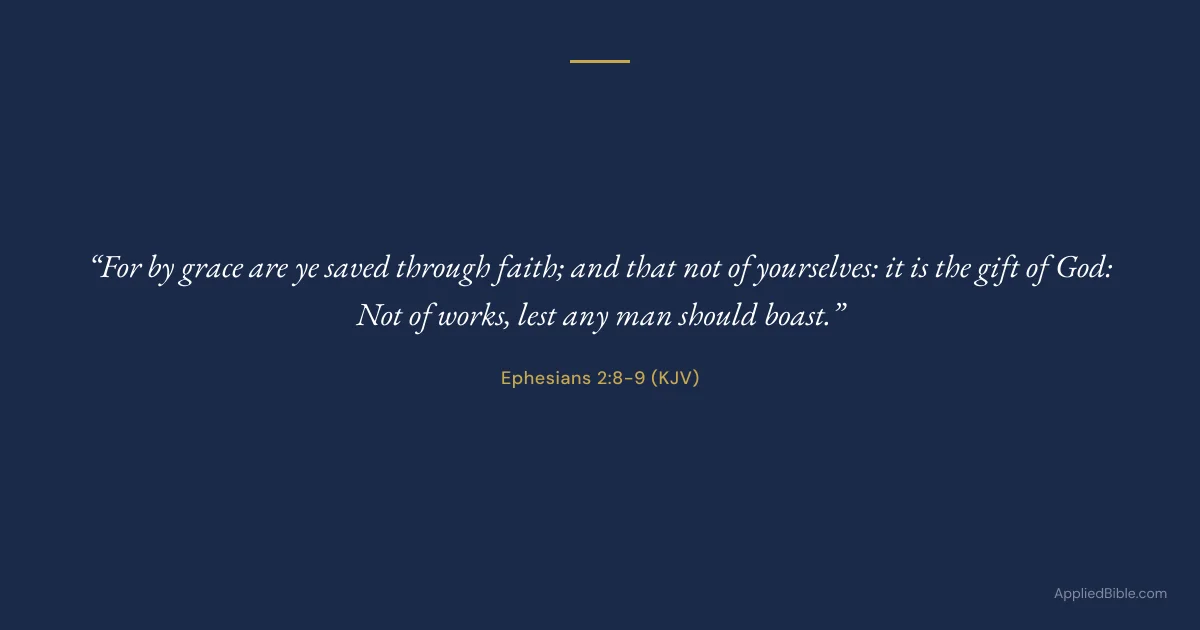
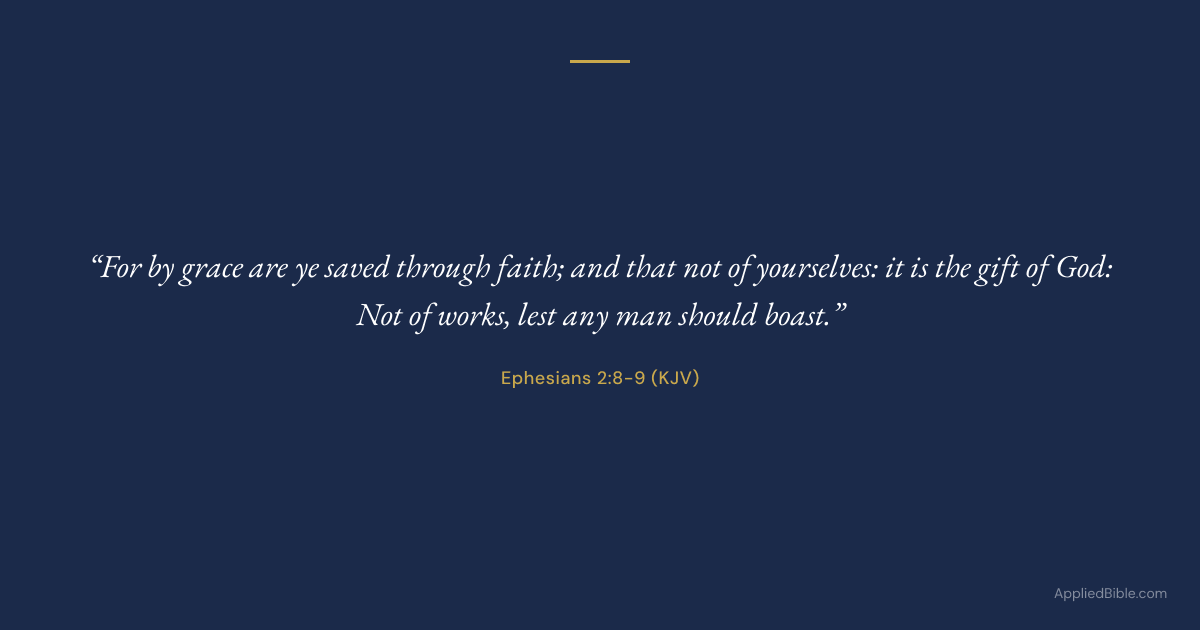
"For by grace are ye saved through faith; and that not of yourselves: it is the gift of God: Not of works, lest any man should boast."
Ephesians 2:8-9 (KJV)
What This Means: Paul leaves no room for ambiguity. Salvation by grace through faith is not of yourselves. It is the gift of God. And then the explicit reason works are excluded: lest anyone boast. If you could earn your salvation, you would take credit for it. Grace removes that possibility entirely. The origin is God, the instrument is faith, the recipient is you who did nothing to deserve it. That is the foundation of the Christian life.
How to Apply This: Is there any area where you are subtly trying to earn God's favor through performance? Not sinning, per se, but performing for acceptance? Write: 'I am saved by grace through faith. Not of myself. It is God's gift.' Let that be the posture you bring to God today, not the resume.
2. Romans 5:8: "God Proved His Love While You Were Still a Sinner"
"But God commendeth his love toward us, in that, while we were yet sinners, Christ died for us."
Romans 5:8 (KJV)
What This Means: The timing is everything in this verse. Not after you cleaned up, not once you believed, not when you became worthy. While you were yet sinners. God demonstrated His love at the point of your greatest unworthiness. This is the character of grace: it moves toward the undeserving. It does not wait for you to improve before it acts. Grace is always preemptive.
How to Apply This: Think of someone you struggle to extend grace to. Notice where you are waiting for them to change before you show them kindness. Romans 5:8 describes what God did for you: He moved first, while you were still undeserving. What would that look like in your relationship with this person today?
3. 2 Corinthians 12:9: "Grace Is Sufficient in Your Weakness"
"And he said unto me, My grace is sufficient for thee: for my strength is made perfect in weakness. Most gladly therefore will I rather glory in my infirmities, that the power of Christ may rest upon me."
2 Corinthians 12:9 (KJV)
What This Means: Paul had asked God to remove a thorn, some persistent difficulty. God's answer is not removal. It is sufficiency: my grace is enough for you in this. And the reason is striking: God's strength is made perfect in weakness. The weakness does not disqualify you from experiencing God's power. It is the very condition in which His power is most fully displayed. Grace is not absent in your weakness. It is most present there.
How to Apply This: What is the thorn in your life right now that you have been asking God to remove? Try receiving His answer: my grace is sufficient for you in this. Not that the thorn is good, but that His grace is enough for it. Name one way His grace is already at work in the very weakness you wish He would take away.
4. Hebrews 4:16: "Come Boldly to the Throne of Grace"
"Let us therefore come boldly unto the throne of grace, that we may obtain mercy, and find grace to help in time of need."
Hebrews 4:16 (KJV)
What This Means: The writer instructs you to come boldly. Not timidly, not hoping you are welcome, not waiting until you are worthy. Boldly. Because it is a throne of grace, not a throne of judgment. And the specific things available there: mercy for your failures and grace to help in time of need. Both are freely given to those who come. The only reason not to come is not knowing that you are welcome, and now you know.
How to Apply This: What do you need today: mercy for something you have done, or grace to help with something you are facing? Go to the throne of grace. Not quietly in the back, hoping to be noticed. Boldly, as Hebrews 4:16 instructs. The throne is called a throne of grace for a reason: that is what is dispensed there.
5. Romans 5:20: "Where Sin Abounded, Grace Abounded More"
"Moreover the law entered, that the offence might abound. But where sin abounded, grace did much more abound:"
Romans 5:20 (KJV)
What This Means: Paul draws a comparison and grace wins overwhelmingly. Where sin increased, grace increased far more. The word translated much more abound is hyperperissuo in Greek, a compound superlative meaning to overflow beyond all bounds. No amount of sin exceeds the supply of grace. This is not a license to sin, as Paul addresses directly in Romans 6:1-2. It is a statement about the inexhaustibility of God's grace. Your history is not too heavy for it.
How to Apply This: Is there something in your past that you believe is beyond grace, something too bad, too repeated, too shameful? Write the sin down. Then write Romans 5:20 over it: 'Where sin abounded, grace did much more abound.' The word much more is a deliberate overstatement by the Holy Spirit. Let it cover what you are holding.
6. Romans 6:14: "Sin Has No Dominion Over You Because You Are Under Grace"
"For sin shall not have dominion over you: for ye are not under the law, but under grace."
Romans 6:14 (KJV)
What This Means: Paul connects being under grace with freedom from sin's dominion. This is the practical power of grace: it does not just forgive past sin. It breaks the rule of sin over your present life. Under the law, sin was defined but not conquered. Under grace, sin's authority is broken. This does not mean you will not sin. It means sin does not own you. You are under a different authority.
How to Apply This: In the area where sin feels most like it has dominion over you, remind yourself: I am under grace, not under law. Sin has no dominion over me. Then ask: am I living as if this is true, or am I still trying to manage sin through law-keeping while grace is available? Let grace be the operating system, not the law.
7. Titus 2:11: "The Grace of God That Brings Salvation Has Appeared"
"For the grace of God that bringeth salvation hath appeared to all men,"
Titus 2:11 (KJV)
What This Means: Grace appeared. It arrived in history in a specific moment, through the person of Jesus Christ. It is not an abstract concept. It is something that appeared, became visible, entered time. And it appeared to all men: it is universal in its offer, not reserved for the deserving. The grace that brings salvation has arrived. What you do with it is the question.
How to Apply This: When was the last time you stood in genuine awe of the fact that grace has appeared? Not that you have handled your salvation correctly, but that the grace itself showed up. Spend a moment today simply being astonished that it appeared, to all men, including you.
8. Ephesians 1:7: "Redemption and Forgiveness Come Through the Riches of Grace"
"In whom we have redemption through his blood, the forgiveness of sins, according to the riches of his grace;"
Ephesians 1:7 (KJV)
What This Means: The standard for forgiveness and redemption is not your repentance or your performance. It is the riches of His grace. The measure of what you receive is not the measure of your contribution. It is the measure of His wealth. And the riches of grace are without bottom. Forgiveness of sins, the release from what holds you, is dispensed according to that inexhaustible supply.
How to Apply This: Are you carrying sins you have confessed but not felt forgiven of? The measure of forgiveness available to you is the riches of His grace, not your feeling of resolution. Bring those specific sins to God and receive forgiveness on the basis of Ephesians 1:7, not on the basis of how you feel about it.
9. 1 Peter 5:10: "God Will Restore You After You Have Suffered a While"
"But the God of all grace, who hath called us unto his eternal glory by Christ Jesus, after that ye have suffered a while, make you perfect, stablish, strengthen, settle you."
1 Peter 5:10 (KJV)
What This Means: Peter calls God the God of all grace. Not some grace, not grace for some people. All grace. And this God, after a season of suffering, will do four things: make you perfect, stablish you, strengthen you, settle you. The suffering is real and acknowledged. It is also temporary. And what it produces, through the God of all grace, is a person who is complete, firm, strong, and settled. That is the destination of suffering in the hands of a gracious God.
How to Apply This: Name the suffering you are currently in. Now read 1 Peter 5:10 as a promise for your specific situation. The God of all grace called you. He will perfect, establish, strengthen, and settle you after this. The after is coming. The God who is involved in the after is the God of all grace.
10. Romans 11:6: "Grace and Works Cannot Both Be the Basis of Salvation"
"And if by grace, then is it no more of works: otherwise grace is no more grace. But if it be of works, then is it no more grace: otherwise work is no more work."
Romans 11:6 (KJV)
What This Means: Paul draws a logical line: grace and works are mutually exclusive as the basis of salvation. If it is grace, works are not the reason. If it is works, grace is irrelevant. You cannot mix them at the foundation level. This does not mean works are unimportant. They flow from grace rather than earning it. The purity of grace, its freeness and giftedness, is what makes it grace. Adding works to the foundation destroys the concept.
How to Apply This: When you think about where you stand with God today, is the basis grace or works? Not in theory but in practice. Do you feel better with God on days when you have read your Bible and prayed, and worse on days when you have not? That is the works-based operating system. Try replacing it with grace as the foundation, today.
11. 2 Timothy 2:1: "Be Strong in the Grace That Is in Christ Jesus"
"Thou therefore, my son, be strong in the grace that is in Christ Jesus."
2 Timothy 2:1 (KJV)
What This Means: Paul's instruction to Timothy is not to be strong in your own resolve, your own discipline, or your own effort. It is to be strong in the grace that is in Christ Jesus. The resource for strength is grace. This connects directly to 2 Corinthians 12:9: His strength is made perfect in weakness, and His grace is sufficient. Strength that comes from grace is not exhausted by your limitations. It draws from an inexhaustible supply.
How to Apply This: In the thing you most need strength for today, consciously draw from grace rather than from your own resolve. Prayer is the act of accessing this: 'I need strength. Not my strength. The grace that is in Christ Jesus.' Say it. Then go do the thing.
12. Titus 3:5: "Salvation Is by Mercy and Renewal, Not Your Righteousness"
"Not by works of righteousness which we have done, but according to his mercy he saved us, by the washing of regeneration, and renewing of the Holy Ghost;"
Titus 3:5 (KJV)
What This Means: Paul says with precision: not by works of righteousness which we have done. The emphasis is on which we have done: your personal moral record is not the basis. His mercy is the basis. And the mechanism is regeneration and renewal by the Holy Spirit, a washing that makes you new from the inside. Grace does not just pardon you. It regenerates you. You are not only forgiven. You are made new.
How to Apply This: Do you think of yourself as primarily pardoned or primarily regenerated? Both are true, but the regeneration aspect changes how you see your capacity for change. You are not trying to reform yourself. You have been renewed by the Holy Spirit. Ask the Spirit to make that renewal visible in one specific area of your life today.
13. 1 Corinthians 15:10: "By the Grace of God I Am What I Am"
"But by the grace of God I am what I am: and his grace which was bestowed upon me was not in vain; but I laboured more abundantly than they all: yet not I, but the grace of God which was with me."
1 Corinthians 15:10 (KJV)
What This Means: Paul traces his entire life's work back to grace: I am what I am by grace. And then: his grace was not in vain, I labored abundantly, yet not I but grace. Grace both defines who Paul is and produces his work. He takes no credit for his output. He credits grace. This is the posture of someone who truly understands grace: not passive, but active, and giving grace credit for every productive thing.
How to Apply This: Name something good that has come from your life. A gift you have, a person you have helped, a way you have grown. Trace it back to grace the way Paul does: 'By the grace of God I am what I am. This came not from me but from the grace of God which is with me.' Let that reframe your gratitude today.
14. James 4:6: "God Gives More Grace to the Humble"
"But he giveth more grace. Wherefore he saith, God resisteth the proud, but giveth grace unto the humble."
James 4:6 (KJV)
What This Means: James opens with a phrase that stands alone: he gives more grace. Whatever grace you have, there is more available. It is not a fixed supply that runs out. And the condition for receiving more is humility: God gives grace to the humble. The proud are resisted. The humble receive. Grace is not withheld. It is channeled toward those who have the posture to receive it.
How to Apply This: Come to God today in humility and ask for more grace specifically for the area where you need it most. Not as a transaction. As the humble person James describes: no pretense, no list of your qualifications, just the open-handed posture of someone who knows they need more grace and believes God gives it generously.
15. Hebrews 13:9: "The Heart Established by Grace Is Not Carried Away"
"Be not carried about with divers and strange doctrines. For it is a good thing that the heart be established with grace; not with meats, which have not profited them that have been occupied therein."
Hebrews 13:9 (KJV)
What This Means: The writer says the heart established with grace is not tossed around by strange teachings. Grace is not just a theological concept. It is a stabilizing foundation for your whole inner life. A heart established in grace, confident in God's unearned favor, rooted in the reality of the gospel, is a heart that is not easily unsettled. The stability you are looking for comes from being grounded in grace.
How to Apply This: How settled is your heart right now? If you feel tossed around by circumstances, by doubt, by changing information, ask whether your heart is established in grace or in something more fragile. Spend time today reviewing the basic grace of Ephesians 2:8-9 and Romans 5:8. Let grace be the ground you stand on.
How to Apply These Verses in Your Daily Life
When you feel like you have used up God's patience
Romans 5:20 is the word: where sin abounded, grace abounded far more. No supply of sin exceeds the supply of grace. Hebrews 4:16 gives the next step: come boldly to the throne of grace. Not quietly hoping, boldly. The throne is called the throne of grace because that is what is dispensed there.
When you are performing for God's approval
Ephesians 2:8-9 is the reset: not of works, lest any man boast. Romans 11:6 draws the line: grace and works cannot both be the foundation. Romans 6:14 gives the liberation: you are under grace, not under law.
When you are in weakness and need strength
2 Corinthians 12:9 is God's direct word: my grace is sufficient. 2 Timothy 2:1 is the instruction: be strong in the grace that is in Christ Jesus. Not in your resolve. In grace. 1 Peter 5:10 gives the promise: the God of all grace will perfect, establish, strengthen, and settle you.
Frequently Asked Questions
What is grace in the Bible?
Grace in the Bible is God's unearned, undeserved favor toward sinners. The Greek word is charis, meaning favor, goodwill, or gift. Ephesians 2:8-9 is the most direct definition: saved by grace through faith, not of yourselves, it is the gift of God. Grace is distinct from mercy in that mercy withholds the punishment you deserve, while grace gives you the blessing you did not deserve. Both are expressions of God's character, and both flow from His love.
How does God's grace work in daily life?
Beyond salvation, grace operates in daily life in several ways. 2 Corinthians 12:9 describes sustaining grace: God's grace is sufficient in weakness. Hebrews 4:16 describes available grace: you can come to the throne of grace to find help in time of need. Romans 6:14 describes liberating grace: sin shall not have dominion over you because you are under grace. Titus 2:12 describes teaching grace: the grace of God teaches you to deny ungodliness. Grace is not just the entrance door to the Christian life. It is the fuel for all of it.
Does grace mean we can sin freely?
Paul addresses this directly in Romans 6:1-2: 'Shall we continue in sin that grace may abound? God forbid.' The logic of grace does not produce more sinning. Romans 6:14 says that being under grace breaks sin's dominion over you. Titus 2:11-12 says grace teaches you to deny ungodliness. A genuine encounter with grace produces a changed life, not because you are trying to earn favor, but because the grace that saved you also transforms you.
What does it mean to grow in grace?
2 Peter 3:18 instructs believers to 'grow in grace, and in the knowledge of our Lord and Saviour Jesus Christ.' Growing in grace means your understanding and experience of God's grace deepens over time. It means increasingly living from grace rather than from rules or performance. It means extending to others the grace you have received. 2 Timothy 2:1 says to be strong in the grace that is in Christ Jesus, drawing on grace as the source of strength rather than on your own effort.
Try This Today
- ✓ Name one area where you are performing for God's approval. Then read Ephesians 2:8-9 slowly: 'Not of yourselves: it is the gift of God. Not of works.' Stop performing in that area today. Just rest in the gift.
- ✓ Come to the throne of grace today (Hebrews 4:16). Boldly, as the verse says. Name what you need: mercy for something you did, or grace to help with something you are facing. Both are available. Come and receive.
- ✓ Write 1 Corinthians 15:10 in your own words: 'By the grace of God I am what I am.' Then name three specific things in your life that are the result of God's grace rather than your own achievement. Let gratitude for grace shape how you see your life today.