15 Bible Verses About Grief
Grief does not follow a schedule. It comes in waves, arrives unexpectedly, and refuses to be rushed. Whether you are in the first raw days of loss or carrying a grief that has been with you for years, the Bible does not tell you to be strong or move on. It tells you that God is near, that Jesus wept, and that your mourning has not gone unnoticed.
What Does the Bible Say About Grief?
Grief is woven all through Scripture. Job lost everything and sat in ashes. David mourned the death of his son so deeply that his servants were afraid to tell him. Mary and Martha collapsed in tears at the tomb of their brother. The Psalms are filled with laments that do not resolve neatly by the last verse.
What is striking is that God never responds to grief with a lecture. When Mary fell at Jesus's feet weeping, He did not correct her theology or remind her that Lazarus was about to be raised. He wept with her first. John 11:35, the shortest verse in the Bible, contains one of the most profound pieces of theology about God's heart toward the grieving.
The biblical promise is not the removal of grief but the presence of God in the middle of it. Psalm 34:18 says God is near to the brokenhearted. Isaiah 43:2 says He is with you when you pass through deep waters. Psalm 147:3 says He heals broken hearts and binds up wounds. He is not at a distance from your grief. He is in it with you.
15 Bible Verses About Grief
1. Psalm 34:18: "God Moves Toward a Broken Heart"
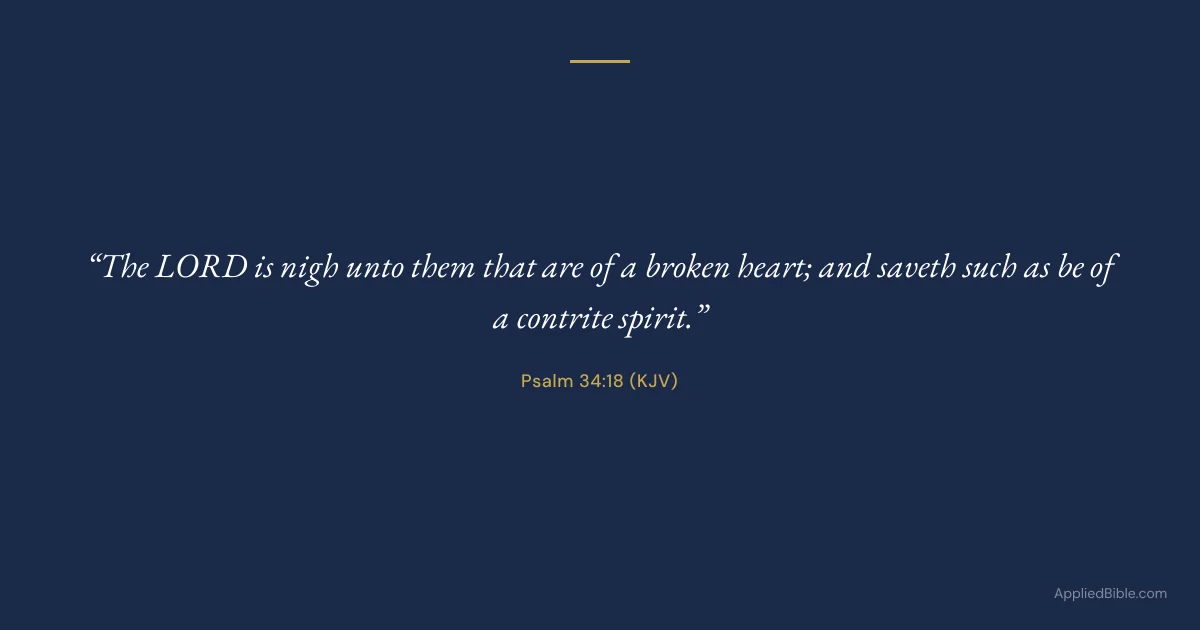
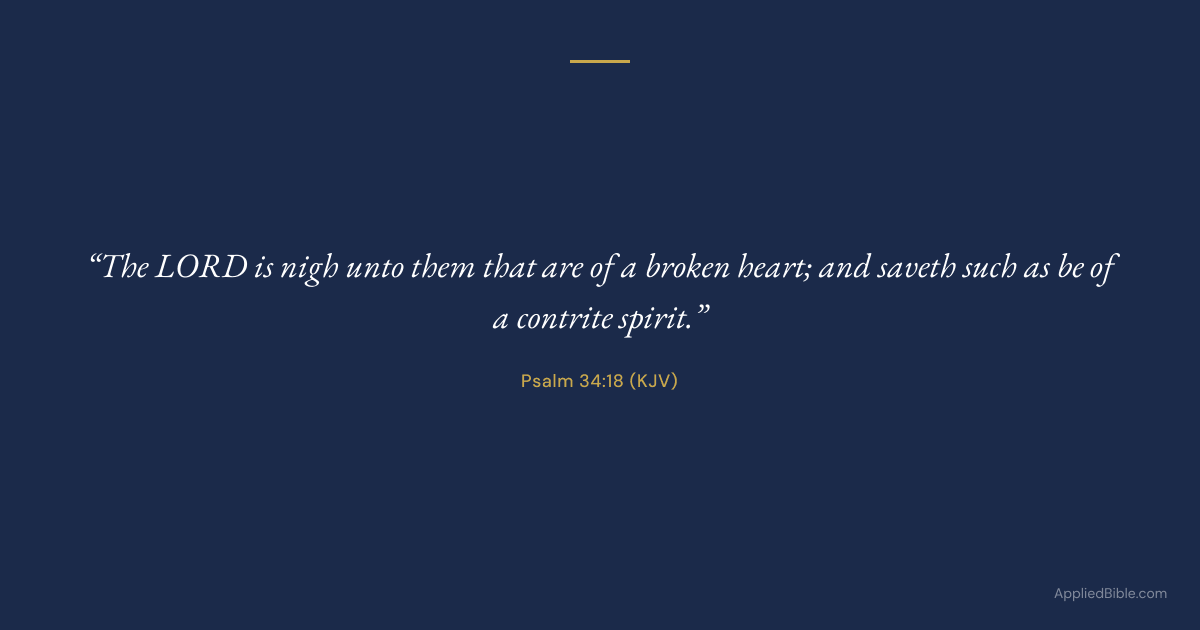
"The LORD is nigh unto them that are of a broken heart; and saveth such as be of a contrite spirit."
Psalm 34:18 (KJV)
What This Means: The word 'nigh' means close, near, present right now. This is not a promise for after you have pulled yourself together. David says God is near in the middle of the breaking. A broken heart does not push God away. It is exactly where He shows up.
How to Apply This: If you are in the middle of grief right now, you do not have to feel God's presence to claim this promise. Say out loud: 'I believe you are near even when I cannot feel you.' Then sit quietly for five minutes and let that truth settle before you move on with your day.
2. Matthew 5:4: "God Blesses Those Who Allow Themselves to Grieve"
"Blessed are they that mourn: for they shall be comforted."
Matthew 5:4 (KJV)
What This Means: Jesus is not saying grief is a requirement for blessing. He is saying the people who actually face their loss, who let themselves mourn rather than bury it, are the ones who will receive comfort. You have to open your hands before God can fill them.
How to Apply This: If you have been holding yourself together and not letting yourself feel the weight, give yourself permission today. Grief is not weakness. It is honest. Find 15 minutes alone, and let yourself feel what you have been pushing down.
3. Revelation 21:4: "The Promise That This Is Not the End of the Story"
"And God shall wipe away all tears from their eyes; and there shall be no more death, neither sorrow, nor crying, neither shall there be any more pain: for the former things are passed away."
Revelation 21:4 (KJV)
What This Means: This is the future God is building toward. Every tear you have ever cried is known to Him, and He has promised to personally wipe them away. Grief is real, but it is not eternal. The One who made all things is making everything new.
How to Apply This: Write this verse somewhere you will see it this week. When grief feels permanent and overwhelming, read it out loud as a declaration: this sorrow is not the final word. Something better is coming.
4. Psalm 30:5: "Weeping Lasts a Night, Joy Comes in the Morning"
"For his anger endureth but a moment; in his favour is life: weeping may endure for a night, but joy cometh in the morning."
Psalm 30:5 (KJV)
What This Means: David wrote this after his own season of deep trouble. 'Night' here is not only nighttime. It represents seasons that feel like they will never end. But David testifies from lived experience: morning came. It always has. God's favor is not withdrawn in the dark. It is at work there.
How to Apply This: Think of one time in your life when a hard season eventually gave way to something better. Write it down as your personal evidence that morning has come before. Hold it as proof that it can come again.
5. 2 Corinthians 1:3-4: "The God of All Comfort Walks With You Through Every Grief"
"Blessed be God, even the Father of our Lord Jesus Christ, the Father of mercies, and the God of all comfort; Who comforteth us in all our tribulation, that we may be able to comfort them which are in any trouble, by the comfort wherewith we ourselves are comforted of God."
2 Corinthians 1:3-4 (KJV)
What This Means: Paul calls God 'the God of all comfort,' which means there is no grief too deep, too strange, or too long-lasting that is outside His ability to console. Notice the purpose He adds: He comforts us so we can comfort others. Your grief is not wasted. It becomes something you can give away.
How to Apply This: Receive before you give. Today, simply ask God to comfort you in this specific grief. Be as specific as you can: tell Him what hurts, what you miss, what you need. He is the God of all comfort, which includes yours.
6. John 11:35: "Jesus Wept, Which Means God Understands Loss"
"Jesus wept."
John 11:35 (KJV)
What This Means: This is the shortest verse in the Bible and one of the most significant. Lazarus was already dead when Jesus arrived. Jesus knew He was about to raise him. And still He wept. Not because He did not know the outcome, but because He stood with the people He loved in their grief. Jesus is not above your tears. He is beside them.
How to Apply This: Read this verse and take it personally: Jesus wept. Not past the grieving people, not around them, but with them. Tell Jesus the specific thing you are grieving today. He is not standing at a distance. He is right there in it with you.
7. Psalm 147:3: "God Is the Healer of Broken Hearts"
"He healeth the broken in heart, and bindeth up their wounds."
Psalm 147:3 (KJV)
What This Means: The word 'bindeth' describes the careful work of wrapping a wound so it can heal cleanly. God does not rush the process or dismiss the injury. He tends to a broken heart the way a skilled doctor tends to a wound: with care, attention, and intention to heal.
How to Apply This: Broken hearts do not heal by ignoring them. What specific wound from your grief have you been trying to push through without tending to? Name it. Tell God about it directly. Healing starts when you stop trying to manage the wound alone.
8. Isaiah 61:3: "God Exchanges Ashes for Beauty"
"To appoint unto them that mourn in Zion, to give unto them beauty for ashes, the oil of joy for mourning, the garment of praise for the spirit of heaviness; that they might be called trees of righteousness, the planting of the LORD, that he might be glorified."
Isaiah 61:3 (KJV)
What This Means: In ancient times, ashes on the head were a sign of total loss and mourning. God promises something specific here: He does not just take away the ashes. He replaces them with beauty. The exchange is not 'your grief for nothing.' It is 'your grief for something I have chosen for you.' That is a different promise entirely.
How to Apply This: Think of one thing grief has taken from you. Hold it honestly. Then ask God: 'What are you putting in its place?' You may not have an answer today. But asking the question is an act of faith that the exchange is real and coming.
9. Lamentations 3:22-23: "His Mercies Are New Every Single Morning"
"It is of the LORD's mercies that we are not consumed, because his compassions fail not. They are new every morning: great is thy faithfulness."
Lamentations 3:22-23 (KJV)
What This Means: Jeremiah wrote Lamentations sitting in the rubble of Jerusalem after its destruction. This was not abstract theology written from comfort. He was surrounded by devastation, and still he wrote this. Grief can make you feel consumed. Jeremiah says you are not, because God's compassions keep renewing every single morning.
How to Apply This: Tomorrow morning, before you do anything else, say out loud: 'His mercies are new today.' Not 'I feel it' but 'it is true.' Do this for seven mornings and notice what it does to the first hour of your day.
10. Romans 8:38-39: "Not Even Death Can Separate You From God's Love"
"For I am persuaded, that neither death, nor life, nor angels, nor principalities, nor powers, nor things present, nor things to come, Nor height, nor depth, nor any other creature, shall be able to separate us from the love of God, which is in Christ Jesus our Lord."
Romans 8:38-39 (KJV)
What This Means: Paul begins with 'I am persuaded,' which means this is a settled conclusion, not wishful thinking. Death is on the list of things that cannot separate you from God's love. If you have lost someone, that love is still present in your grief. If you fear what comes next, that love goes ahead of you.
How to Apply This: Read this verse slowly and list in your own words everything Paul says cannot separate you from God's love. Then add the specific thing you have been afraid might have changed how much God loves you or cares about you. It belongs on that list too.
11. Isaiah 43:2: "God Is With You in the Middle of the Deep Water"
"When thou passest through the waters, I will be with thee; and through the rivers, they shall not overflow thee: when thou walkest through the fire, thou shalt not be burned; neither shall the flame kindle upon thee."
Isaiah 43:2 (KJV)
What This Means: God does not say 'I will keep you from the waters.' He says when you go through them, He is there with you. Grief is a kind of deep water. The promise is not to remove the experience but to walk through it with you so that it does not swallow you whole.
How to Apply This: Write 'I will be with thee' somewhere you will see it today. When grief feels like it is about to pull you under, say it: God is with me in this. Not after it. Not watching from a distance. In it.
12. 1 Thessalonians 4:13-14: "We Grieve With Hope, Not Without It"
"But I would not have you to be ignorant, brethren, concerning them which are asleep, that ye sorrow not, even as others which have no hope. For if we believe that Jesus died and rose again, even so them also which sleep in Jesus will God bring with him."
1 Thessalonians 4:13-14 (KJV)
What This Means: Paul is not saying 'do not grieve.' He is saying do not grieve as if there is no hope. Christians can mourn deeply and hold hope at the same time. If you have lost someone who belonged to Christ, Paul says God will bring them with Him. That is not a comfort platitude. That is a doctrinal promise.
How to Apply This: If you are grieving the loss of someone who trusted in Jesus, write down one specific memory of them that brings you joy alongside the grief. Hold the sorrow and the hope together. Both are real. Both are allowed.
13. Psalm 23:4: "God Is Your Shepherd Through the Darkest Valley"
"Yea, though I walk through the valley of the shadow of death, I will fear no evil: for thou art with me; thy rod and thy staff they comfort me."
Psalm 23:4 (KJV)
What This Means: The valley of the shadow of death is not a metaphor David kept at arm's length. It describes real loss, real darkness, real fear. And the comfort he found there was not the removal of the valley. It was the presence of the Shepherd. The rod and staff meant the shepherd was right there, close enough to guide and close enough to help.
How to Apply This: Name the specific valley you are walking through right now. Then read Psalm 23:4 with your valley in mind: 'Even in this, Thou art with me.' Say it until you believe it, even a little.
14. Romans 12:15: "God Made Us to Carry Each Other's Grief"
"Rejoice with them that do rejoice, and weep with them that weep."
Romans 12:15 (KJV)
What This Means: Paul gives a simple command that most people find hard to follow: enter into someone else's emotional reality. Do not fix it, explain it, or rush past it. Just weep with the weeping. This verse works both ways. It is permission to let others weep with you, and a call to show up for those who are hurting.
How to Apply This: Think of one person who is grieving right now. Not what to say, not how to fix it. Just show up. A text that says 'I am thinking of you today' counts. So does sitting quietly with someone. Let them know they are not weeping alone.
15. Ecclesiastes 3:4: "Grief Has Its Season, and So Does Joy"
"A time to weep, and a time to laugh; a time to mourn, and a time to dance;"
Ecclesiastes 3:4 (KJV)
What This Means: Solomon is not giving a timeline. He is observing that weeping and laughing both have their proper place. Grief is not something to rush past. Mourning is a legitimate season. This verse gives you permission to be where you are without feeling that you should already be somewhere else.
How to Apply This: If people around you are pushing you to move on or be strong, carry this verse with you. You are allowed to be in your season. Grief has a time. You are in yours. And the time for dancing will come.
How to Apply These Verses When Grief Is Heavy
In the first days of fresh loss
The early days of grief are often marked by shock, numbness, or a pain so sharp you cannot think straight. This is not the time for long Bible studies. Read one verse and sit with it. Psalm 34:18 and Psalm 23:4 are short enough to memorize in minutes and substantial enough to carry you through the day. Tell God exactly where you are. You do not have to clean it up before you bring it to Him.
When grief keeps coming back in waves
Grief is rarely a straight line. Months after a loss, a song, a smell, or an ordinary Tuesday can bring it rushing back. Lamentations 3:22-23 is the verse for those moments. Jeremiah wrote from real devastation and still found that God's mercies were new every morning. Not every year. Every morning. When the wave hits, you have permission to start over with God that day.
When you have lost someone to death
The loss of someone you love is in a category of its own. 1 Thessalonians 4:13-14 was written specifically for this: Paul says we do not grieve as those without hope. If the person you lost trusted in Jesus, the promise is that God will bring them with Him. Revelation 21:4 gives you the future: no more death, no more sorrow, every tear wiped away. Hold both the grief and the hope. Scripture gives you room for both.
When you want to support someone who is grieving
Most people freeze when someone they love is grieving because they do not know what to say. Romans 12:15 frees you from needing the right words: weep with those who weep. Show up, stay present, do not rush them toward resolution. The greatest gift you can give someone in grief is the knowledge that they are not in it alone. You do not have to fix anything. Just be there.
Frequently Asked Questions
Is it okay to grieve as a Christian?
Yes. The Bible never tells believers to suppress grief. Jesus wept at Lazarus's tomb even knowing He would raise him (John 11:35). Paul tells believers to 'weep with those who weep' (Romans 12:15). The command in 1 Thessalonians 4:13 is not 'do not grieve' but 'grieve not as those who have no hope.' Christians grieve differently because of hope, not less deeply because of faith.
What is the best Bible verse to read when someone dies?
1 Thessalonians 4:13-14 addresses death most directly, promising that those who died in Christ will be raised. John 11:35 reminds you that Jesus enters grief with you, not around it. Psalm 34:18 promises God is close to the brokenhearted right now. The verse that will help most is the one that speaks to where you are in that moment.
What does 'Jesus wept' mean for someone who is grieving?
Jesus wept at the tomb of Lazarus, His friend. He already knew He was about to raise Lazarus from the dead, and He still wept. This means Jesus does not stay at a distance from human sorrow. He entered the grief before He did anything about it. He stood with Mary and Martha in their pain. When you are grieving, you are not alone. Jesus has stood where you are standing.
Does the Bible say grief ever ends?
Scripture does not give a timeline for grief, but it offers two promises. One is present: God is near to the brokenhearted now, and His mercies are new every morning (Lamentations 3:22-23). The other is future: Revelation 21:4 says there will come a day when God Himself wipes away every tear and sorrow is no more. Grief is real, it is allowed, and it is not the final word.
Try This Today
- ✓ Pick the one verse from this list that landed hardest. Write it out by hand on a card or sticky note.
- ✓ Put it somewhere you will see it first thing tomorrow morning: your bathroom mirror, your coffee maker, your phone lock screen.
- ✓ When grief hits today, read the verse out loud before you do anything else. Do this for seven days.