Bible Verses About Hope
Some days, hope feels like the easiest thing in the world. Other days, it takes everything you have just to hold onto it. If you are in one of those harder seasons right now, Scripture has something to say to you. The 15 verses below are some of the Bible's clearest words about hope, and each one comes with a plain-English explanation and a specific way to live it out today.
What Does the Bible Say About Hope?
Biblical hope is not wishful thinking. It is not crossing your fingers and hoping for the best. In Scripture, hope means confident expectation rooted in who God is and what He has promised. The world says hope is fragile. The Bible says hope is an anchor (Hebrews 6:19). There is a massive difference between the two.
All through the Bible, you find people who held onto hope in impossible situations. Abraham waited decades for the son God promised, and he got him. David wrote psalms of hope while hiding in caves from a king who wanted him dead. Paul wrote about overflowing hope from the inside of a prison cell. None of these people had easy circumstances. What they had was a God who kept His word. That is where biblical hope comes from: not from what you can see, but from who you know.
The beautiful thing about hope in Scripture is that it is not a one-time feeling you either have or you don't. It is something you choose daily. Psalm 71:14 says, "I will hope continually." Lamentations 3:21-23 says God's mercies are new every morning. Hope is renewable. Even if yesterday drained it completely, today you can start again with fresh mercy and a God who has not moved.
15 Bible Verses About Hope
1. Jeremiah 29:11: "God's Plans for You Are Not Done"
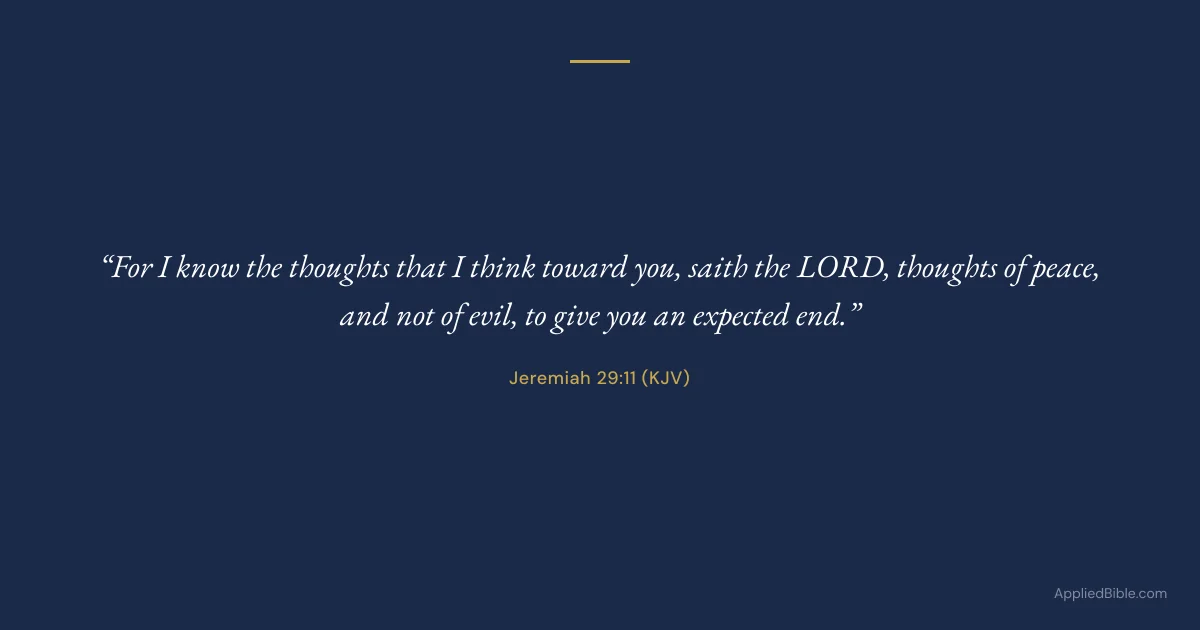
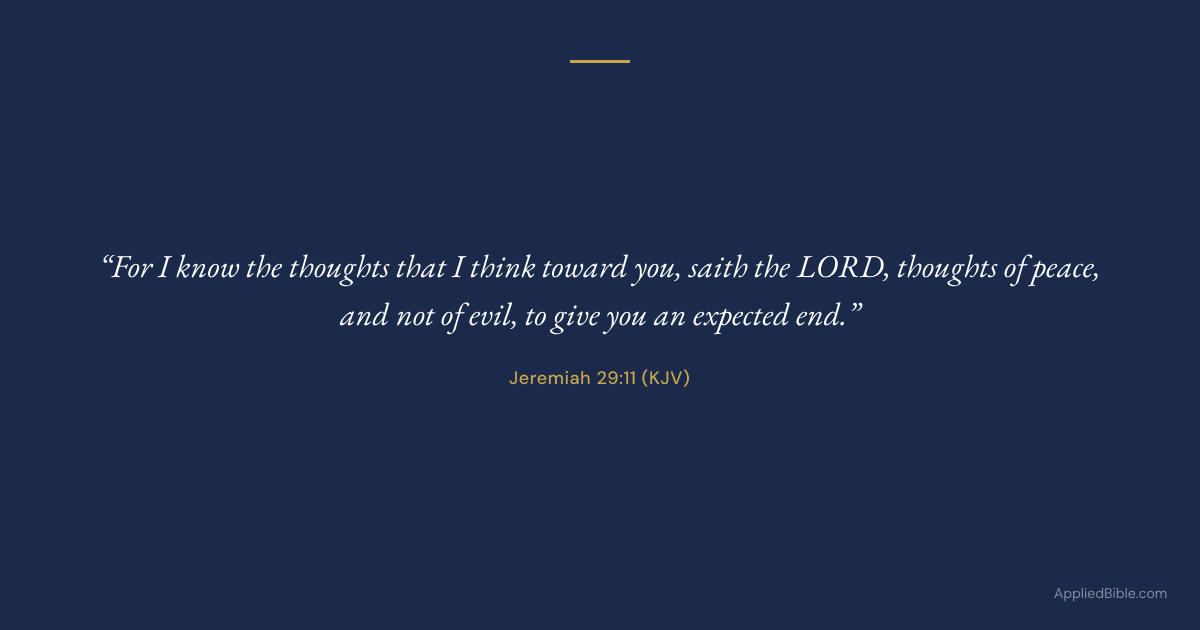
"For I know the thoughts that I think toward you, saith the LORD, thoughts of peace, and not of evil, to give you an expected end."
Jeremiah 29:11 (KJV)
What This Means: God spoke this to Israel during exile, one of the lowest points in their history. He was telling them that even in the middle of displacement and loss, He had not forgotten His plans for them. Those plans were for peace, not harm, and they pointed toward a future worth waiting for.
How to Apply This: If you are in a season where nothing makes sense, write this verse on a card and read it before bed tonight. Remind yourself that God's plans for you are still active, even when you cannot see them working.
2. Romans 15:13: "Hope That Overflows"
"Now the God of hope fill you with all joy and peace in believing, that ye may abound in hope, through the power of the Holy Ghost."
Romans 15:13 (KJV)
What This Means: Paul calls God the "God of hope." Hope is not something you manufacture on your own. It comes from God Himself. And He does not give you just enough to get by. He fills you to overflowing with joy, peace, and hope through His Spirit.
How to Apply This: Stop trying to work up hope by sheer willpower. Instead, ask God to fill you. Pray this verse out loud today, slowly, and let it become your request: "God, fill me with joy and peace in believing, so that I overflow with hope."
3. Romans 8:24-25: "Hope Is Believing What You Cannot Yet See"
"For we are saved by hope: but hope that is seen is not hope: for what a man seeth, why doth he yet hope for? But if we hope for that we see not, then do we with patience wait for it."
Romans 8:24-25 (KJV)
What This Means: Paul makes a straightforward point here. If you could already see the outcome, you would not need hope. Hope exists precisely because the answer has not arrived yet. And waiting with patience is not weakness. It is what faith looks like in real time.
How to Apply This: Think about something you have been waiting on. Instead of demanding an answer today, practice patience on purpose. Tell God, "I cannot see how this ends, but I trust that You can." That is hope at work.
4. Psalm 42:11: "Talk to Your Soul About God"
"Why art thou cast down, O my soul? and why art thou disquieted within me? hope thou in God: for I shall yet praise him, who is the health of my countenance, and my God."
Psalm 42:11 (KJV)
What This Means: The psalmist is talking to himself. He is not pretending to feel fine. He is asking his own soul, "Why are you so low?" and then answering with truth: put your hope in God. Sometimes the most spiritual thing you can do is argue with your own discouragement.
How to Apply This: The next time you feel hopeless, try this: talk to your soul out loud. Say, "Why am I so downcast? I will put my hope in God." It feels strange at first. But speaking truth to yourself changes the conversation inside your head.
5. Isaiah 40:31: "Hope Means Waiting with Expectation"
"But they that wait upon the LORD shall renew their strength; they shall mount up with wings as eagles; they shall run, and not be weary; and they shall walk, and not faint."
Isaiah 40:31 (KJV)
What This Means: Waiting on God is not sitting idle. The Hebrew word for "wait" here carries the idea of eager expectation, like watching for the sun to come up because you know it will. God promises that those who wait on Him will get their strength back. Not just enough to survive, but enough to soar.
How to Apply This: Are you running on empty? Stop pushing through on your own strength. Sit with God for ten minutes today, no agenda, no requests. Just wait. Tell Him you are expecting Him to renew what you have lost.
6. Lamentations 3:21-23: "New Mercies, New Hope, Every Morning"
"This I recall to my mind, therefore have I hope. It is of the LORD'S mercies that we are not consumed, because his compassions fail not. They are new every morning: great is thy faithfulness."
Lamentations 3:21-23 (KJV)
What This Means: Jeremiah wrote this in the middle of devastation. Jerusalem had fallen. Everything was lost. And yet he found hope by choosing to remember one thing: God's mercies are new every single morning. No matter how dark yesterday was, this morning brought a fresh supply of His compassion.
How to Apply This: Tomorrow morning, before you check your phone or start your to-do list, say these words: "God's mercies are new today." Start your day anchored in that truth instead of yesterday's pain.
7. Hebrews 6:19: "Hope Is Your Soul's Anchor"
"Which hope we have as an anchor of the soul, both sure and stedfast, and which entereth into that within the veil."
Hebrews 6:19 (KJV)
What This Means: An anchor keeps a ship from drifting, even when the waves are violent. That is what hope does for your soul. It holds you in place when everything around you feels unstable. And this anchor is not flimsy. It is sure and steadfast, connected to God Himself.
How to Apply This: If you feel like you are drifting right now, name it. Say, "I feel unmoored." Then read this verse and picture your soul being anchored to something that cannot move. God does not drift. Neither does your hope when it is attached to Him.
8. Psalm 130:5: "Put Your Hope in God's Word"
"I wait for the LORD, my soul doth wait, and in his word do I hope."
Psalm 130:5 (KJV)
What This Means: This is a short verse, but look at what is happening. The psalmist is waiting for God with his whole being, his soul included. And his hope is rooted in God's Word. Not in feelings. Not in circumstances. In what God has said and promised.
How to Apply This: Open your Bible to one promise of God today. It could be any verse on this list. Read it slowly. Then say, "This is where my hope is. Not in how I feel, not in what I see, but in what God has said."
9. 1 Peter 1:3: "A Living Hope, Not a Dead Dream"
"Blessed be the God and Father of our Lord Jesus Christ, which according to his abundant mercy hath begotten us again unto a lively hope by the resurrection of Jesus Christ from the dead."
1 Peter 1:3 (KJV)
What This Means: Peter calls it a "lively hope," a living hope. This is not wishful thinking or a vague optimism. It is a hope that is alive because Jesus is alive. The resurrection did not just change history. It changed the nature of hope itself. Because Jesus got up from the grave, your hope has a pulse.
How to Apply This: Write the phrase "living hope" somewhere you will see it today. Let it remind you that your hope is not a dead dream. It is alive, breathing, and backed by the power that raised Jesus from the dead.
10. Proverbs 13:12: "God Understands When Hope Hurts"
"Hope deferred maketh the heart sick: but when the desire cometh, it is a tree of life."
Proverbs 13:12 (KJV)
What This Means: Solomon does not sugarcoat this. Waiting for something that never seems to come makes your heart sick. That ache is real, and God knows it. But the second half of the verse matters too: when the thing you have been hoping for finally arrives, it brings life like a tree that bears fruit in season.
How to Apply This: If your heart is sick from waiting, let yourself grieve that. You do not have to pretend it does not hurt. Then hold onto the second half of this verse. The story is not over. The tree of life is still coming.
11. Romans 5:3-5: "Hard Seasons Build Real Hope"
"And not only so, but we glory in tribulations also: knowing that tribulation worketh patience; And patience, experience; and experience, hope: And hope maketh not ashamed; because the love of God is shed abroad in our hearts by the Holy Ghost which is given unto us."
Romans 5:3-5 (KJV)
What This Means: Paul lays out a chain reaction: suffering produces patience, patience produces character, and character produces hope. This is not cheap hope. It is the kind that has been tested by fire and came out stronger. And at the end of the chain, God's love floods your heart through the Holy Spirit.
How to Apply This: Look back on a hard season you survived. Can you trace the chain? Suffering led to patience, patience built something in you, and that something gave you hope for the next trial. Thank God for what the hard seasons have built in you.
12. Psalm 71:14: "Choose Hope on Repeat"
"But I will hope continually, and will yet praise thee more and more."
Psalm 71:14 (KJV)
What This Means: This is a decision, not a feeling. The psalmist says "I will." He is choosing to hope and choosing to praise, even when circumstances do not inspire it. Continual hope is not about ignoring reality. It is about deciding, over and over, to trust the God who holds reality in His hands.
How to Apply This: Make this your declaration today. Say it out loud: "I will hope continually, and I will praise God more and more." Repeat it when discouragement knocks. Hope is not a one-time decision. It is something you choose on repeat.
13. Micah 7:7: "Look to God. He Will Hear You."
"Therefore I will look unto the LORD; I will wait for the God of my salvation: my God will hear me."
Micah 7:7 (KJV)
What This Means: Micah wrote this when the nation was full of corruption and everything seemed broken. His response was simple: I will look to God. I will wait for Him. He will hear me. Three statements of trust in the middle of total chaos. No complicated formula. Just a decision to keep his eyes on God.
How to Apply This: When your situation feels broken beyond repair, do what Micah did. Look up. Say, "God, I am looking to You. I am waiting for You. I know You hear me." That is enough. He does not need you to figure it out. He just needs you to look to Him.
14. Psalm 33:18: "God's Eyes Are on Those Who Hope in Him"
"Behold, the eye of the LORD is upon them that fear him, upon them that hope in his mercy."
Psalm 33:18 (KJV)
What This Means: God is watching. Not in a surveillance kind of way, but in the way a parent watches a child learning to walk. His eyes are on the ones who revere Him and put their hope in His mercy. You are not invisible to Him. You are not forgotten. His gaze is fixed on you.
How to Apply This: If you have felt unseen lately, let this verse correct that lie. God's eyes are on you right now. He sees your situation. He sees your faith. Sit with that for a moment and let it settle into your heart.
15. Isaiah 49:23: "Your Waiting Will Not Be Wasted"
"...they shall not be ashamed that wait for me."
Isaiah 49:23 (KJV)
What This Means: Short and powerful. God promises that those who wait for Him will not be put to shame. Your patience will not be wasted. Your faithfulness will not be mocked. The world may say you are foolish for holding on, but God says the opposite: your waiting will be honored.
How to Apply This: If you have been wondering whether all this waiting is worth it, here is your answer. God says it is. Keep holding on. Your hope is not misplaced, and your wait will not be wasted. Trust Him with the timeline.
How to Apply These Verses When Hope Feels Hard
When you have been waiting for a long time
Long waits wear you down. Whether you are waiting for a relationship to heal, a prayer to be answered, or a season to change, the waiting itself can feel heavier than the original problem. Isaiah 40:31 was written for this. Waiting on God is not passive. It is active trust. It is saying, "I believe You are working even though I cannot see it." Read that verse every morning this week and let it remind you that your strength will be renewed.
When you feel like giving up
There is no shame in admitting you are tired. The psalmist in Psalm 42 was right there, so low he had to talk himself through it. If you feel like quitting, do what he did: talk to your soul about God instead of listening to your feelings about your circumstances. Read Psalm 71:14 and make it your decision, not a feeling: "I will hope continually." Then take one small step forward. Just one.
When hope has been disappointed before
Proverbs 13:12 names what you are feeling: hope deferred makes the heart sick. If you have been let down so many times that hoping again feels dangerous, God sees that. He is not asking you to pretend the past did not hurt. He is asking you to try again, not with blind optimism, but with trust anchored in His character. Start small. Pick one promise from this list and hold onto it for a week. Let God prove Himself faithful in the little things.
When holding hope for someone else
Sometimes the person who needs hope is not you. It is your child, your friend, your spouse. You can see them struggling, and you want to fix it, but you cannot. In those moments, Romans 15:13 becomes a prayer you can pray on their behalf. "God, fill them with joy and peace in believing, so they overflow with hope." You may not be able to give them hope yourself, but you can ask the God of hope to do it.
Frequently Asked Questions
What is the best Bible verse about hope?
Romans 15:13 is one of the most complete verses about hope in the Bible. Paul calls God the "God of hope" and prays that believers would be filled with joy and peace so they can overflow with hope through the Holy Spirit. It connects hope directly to God's character and His power, which makes it deeply encouraging for anyone who feels like hope is running low.
How do I have hope when everything seems hopeless?
Start with honesty. The Bible is full of people who felt hopeless and told God about it. The psalmist in Psalm 42 talked to his own soul and told it to hope in God. Jeremiah found hope in the middle of devastation by remembering God's mercies (Lamentations 3:21-23). You do not have to fake it. Bring your hopelessness to God and ask Him to rebuild your hope one morning at a time.
What does the Bible mean by 'hope'?
Biblical hope is not the same as wishful thinking. In the Bible, hope means confident expectation based on who God is and what He has promised. Romans 8:24-25 explains that hope is trusting in what you cannot yet see and waiting for it with patience. It is anchored in God's character, not in your circumstances.
Can I lose hope and still have faith?
Yes. Many people in the Bible experienced seasons where hope felt distant, including David, Jeremiah, and even Jesus' own disciples. Struggling with hope does not mean you have lost your faith. It means you are human. Proverbs 13:12 says that hope deferred makes the heart sick. God understands that. Bring your weary heart to Him, and let Him restore what has been depleted.
Try This Today
- ✓ Write down one thing you have been hoping for. Be specific. Name it.
- ✓ Find the verse from this list that speaks most directly to that situation. Read it slowly and let it sink in.
- ✓ Read that verse every morning this week before you do anything else. Let God rebuild your hope from the inside out.