Bible Verses About Love
Love is the word the Bible uses more than almost any other to describe who God is and how He wants us to live. But Scripture does not talk about love the way greeting cards do. The Bible's love is gritty, sacrificial, and intensely practical. These 15 verses will show you what love really looks like, and each one comes with a plain-English explanation and one specific way to live it out today.
What Does the Bible Say About Love?
The Bible talks about love more than almost any other topic. It is woven through every book, from Genesis to Revelation. And the central message is this: love is not something you fall into. It is something you choose, something you do, and something that flows from a God who loved you first.
Everything starts with God's love. John 3:16 tells us He loved the world so deeply that He gave His only Son. Romans 5:8 says He demonstrated that love while we were still sinners, not after we cleaned up. God's love is not a reward for good behavior. It is the foundation everything else is built on. Every other kind of love in Scripture, marriage, friendship, neighborly kindness, grows from this one root.
And that love is meant to flow through us to others. 1 John 4:7-8 says that everyone who loves is born of God and knows God, and that anyone who does not love does not know God, because God is love. The Bible makes it personal. If you know God, you will love people. Not perfectly, but genuinely. Love is the clearest evidence that God is alive in your life.
15 Bible Verses About Love
1. 1 Corinthians 13:4-7: "Love Is an Action, Not a Feeling"
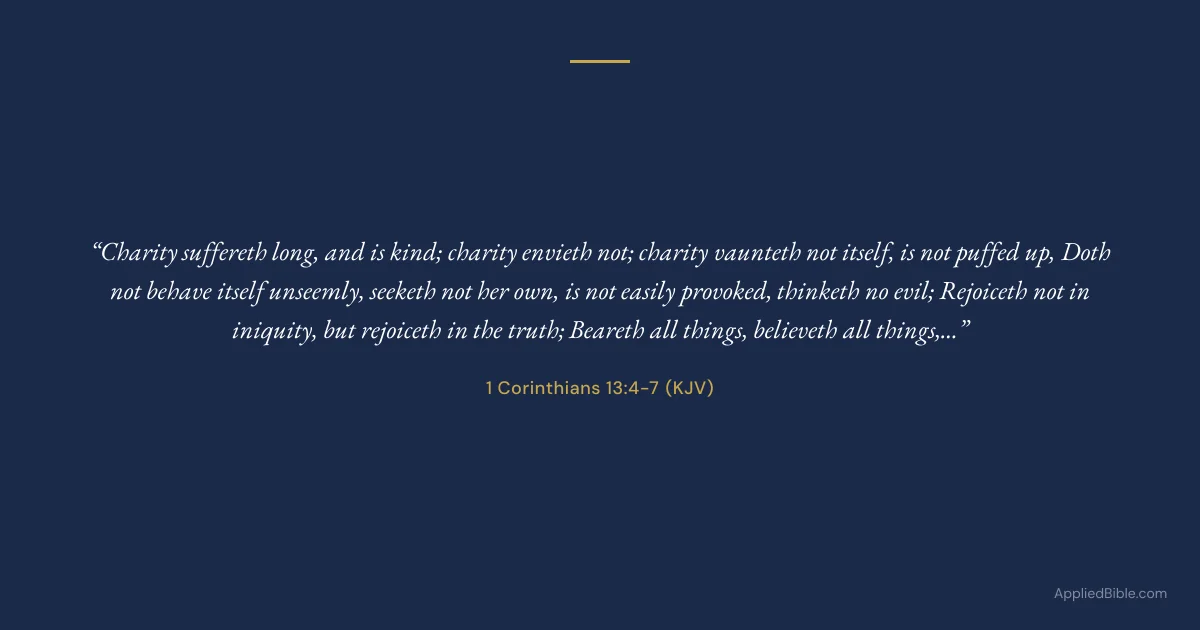
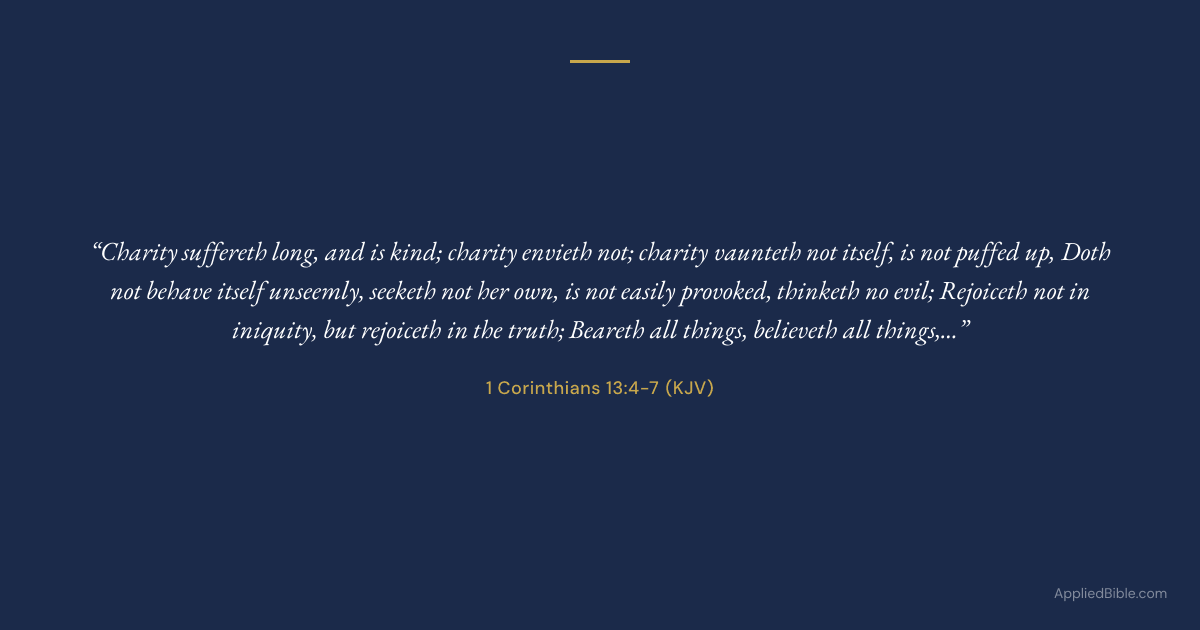
"Charity suffereth long, and is kind; charity envieth not; charity vaunteth not itself, is not puffed up, Doth not behave itself unseemly, seeketh not her own, is not easily provoked, thinketh no evil; Rejoiceth not in iniquity, but rejoiceth in the truth; Beareth all things, believeth all things, hopeth all things, endureth all things."
1 Corinthians 13:4-7 (KJV)
What This Means: Paul gives a list of what love actually looks like in practice. None of these are feelings. Every single one is a choice. Love is patient when you want to snap. Love is kind when you would rather withdraw. Love does not keep a record of wrongs. This is a description of daily, unglamorous, costly love.
How to Apply This: Read through this list slowly and pick the one quality you struggle with most right now. Is it patience? Kindness? Not keeping score? Focus on that one quality for the rest of the week. Love grows one choice at a time.
2. John 3:16: "The Love That Started Everything"
"For God so loved the world, that he gave his only begotten Son, that whosoever believeth in him should not perish, but have everlasting life."
John 3:16 (KJV)
What This Means: This single verse captures the entire gospel. God loved a broken world so deeply that He gave His most precious gift to save it. The word "whosoever" means there is no one excluded. This love is not selective. It reaches everyone willing to receive it.
How to Apply This: If you have heard this verse a thousand times, read it again as if it were written just for you. Replace "the world" with your own name. Let it sink in that God gave everything because He loves you specifically.
3. 1 John 4:19: "Love Starts with God"
"We love him, because he first loved us."
1 John 4:19 (KJV)
What This Means: John makes the order crystal clear. We do not earn God's love by loving Him first. He loved us first. Our ability to love at all is a response to the love He already showed us. You are not starting from scratch. You are responding to a love that has been there all along.
How to Apply This: The next time you feel like you are failing at love, remember this: you are not the source. God is. Ask Him to fill you up so you have something to give. You cannot pour from an empty cup, but His supply never runs out.
4. Romans 5:8: "Love That Does Not Wait for You to Be Ready"
"But God commendeth his love toward us, in that, while we were yet sinners, Christ died for us."
Romans 5:8 (KJV)
What This Means: God did not wait for us to get our lives together before He demonstrated His love. Christ died for us while we were still in the middle of our mess. That is the kind of love God offers. It is not based on your performance. It is based on His character.
How to Apply This: Think about someone in your life you have been waiting to change before you show them love. Consider what it would look like to love them right where they are, the way God loved you before you were ready.
5. 1 John 4:7-8: "Loving Others Is How You Know God"
"Beloved, let us love one another: for love is of God; and every one that loveth is born of God, and knoweth God. He that loveth not knoweth not God; for God is love."
1 John 4:7-8 (KJV)
What This Means: John ties knowing God directly to loving people. If you know God, you will love others. Not perfectly, but genuinely. And the reverse is also true: a life without love for others reveals a life that does not truly know God. Love is not optional for the believer. It is evidence.
How to Apply This: Ask yourself honestly: is there someone in your life you have stopped trying to love? Not someone dangerous or abusive, but someone you have simply written off. Ask God to soften your heart toward that person today.
6. Romans 8:38-39: "Nothing Can Separate You from God's Love"
"For I am persuaded, that neither death, nor life, nor angels, nor principalities, nor powers, nor things present, nor things to come, Nor height, nor depth, nor any other creature, shall be able to separate us from the love of God, which is in Christ Jesus our Lord."
Romans 8:38-39 (KJV)
What This Means: Paul goes through every possible category of threat and declares that none of them can separate you from God's love. Not your worst day. Not your biggest failure. Not the thing you are most ashamed of. Nothing in all of creation has the power to pull you out of God's love.
How to Apply This: Write down the thing that makes you feel most distant from God. Then read this verse again and let Paul's words settle over it. That thing, whatever it is, cannot separate you from His love. Let that truth quiet the voice that says otherwise.
7. John 15:13: "The Highest Form of Love Is Sacrifice"
"Greater love hath no man than this, that a man lay down his life for his friends."
John 15:13 (KJV)
What This Means: Jesus said this shortly before He did exactly what He described. The greatest love is not expressed through words or feelings. It is expressed through sacrifice. Laying down your life can look like literally dying for someone, but it also looks like giving up your comfort, your time, your preferences for the good of someone else.
How to Apply This: You probably will not be asked to die for someone today. But you will be asked to lay something down. Your schedule, your pride, your desire to be right. Look for one opportunity today to put someone else's needs ahead of your own.
8. Ephesians 5:25: "Love That Gives Itself Away"
"Husbands, love your wives, even as Christ also loved the church, and gave himself for it."
Ephesians 5:25 (KJV)
What This Means: Paul sets the bar for love in marriage at the highest possible level: the way Christ loved the church. That is selfless, sacrificial, and all-in. This verse speaks directly to husbands, but the principle applies to every relationship. Real love gives itself away without keeping a tab.
How to Apply This: Whether you are married or not, think about the closest relationship in your life. Ask yourself: am I giving, or am I keeping score? Do one thing today that puts the other person first with no expectation of anything in return.
9. 1 Peter 4:8: "Love Covers What Others Have Done"
"And above all things have fervent charity among yourselves: for charity shall cover the multitude of sins."
1 Peter 4:8 (KJV)
What This Means: Peter says love should be "fervent," which means intense and constant, not lukewarm. And this kind of love covers sins. Not by ignoring them, but by choosing not to hold them over someone's head. Love does not broadcast someone else's failures. It absorbs the hurt and chooses grace.
How to Apply This: Is there a grudge you have been carrying? A wrong someone did that you keep replaying? Ask God to help you release it. Covering a sin does not mean pretending it did not happen. It means choosing not to let it define the relationship.
10. Proverbs 10:12: "Love Chooses Peace Over Conflict"
"Hatred stirreth up strifes: but love covereth all sins."
Proverbs 10:12 (KJV)
What This Means: Solomon draws a clear line between two responses. Hatred stirs up conflict. It pokes at wounds, brings up old arguments, and fans the flames. Love does the opposite. It covers offenses. It chooses peace over being right. That does not mean love is passive. It means love is intentional about what it fuels.
How to Apply This: The next time you are in a disagreement, pause before you respond. Ask yourself: am I about to stir up strife, or cover it with love? Sometimes the most loving thing you can do is let something go.
11. Song of Solomon 8:6-7: "Love That Cannot Be Drowned"
"Set me as a seal upon thine heart, as a seal upon thine arm: for love is strong as death; jealousy is cruel as the grave: the coals thereof are coals of fire, which hath a most vehement flame. Many waters cannot quench love, neither can the floods drown it: if a man would give all the substance of his house for love, it would utterly be contemned."
Song of Solomon 8:6-7 (KJV)
What This Means: This is one of the most passionate descriptions of love in all of Scripture. Love is described as unquenchable fire, a force as strong as death. No amount of hardship can drown it. No amount of money can buy it. Real love is not fragile. It endures what should destroy it.
How to Apply This: If you are in a season where love feels hard, weak, or barely alive, remember this: love that comes from God cannot be drowned. Ask Him to reignite the flame where it has grown dim. He is the source, and His fire does not run out.
12. 1 John 3:18: "Love Is What You Do, Not What You Say"
"My little children, let us not love in word, neither in tongue; but in deed and in truth."
1 John 3:18 (KJV)
What This Means: John is blunt. Talking about love is not the same as showing love. Saying "I love you" matters, but it means nothing if your actions do not match. Real love shows up. It does the dishes. It makes the phone call. It stays when staying is hard.
How to Apply This: Think of someone you have told you love recently. Now ask: do my actions back that up? Pick one tangible thing you can do today that shows love through action, not just words. A meal, a note, an hour of your time.
13. Colossians 3:14: "Love Holds Everything Together"
"And above all these things put on charity, which is the bond of perfectness."
Colossians 3:14 (KJV)
What This Means: Paul has just listed a string of virtues: compassion, kindness, humility, patience, forgiveness. Then he says to put on love over all of them, because love is what holds everything together. Without love, the other virtues fall apart. Love is the thread that ties a godly life into one piece.
How to Apply This: Look at the relationships and responsibilities in your life. Where does it feel like things are unraveling? Try leading with love in that area today. Not a strategy, not a plan. Just love. It has a way of pulling the loose threads back together.
14. Mark 12:30-31: "The Two Commands That Cover Everything"
"And thou shalt love the Lord thy God with all thy heart, and with all thy soul, and with all thy mind, and with all thy strength: this is the first commandment. And the second is like, namely this, Thou shalt love thy neighbour as thyself. There is none other commandment greater than these."
Mark 12:30-31 (KJV)
What This Means: When asked which commandment is the greatest, Jesus gave two. Love God completely. Love your neighbor as yourself. Every other commandment hangs on these two. If you get these right, the rest follows. It is both the simplest and the hardest instruction in all of Scripture.
How to Apply This: Pick one of these two today. If you have been distant from God, spend ten minutes just talking to Him. If you have been distant from someone near you, reach out. Love God and love people. Start there and keep going.
15. Zephaniah 3:17: "God Sings Over You"
"The LORD thy God in the midst of thee is mighty; he will save, he will rejoice over thee with joy; he will rest in his love, he will joy over thee with singing."
Zephaniah 3:17 (KJV)
What This Means: This verse paints an image most people miss. God does not just tolerate you. He rejoices over you with joy and sings over you. The Creator of the universe delights in you. If you have ever wondered whether God's love for you is real, this verse answers it with a song.
How to Apply This: Sit quietly for a moment and let this truth settle in: God sings over you. Not because you earned it, but because He loves you. If you feel unloved today, come back to this verse. Let it remind you of what is true even when your feelings say otherwise.
How to Apply These Verses
When your marriage feels like hard work
Every marriage hits seasons where love feels more like discipline than delight. That does not mean something is wrong with your marriage. It means you are in the part where love becomes a verb. 1 Corinthians 13:4-7 was not written for wedding ceremonies. It was written for Tuesday mornings when patience is thin and kindness takes effort. Ephesians 5:25 sets the standard: love the way Christ loved. That means showing up, giving freely, and choosing your spouse even when the feeling is not there.
When loving someone who has hurt you
Loving someone who wounded you is one of the hardest things God asks us to do. But Romans 5:8 reminds us that God loved us when we were at our worst. 1 Peter 4:8 says fervent love covers a multitude of sins. That does not mean you pretend the hurt did not happen or stay in a harmful situation. It means you hand the bitterness to God and choose not to let it own you. Forgiveness and love are not the same as trust. You can love someone and still have boundaries.
When you feel unloved or unlovable
If the voice in your head says you are too much or not enough, Romans 8:38-39 has a direct answer: nothing in all of creation can separate you from God's love. Zephaniah 3:17 says God rejoices over you with singing. You do not have to earn it. You do not have to perform for it. On your worst day, God's love for you has not decreased by a fraction. Let that truth be louder than the lie.
When you want to teach your children about love
Children learn love by watching it more than hearing about it. 1 John 3:18 says to love in deed and in truth, not just in words. Let your kids see you choose patience when you are frustrated. Let them see you forgive when it costs you something. Read 1 Corinthians 13:4-7 together and talk about what each quality looks like in your family. The best way to teach love is to live it where they can see it.
Frequently Asked Questions
What is the greatest Bible verse about love?
Many people point to 1 Corinthians 13:4-7 as the greatest Bible passage about love because it describes what love actually looks like in action. Others choose John 3:16 because it captures God's love for the world in a single sentence. Both are worth memorizing. The best verse for you is the one that meets you where you are right now.
What are the different types of love in the Bible?
The Bible describes several kinds of love. God's unconditional love for humanity is shown in John 3:16 and Romans 5:8. Sacrificial love between people is described in John 15:13. Romantic love appears in Song of Solomon. Brotherly love and friendship love show up in passages like 1 John 4:7-8. And the command to love your neighbor as yourself (Mark 12:31) covers love for the people around you, even the difficult ones.
How does the Bible define love?
The clearest definition of love in the Bible is found in 1 Corinthians 13:4-7: love is patient, kind, not envious, not boastful, not proud. It does not keep a record of wrongs. It bears all things and endures all things. Notice that every item on the list is a verb, not a feeling. The Bible defines love by what it does, not by how it feels.
What does the Bible say about loving someone who is hard to love?
The Bible does not promise that loving everyone will be easy. But it does say to do it anyway. Romans 5:8 reminds us that God loved us while we were still sinners, not after we cleaned up. 1 Peter 4:8 says fervent love covers a multitude of sins. Jesus commanded us to love our enemies (Matthew 5:44). Loving difficult people is not about feeling warm toward them. It is about choosing to act in love, even when the feeling is not there.
Try This Today
- ✓ Think of one person in your life who is hard to love right now. Not hard to like. Hard to love.
- ✓ Do one specific, tangible act of love for that person today. A kind text, a meal dropped off, a genuine compliment, five minutes of undivided attention.
- ✓ Do not wait until you feel like it. Love is a verb. Start with the action and let the feeling follow.