15 Bible Verses About Parenting
Parenting is one of the most consequential and most humbling assignments in life. The Bible does not leave parents without guidance. These 15 verses show what Scripture says about training, correcting, loving, and releasing the children entrusted to you.
What Does the Bible Say About Parenting?
The foundation is in Proverbs 22:6: train up a child in the way he should go. The Hebrew word for train means to dedicate for a purpose: to help a child discover who they were made to be and form them in that direction. It is deeper than behavior management.
Deuteronomy 6:6-7 describes where faith transmission actually happens: not in formal lessons alone, but in the sitting, walking, lying down, and rising up moments of ordinary life. The faith must be in the parent's heart first. Then it flows naturally into every direction of the day.
Psalm 127:3 reframes the weight of parenting: children are God's heritage entrusted to you. You are the steward, not the author. That distinction removes the crushing burden of believing you are solely responsible for who they become.
15 Bible Verses About Parenting
1. Proverbs 22:6: "Train a Child in the Way They Should Go"
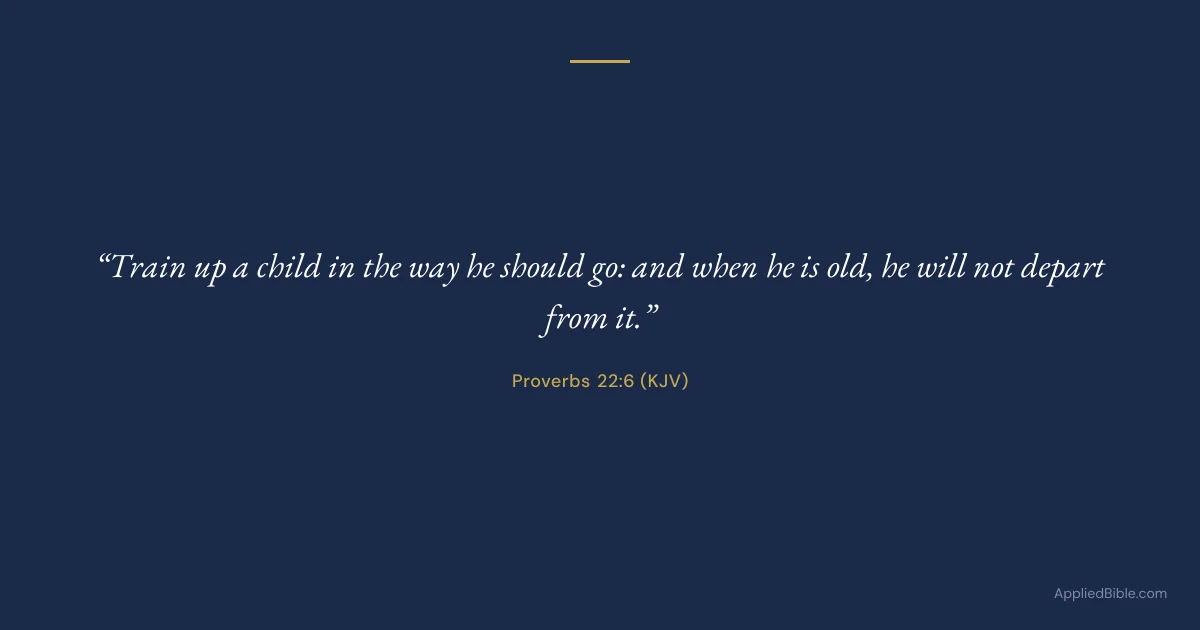
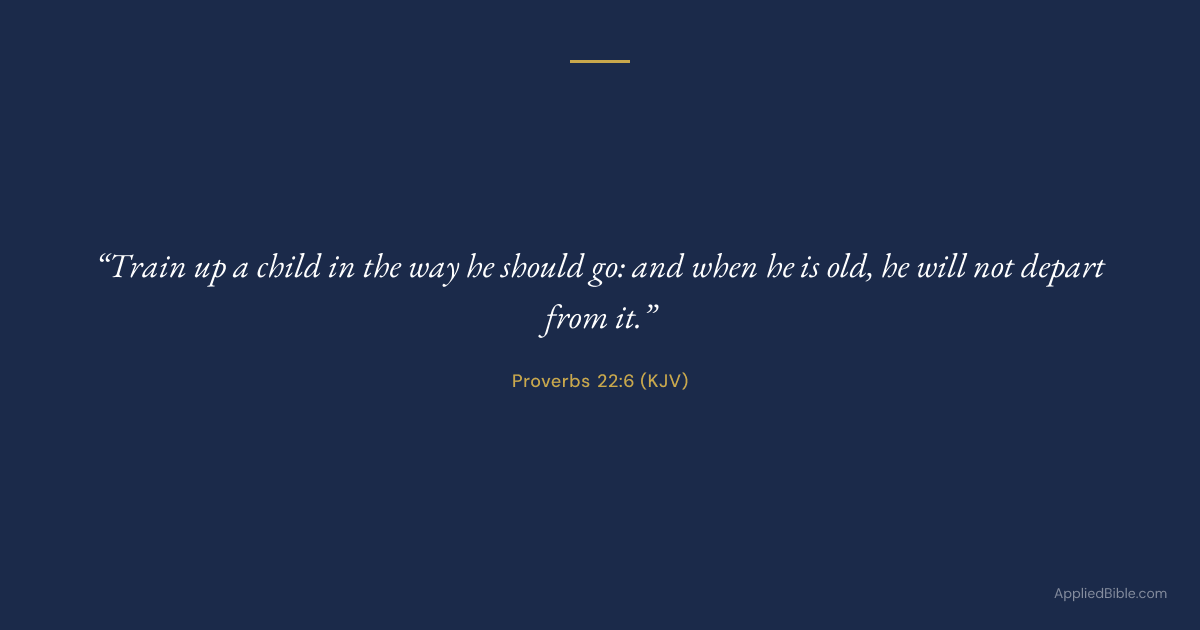
"Train up a child in the way he should go: and when he is old, he will not depart from it."
Proverbs 22:6 (KJV)
What This Means: The word train in Hebrew is chanak, the same root used for dedicating a building: to set something apart for its intended purpose. Training a child is not just behavior management. It is helping them discover who they were made to be and how to live in alignment with that. The promise is not that they will be perfect or will never stray. It is that the deep formation of early years leaves a mark that persists.
How to Apply This: What is the most important thing you are training into your child right now: what they believe about God, about themselves, about how to treat others? Is it happening intentionally or by accident? Name one specific thing you want to train in more deliberately this week.
2. Deuteronomy 6:6-7: "Pass Your Faith to Your Children in Every Moment"
"And these words, which I command thee this day, shall be in thine heart: And thou shalt teach them diligently unto thy children, and shalt talk of them when thou sittest in thine house, and when thou walkest by the way, and when thou liest down, and when thou risest up."
Deuteronomy 6:6-7 (KJV)
What This Means: Moses describes faith transmission as a continuous, everyday practice, not a formal curriculum. When you sit at home, when you walk, when you lie down, when you rise up. Faith is passed through the ordinary moments of family life, through casual conversation, through how you handle difficulty, through what you talk about at the table. The faith must be in your heart first. Then it flows naturally into every direction of your day.
How to Apply This: When did you last talk about your faith with your children in an ordinary moment: not in a lesson or devotional, but just naturally, in the flow of life? Identify one ordinary moment today, a meal, a drive, a bedtime, where you could naturally bring God into the conversation.
3. Psalm 127:3: "Children Are God's Heritage, Not Your Projects"
"Lo, children are an heritage of the LORD: and the fruit of the womb is his reward."
Psalm 127:3 (KJV)
What This Means: Heritage in Hebrew is nachalah, an inheritance received from God. Your children were not produced by you alone. They are entrusted to you. This changes everything about how you hold the weight of parenting. You are not the sole author of who they become. You are a steward of what God has given you. This removes both the pride of their successes and the crushing guilt of their failures. They are His. You are their steward.
How to Apply This: When do you most feel like your children are your project to control rather than God's heritage entrusted to you? Name that area of parenting. Then hold it with open hands today: this is God's child. I am the steward. Ask God what faithful stewardship looks like in that specific area.
4. Ephesians 6:4: "Bring Children Up Without Provoking Them to Wrath"
"And, ye fathers, provoke not your children to wrath: but bring them up in the nurture and admonition of the Lord."
Ephesians 6:4 (KJV)
What This Means: Paul gives a negative command and a positive one. Do not provoke: do not parent in ways that generate unnecessary anger in your child through harshness, unreasonable expectations, constant criticism, or favoritism. And then the positive: nurture and admonition of the Lord. Nurture is tender, caring formation. Admonition is instruction and correction. Both should be of the Lord: rooted in His character, His Word, and His way.
How to Apply This: Honestly ask: does your parenting tend to provoke your children unnecessarily? Not all anger is provoked. But some is. Name one specific way you might be generating unnecessary frustration in your child. Then consider what nurture-not-provocation looks like in that same area.
5. Colossians 3:21: "Do Not Embitter Your Children"
"Fathers, provoke not your children to anger, lest they be discouraged."
Colossians 3:21 (KJV)
What This Means: Paul repeats the instruction from Ephesians but adds the result: they will be discouraged. Discouragement is the long-term fruit of being constantly provoked. The child who receives unrelenting criticism, unrealistic expectations, or harsh correction without warmth does not get tougher. They get smaller. Discouragement robs them of the confidence to try, to grow, and eventually to believe in what God says about them.
How to Apply This: Is there a child in your life who seems consistently discouraged? Ask honestly whether any of your responses to them might be contributing to it. Not all discouragement is your fault. But your words and tone have power. Name one thing you could say or do this week that builds rather than discourages.
6. 3 John 4: "No Greater Joy Than to Know Your Children Walk in Truth"
"I have no greater joy than to hear that my children walk in truth."
3 John 4 (KJV)
What This Means: John is writing about his spiritual children, but the principle applies directly to physical parenting. The greatest possible parenting outcome is not achievement, popularity, or even happiness. It is walking in truth: living in alignment with what is real, with what God says, with the gospel. When your child walks in truth, you have succeeded at the thing that matters most. When they do not, no other success compensates for it.
How to Apply This: When you picture your child's future success, what does success actually look like in your imagination? Achievement, comfort, happiness? Spend some time today asking God to align your definition of success with His: a child who walks in truth. Then pray that specifically over each of your children.
7. 2 Timothy 3:15: "Scripture Can Make Children Wise Unto Salvation"
"And that from a child thou hast known the holy scriptures, which are able to make thee wise unto salvation through faith which is in Christ Jesus."
2 Timothy 3:15 (KJV)
What This Means: Paul credits Timothy's knowledge of Scripture from childhood as the foundation of his faith and ministry. The holy scriptures have a specific power: they are able to make you wise unto salvation. Bible knowledge in childhood is not merely cultural or educational. It plants something that has the power to save. The investment in Scripture with your children is not the same as other education. It has a unique kind of power.
How to Apply This: How much regular Scripture engagement is happening in your children's lives: through family reading, church, their own reading, or memorization? Name one concrete step to increase that engagement this week. The stakes described in 2 Timothy 3:15 are eternal.
8. Proverbs 13:24: "Discipline Is an Expression of Love"
"He that spareth his rod hateth his son: but he that loveth him chasteneth him betimes."
Proverbs 13:24 (KJV)
What This Means: Solomon makes a striking equation: withholding correction is a form of failing the child. Not correcting them is not kindness. It is a failure to take their formation seriously. The parent who corrects betimes, meaning early and promptly, is the one who loves. This does not prescribe the specific form of discipline. It establishes that the loving parent shapes behavior rather than allowing the child to develop without correction.
How to Apply This: Is there a behavior or pattern in your child that you have been avoiding addressing because it is easier to ignore it? Name it. Then consider what loving, timely correction looks like in that specific situation. Not harsh. Prompt, clear, and consistent.
9. Proverbs 29:17: "Consistent Correction Brings Rest and Delight"
"Correct thy son, and he shall give thee rest; yea, he shall give delight unto thy soul."
Proverbs 29:17 (KJV)
What This Means: Solomon gives the long-term outcome of consistent correction: rest and delight. The parent who addresses issues when they are small, who trains consistently rather than reactively, ends up with a child who brings peace rather than constant conflict. This is not a promise that all corrected children turn out perfectly. It is wisdom about the general fruit of patient, consistent discipline over time.
How to Apply This: What is the most consistent area of correction worth applying with your child right now? Not the most dramatic issue. The one that keeps coming up and keeps being inconsistently addressed. Consistency is the key word in Proverbs 29:17. Name one step toward being more consistent in that area.
10. Isaiah 54:13: "Your Children Shall Be Taught by the LORD"
"And all thy children shall be taught of the LORD; and great shall be the peace of thy children."
Isaiah 54:13 (KJV)
What This Means: God makes a promise to the children of His people: they shall be taught of the LORD. Not only by you. Not only through the church. God Himself is involved in the formation of your children. And the fruit of being taught by the LORD is great peace. This promise releases the weight of believing you are solely responsible for who your children become. God is working in them beyond what you can see or engineer.
How to Apply This: When you feel inadequate as a parent, when you feel like you have failed to give your child something they needed, return to Isaiah 54:13. Your children shall be taught of the LORD. Pray that specifically over each child: 'Lord, teach them what only You can teach them.'
11. Proverbs 1:8: "A Mother's Teaching Is Not Optional"
"My son, hear the instruction of thy father, and forsake not the law of thy mother:"
Proverbs 1:8 (KJV)
What This Means: Proverbs opens its first parental instruction by naming both father and mother as sources of wisdom the child needs. The law of the mother is worth keeping, not forsaking. The mother's teaching has authority and weight. In a culture where fathers held primary authority, this inclusion is significant. Both parents, together, form the wisdom inheritance the child receives. Neither role is dispensable.
How to Apply This: What is the most important thing you are teaching your children through your consistent example, whether you know it or not? Not what you intend to teach. What you are actually modeling. Name it honestly. Is it what you want them to learn?
12. Psalm 78:4: "Tell the Next Generation What God Has Done"
"We will not hide them from their children, shewing to the generation to come the praises of the LORD, and his strength, and his wonderful works that he hath done."
Psalm 78:4 (KJV)
What This Means: The psalmist identifies a specific responsibility: do not hide from your children what God has done. Tell them His praises. Tell them His strength. Tell them His wonderful works. This is the transmission of testimony across generations. Your children need to know not only what the Bible says about God but what God has done in your life specifically. Your testimony is part of what they inherit.
How to Apply This: When did you last tell your children a specific story of what God has done in your life? Not a general statement that God is good, but a specific: here is what happened, and here is what I saw God do in it. Tell one story this week. Your testimony is not just yours to keep.
13. Luke 2:52: "Jesus Grew in Four Dimensions: Wisdom, Stature, Favor With God and Man"
"And Jesus increased in wisdom and stature, and in favour with God and man."
Luke 2:52 (KJV)
What This Means: Luke describes Jesus' development in four areas: wisdom (intellectual and spiritual), stature (physical), favor with God (spiritual relationship), and favor with man (social and relational). This gives a holistic picture of what healthy development looks like. Parents who focus only on academic performance, or only on spiritual formation, or only on social success, are developing incomplete children. All four dimensions matter.
How to Apply This: Think about your child across the four dimensions Luke 2:52 describes: wisdom, physical development, relationship with God, and relationships with people. Which of the four is receiving the most attention from you? Which is receiving the least? What would a small rebalancing look like?
14. Proverbs 22:15: "Foolishness Is in Every Child's Heart and Needs to Be Addressed"
"Foolishness is bound in the heart of a child; but the rod of correction shall drive it far from him."
Proverbs 22:15 (KJV)
What This Means: Solomon is realistic about children: foolishness is not a phase or an accident. It is bound in the heart. The child left to themselves will default toward foolishness. This is not pessimism about children. It is an accurate assessment that shapes how seriously to take the work of correction. The rod of correction, used as a metaphor for consistent discipline and instruction, is what drives it out. This takes sustained, patient effort.
How to Apply This: What specific foolish patterns do you see in your child that you have been hoping they will outgrow on their own? Note what Proverbs says: it is bound in their heart and requires correction to drive it out. Name the pattern. Then design one consistent response to it.
15. Psalm 128:3-4: "The Blessed Home Has God at the Center"
"Thy wife shall be as a fruitful vine by the sides of thine house: thy children like olive plants round about thy table. Behold, that thus shall the man be blessed that feareth the LORD."
Psalm 128:3-4 (KJV)
What This Means: The image here is one of abundance and closeness: a fruitful vine, olive plants growing up around the table. The family gathered, flourishing. And the source of this blessing is the final line: the man who fears the LORD. The blessed home is not the one with the most resources or the most achievements. It is the one where the fear of God, genuine reverence and obedience, is present. Everything else grows from that root.
How to Apply This: What is the spiritual temperature of your home right now? Is the fear of the LORD present and visible in how you make decisions, how you handle conflict, how you speak about God with your children? That is the root of the flourishing Psalm 128 describes. Ask God today: what does fearing You look like in my home this week?
How to Apply These Verses in Your Parenting
When you feel like you are failing as a parent
Psalm 127:3 is the stabilizer: they are God's heritage, not your sole responsibility. Isaiah 54:13 is the promise: your children shall be taught of the LORD. You are not the only one working on your child's formation. God is at work in them beyond what you can see.
When correction is called for
Ephesians 6:4 sets the boundaries: do not provoke to wrath, bring up in nurture and admonition of the Lord. Proverbs 13:24 establishes the motivation: loving parents correct. The goal is not to vent frustration but to train for who they are meant to become.
When you want to pass your faith to your children
Deuteronomy 6:7 is the method: in the flow of life, in every direction of the day. Psalm 78:4 is the content: your specific testimony of what God has done. 2 Timothy 3:15 is the most powerful tool: Scripture from childhood.
Frequently Asked Questions
What does the Bible say about parenting?
The Bible gives both principles and specific instructions for parenting. Proverbs 22:6 calls parents to train children in the way they should go. Deuteronomy 6:6-7 describes passing faith to children in the ordinary moments of daily life. Ephesians 6:4 instructs parents not to provoke children to wrath but to bring them up in the nurture and admonition of the Lord. Psalm 127:3 frames children as God's heritage, meaning parents are stewards of what God has entrusted to them. The consistent message is that parenting is a spiritual calling with eternal stakes.
What does the Bible say about disciplining children?
Proverbs addresses discipline extensively. Proverbs 13:24 says withholding correction is a failure of love. Proverbs 22:15 says foolishness is in the heart of a child and correction drives it out. Proverbs 29:15 says a child left to himself brings his mother to shame. Ephesians 6:4 says correction must happen without provoking children to wrath: it should be in nurture, not harshness. Hebrews 12:11 compares God's fatherly discipline to human parental discipline, acknowledging it is not pleasant in the moment but produces the peaceful fruit of righteousness.
What does the Bible say about a mother's role?
Scripture presents the mother as a central figure in the formation of children. Proverbs 1:8 places the law of the mother alongside the instruction of the father as wisdom the child must not forsake. Proverbs 31:26 describes the excellent woman as one whose mouth is full of wisdom and kindness. 2 Timothy 1:5 credits Timothy's sincere faith to his grandmother Lois and his mother Eunice. Titus 2:4-5 instructs older women to teach younger women to love their children. A mother's faith, teaching, and character are identified throughout Scripture as formative forces in children's lives.
How do you pray for your children according to the Bible?
Several patterns emerge from Scripture. Isaiah 54:13 is a promise to pray: 'All my children shall be taught of the LORD, and great shall be their peace.' 3 John 4 captures the core desire: that they walk in truth. Ephesians 1:17-19 provides a prayer framework Paul used for his spiritual children: for wisdom and revelation, that the eyes of their hearts would be opened, that they would know the hope of their calling. Deuteronomy 6 suggests that prayer for children should happen in the normal flow of life, not just at formal prayer times.
Try This Today
- ✓ Identify one specific thing God has done in your life that your children do not know about. Tell them that story this week (Psalm 78:4). Your testimony is part of their inheritance.
- ✓ Ask your child one genuine question today: 'What do you think about God?' or 'What's the hardest thing about school right now?' Then listen more than you talk. Deuteronomy 6:7 puts walking together before the teaching.
- ✓ Name the behavior pattern in your child you have been inconsistently addressing. Write down one clear, consistent response for the next time it happens. Proverbs 29:17 connects consistent correction to eventual rest. The consistency is the hard part.