15 Bible Verses About Patience
Patience in the Bible is not gritting your teeth until things get better. It is active trust in a God whose timing you cannot always see. These 15 verses show what Scripture says about waiting well, and give you something concrete to do when the wait feels too long.
What Does the Bible Say About Patience?
James 1:3 says the trying of your faith works patience. That word worketh means manufactured, produced. Patience is not a personality trait you have or lack. It is something God is building in you through the exact trials you are trying to escape from.
Isaiah 40:31 gives the most famous patience verse in the Bible, but it is commonly misread. Waiting on the LORD is not the same as waiting for the LORD. The Hebrew word for wait here means to bind together, to intertwine. You are not sitting still enduring until God finally acts. You are staying attached to God during the delay, and that connection is what renews your strength.
Galatians 6:9 addresses the most practical temptation: quitting before the harvest comes. Due season is God's timing, not yours. The harvest is promised to those who do not faint. Patience is what keeps you planting when you cannot yet see the crop.
15 Bible Verses About Patience
1. James 1:3: "Difficulty Is the Classroom Where Patience Is Built"
"Knowing this, that the trying of your faith worketh patience."
James 1:3 (KJV)
What This Means: James does not say trials are pleasant. He says they work patience. The word worketh carries the sense of producing or manufacturing: trials are the process that creates patience in you. This reframes what is happening when everything feels hard and slow. God is not absent. He is at work, and the medium He is using is exactly the thing you want to escape from.
How to Apply This: Name one current trial that has been wearing you down. Write down one thing God might be building in you through it. Not a neat answer. Just one possibility. The asking reshapes how you carry it.
2. Romans 5:3-4: "Tribulation Has a Purpose Beyond Itself"
"And not only so, but we glory in tribulations also: knowing that tribulation worketh patience; And patience, experience; and experience, hope:"
Romans 5:3-4 (KJV)
What This Means: Paul draws a chain: tribulation produces patience, patience produces experience (the word is dokime, meaning proven character), and proven character produces hope. The suffering is not the destination. It is the first link in a chain that ends in hope. When you are in the tribulation, it is hard to see the rest of the chain. But it is there.
How to Apply This: Trace this chain for one hard season you have already come through. What patience did it build? What did you know about God afterward that you did not know before? That is the chain in operation. Write it down as evidence for the next hard season.
3. Hebrews 12:1: "Patience Is What Keeps You in the Race"
"Wherefore seeing we also are compassed about with so great a cloud of witnesses, let us lay aside every weight, and the sin which doth so easily beset us, and let us run with patience the race that is set before us,"
Hebrews 12:1 (KJV)
What This Means: The race metaphor is specific: you run with patience, not with speed. The goal is not finishing fast. The goal is finishing. Patience here means endurance, the steady persistence that does not quit when the distance seems too long. The witnesses surrounding you are the saints who ran the same kind of race before. They made it. That is what witnesses means in this context.
How to Apply This: Identify one weight, not necessarily sin, that is slowing you down right now. Something you're carrying that is making the race harder. Ask God what it would look like to lay it down. That is the first step in running with patience.
4. Romans 8:25: "Hoping for What You Cannot See Requires Patient Waiting"
"But if we hope for that we see not, then do we with patience wait for it."
Romans 8:25 (KJV)
What This Means: Paul connects hope and patience: if you are hoping for something you cannot see yet, patience is how you wait for it. This is not white-knuckling through time. This is the posture of someone whose hope is real enough that they are willing to wait for what they cannot yet hold. Patient waiting is itself an expression of real faith.
How to Apply This: Write down one thing you are hoping for that you cannot see yet. Then write one reason you believe God is trustworthy enough to wait for. That written trust is an act of the patience this verse describes.
5. Isaiah 40:31: "Waiting on God Renews What Waiting Depletes"
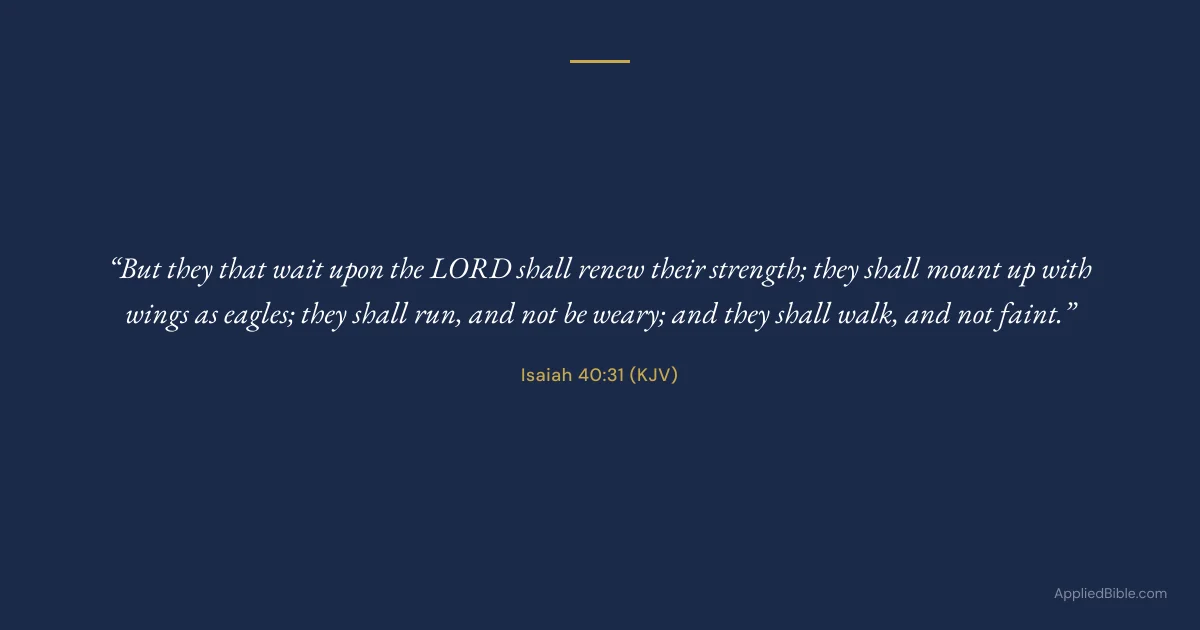
"But they that wait upon the LORD shall renew their strength; they shall mount up with wings as eagles; they shall run, and not be weary; and they shall walk, and not faint."
Isaiah 40:31 (KJV)
What This Means: Waiting on the Lord is not the same as waiting for the Lord. The Hebrew word qavah means to bind together, to attach, to intertwine. Waiting on God means staying connected to Him during the wait, not gritting your teeth and enduring until circumstances change. The promise is renewed strength. The waiting itself is the means of renewal, not something that depletes you before the good part arrives.
How to Apply This: Set aside 10 minutes today to wait on God with no agenda. No requests, no list. Just sit with Him. This is what Isaiah means by waiting on the LORD. Notice whether you feel differently afterward than before.
6. James 5:7: "Some Things Require a Long Wait to Come to Harvest"
"Be patient therefore, brethren, unto the coming of the Lord. Behold, the husbandman waiteth for the precious fruit of the earth, and hath long patience for it, until he receive the early and latter rain."
James 5:7 (KJV)
What This Means: James uses a farmer waiting for rain as a picture of patient waiting. The farmer does not dig up the seed to check on it. He knows the rain comes in its season, and he waits with confidence based on how things work, not on whether he can see it happening. Your wait has a harvest attached to it. The season will come.
How to Apply This: Think of one thing you planted in faith that has not yet come to harvest. Write a short prayer of patient trust: 'Lord, I planted this. I am waiting for the rain. I trust your timing.' Say it without demanding a timeline.
7. Psalm 27:14: "Waiting on God Is Something You Do More Than Once"
"Wait on the LORD: be of good courage, and he shall strengthen thine heart: wait, I say, on the LORD."
Psalm 27:14 (KJV)
What This Means: David says it twice in the same verse. This is not accidental. The repetition is the instruction: wait, and then wait again. And in between, be of good courage, because the waiting requires it. The promise is that God will strengthen your heart during the wait. He is not absent while you are waiting. He is the one doing the strengthening.
How to Apply This: Say 'Wait on the LORD' out loud once in the morning and once before bed today. Both times, ask God to strengthen your heart during whatever you are waiting on. Let the repetition be intentional, the way David made it.
8. Lamentations 3:25: "Waiting and Seeking Are Connected"
"The LORD is good unto them that wait for him, to the soul that seeketh him."
Lamentations 3:25 (KJV)
What This Means: Jeremiah wrote Lamentations after Jerusalem was destroyed. This is not a verse written from a comfortable place. It is one that was forged in loss, and it still arrives at: the LORD is good to those who wait for Him, to the soul who seeks Him. Seeking and waiting are paired here. Waiting without seeking can become passive despair. Waiting while seeking keeps you engaged with God through the delay.
How to Apply This: What are you waiting on God for? Pair your waiting with seeking today. Read one passage about the character of God related to your situation. Let your waiting be active, not just endurance.
9. Proverbs 19:11: "Patience With People Is a Mark of Wisdom"
"The discretion of a man deferreth his anger; and it is his glory to pass over a transgression."
Proverbs 19:11 (KJV)
What This Means: Patience is not only about waiting on God for good things. It is also about how you respond when people wrong you or disappoint you. Solomon says passing over a transgression, choosing not to react with immediate anger, is a person's glory. Patience in relationships is not weakness. It is wisdom, and it honors you.
How to Apply This: Think of one person who has frustrated or disappointed you recently. Choose one specific way to extend patience to them today. Not by pretending nothing happened, but by choosing not to react in kind. That is glory in the biblical sense.
10. Romans 12:12: "Three Things That Hold Together During Hard Waits"
"Rejoicing in hope; patient in tribulation; continuing instant in prayer;"
Romans 12:12 (KJV)
What This Means: Paul gives a three-part rhythm for difficult seasons: rejoice in hope, be patient in tribulation, keep praying. These are not three separate instructions for three separate situations. They work together simultaneously. When patience is hard, prayer feeds it. When prayer feels thin, hope in what God has promised refills it. The three anchor each other.
How to Apply This: When patience is wearing thin today, run the three-part check: Am I rejoicing in hope? Am I praying through this? If one is missing, that is the one to start with.
11. Psalm 37:7: "Rest in God During the Wait"
"Rest in the LORD, and wait patiently for him: fret not thyself because of him who prospereth in his way, because of the man who bringeth wicked devices to pass."
Psalm 37:7 (KJV)
What This Means: David addresses something specific: the frustration of watching others do wrong and seem to flourish. The temptation is to fret, to be unsettled and anxious about the apparent unfairness of it. His instruction is rest and patient waiting. God sees it. God will act. Your fretting changes nothing but your own peace.
How to Apply This: Is there a situation where things seem unfair and you feel the pull to fret? Write one sentence: 'God sees this, and I will rest while He handles it.' Not because you have stopped caring, but because fretting is not your job here.
12. Galatians 6:9: "The Harvest Comes to Those Who Don't Quit"
"And let us not be weary in well doing: for in due season we shall reap, if we faint not."
Galatians 6:9 (KJV)
What This Means: The condition is if we faint not. The harvest is not guaranteed to everyone regardless of whether they quit. It is promised to those who do not give up. Due season means God's timing, not yours. The reaping is coming. The question is whether you will still be planting when it arrives.
How to Apply This: What good thing have you been doing that is starting to feel thankless or pointless? Write down one reason to keep going. Not a feeling, a truth. 'In due season I will reap if I do not faint.' Say it before you make any decision to quit.
13. Psalm 40:1: "God Hears the Cry of Those Who Wait on Him"
"I waited patiently for the LORD; and he inclined unto me, and heard my cry."
Psalm 40:1 (KJV)
What This Means: David uses two words for patience here in the Hebrew: qavoh qavithi, an intensified form meaning he waited and kept on waiting. And God inclined unto him: leaned in, turned toward, heard. The waiting was not wasted. The cry was heard. The testimony David is recording here is meant to encourage your own waiting.
How to Apply This: Have you been waiting and crying out to God for something? Write this verse in your own words as a declaration about your current situation: 'I am waiting patiently for the LORD. He has inclined toward me. He hears my cry.' Say it as truth even before you see the answer.
14. Colossians 1:11: "God Strengthens You for Patient Endurance"
"Strengthened with all might, according to his glorious power, unto all patience and longsuffering with joyfulness;"
Colossians 1:11 (KJV)
What This Means: Paul prays that the Colossians would be strengthened with God's power, and the purpose of that strength is patience and longsuffering with joyfulness. God gives you strength for endurance. This is not a personality trait you either have or lack. It is something you are strengthened for by God's own power. The joyfulness attached to it is the mark that it is coming from the right source.
How to Apply This: Ask God today specifically for the strength to be patient in what you are waiting through. Not the patience itself, but the strength for it. That is the specific prayer Paul models here. He is the one who strengthens you for it.
15. 2 Thessalonians 3:5: "God Directs Your Heart Into What Patience Requires"
"And the Lord direct your hearts into the love of God, and into the patient waiting for Christ."
2 Thessalonians 3:5 (KJV)
What This Means: Paul prays that God Himself would direct their hearts into patient waiting. This is not something you achieve by trying harder. God directs you into it, like water being directed into a channel. You can ask for this. Patient waiting for Christ is not a solo effort. It is something God leads you into when you ask Him to.
How to Apply This: Pray this verse as a direct request today: 'Lord, direct my heart into your love and into patient waiting.' Short, specific, and exactly what Paul prayed for others. God will direct what you ask Him to direct.
How to Practice Patience When the Wait Is Long
When the wait is longer than you expected
Psalm 40:1 records David's testimony of waiting and waiting and finally having God incline toward him. He uses an intensified Hebrew form for patience: he waited and kept waiting. The answer came. The testimony is your evidence that prolonged waiting does not mean God has forgotten you.
When you are weary of doing the right thing
Galatians 6:9 is specifically for you right now. "Let us not be weary in well doing." The word weary here means to lose heart or grow faint. You are allowed to be tired. But the instruction is to not faint, because the harvest is tied to continuing. Write it down. Put it where you will see it today.
When you are fretting about what seems unfair
Psalm 37:7 addresses this situation directly: rest in the LORD and wait, fretting not about those whose lives seem to be going better. Fretting is a choice. So is rest. You can choose to let God be the one who sees and handles what seems unjust, while you tend to what He has given you.
When patience with people is running out
Proverbs 19:11 says passing over a transgression is a person's glory. Biblical patience includes how you respond when others wrong or disappoint you. The choice not to react in kind is not weakness. In the language of Proverbs, it is something that honors you.
Frequently Asked Questions
What does the Bible say about patience in suffering?
Romans 5:3-4 says tribulation works patience, and patience builds proven character, and proven character produces hope. James 1:3 says the trying of your faith produces patience. The pattern in Scripture is consistent: suffering is not a detour from God's plan. It is often the specific process He uses to build the things that cannot be built any other way. Hebrews 12:1 calls this running the race with patience, suggesting endurance is the spiritual goal, not the obstacle.
How do you wait on God patiently when the wait is very long?
Isaiah 40:31 distinguishes waiting on God (connected, active, seeking) from merely waiting for God (passive, enduring). Waiting on God means staying attached to Him during the delay, reading His word, praying, staying in community, trusting His character while the answer has not yet come. Psalm 27:14 repeats the instruction: wait on the LORD, then wait again. The repetition is the practical advice. You do not wait once. You choose to wait again each day.
Is impatience a sin?
Scripture does not categorize impatience as a sin the way it does things like theft or lying, but it does consistently connect impatience with lack of trust in God. Psalm 37:7 says 'fret not thyself,' implying that fretting is a choice, not just a feeling. James 1:4 says patience leads to spiritual maturity, which implies that resisting patience stunts growth. Impatience can be the soil in which anxiety, bitterness, and rash decisions grow. It is worth taking seriously, even if the label 'sin' is not always the right frame.
What is the difference between patience and passivity?
Biblical patience is active, not passive. Psalm 27:14 pairs patient waiting with 'be of good courage,' which is not passive. Galatians 6:9 says 'let us not be weary in well doing,' which assumes you are still doing something. Lamentations 3:25 connects waiting with seeking. Patient waiting means continuing to plant, pray, seek, and trust while the answer has not come, not stopping everything until it does. Passivity says 'I give up.' Patience says 'I trust, and I keep going.'
Try This Today
- ✓ Write down one thing you are waiting on God for. Then write one reason you believe His timing is trustworthy, based on something He has done before.
- ✓ When patience wears thin today, run the Romans 12:12 check: Am I rejoicing in hope? Am I patient in this? Am I praying? Start with whichever one is missing.
- ✓ Say Isaiah 40:31 out loud before a moment today where you feel depleted. Let the promise settle before the difficulty does.