15 Bible Verses About Prayer
Prayer is the part of the Christian life that everyone knows is important and many people feel like they are not doing correctly. The Bible is direct about what prayer actually is, how it works, and what to do when it feels like your prayers are going nowhere. These 15 verses cover the full range: what to say, how to persist, what God does when you pray, and what happens when you run out of words.
What Does the Bible Say About Prayer?
The most practical verse on prayer is Philippians 4:6-7: bring everything in prayer with thanksgiving, and the peace of God will guard your heart. Prayer is the exchange where anxiety gives way to peace. Not because the situation changes, but because you gave it to God rather than carrying it alone.
Jeremiah 33:3 makes a striking promise: call unto Me, and I will answer you, and show you great and mighty things which you do not know. The answer God gives is not just the resolution of your request. It is revelation. Prayer opens access to things you would not have known or seen otherwise.
Romans 8:26 is for the moments when words fail. The Spirit makes intercession for us with groanings that cannot be uttered. When you do not know what to pray, you are not without a voice before God. The Spirit takes over where your language runs out. You cannot pray badly enough to be unheard.
15 Bible Verses About Prayer
1. Philippians 4:6-7: "Bring Everything to God in Prayer, and Receive Peace That Surpasses Logic"
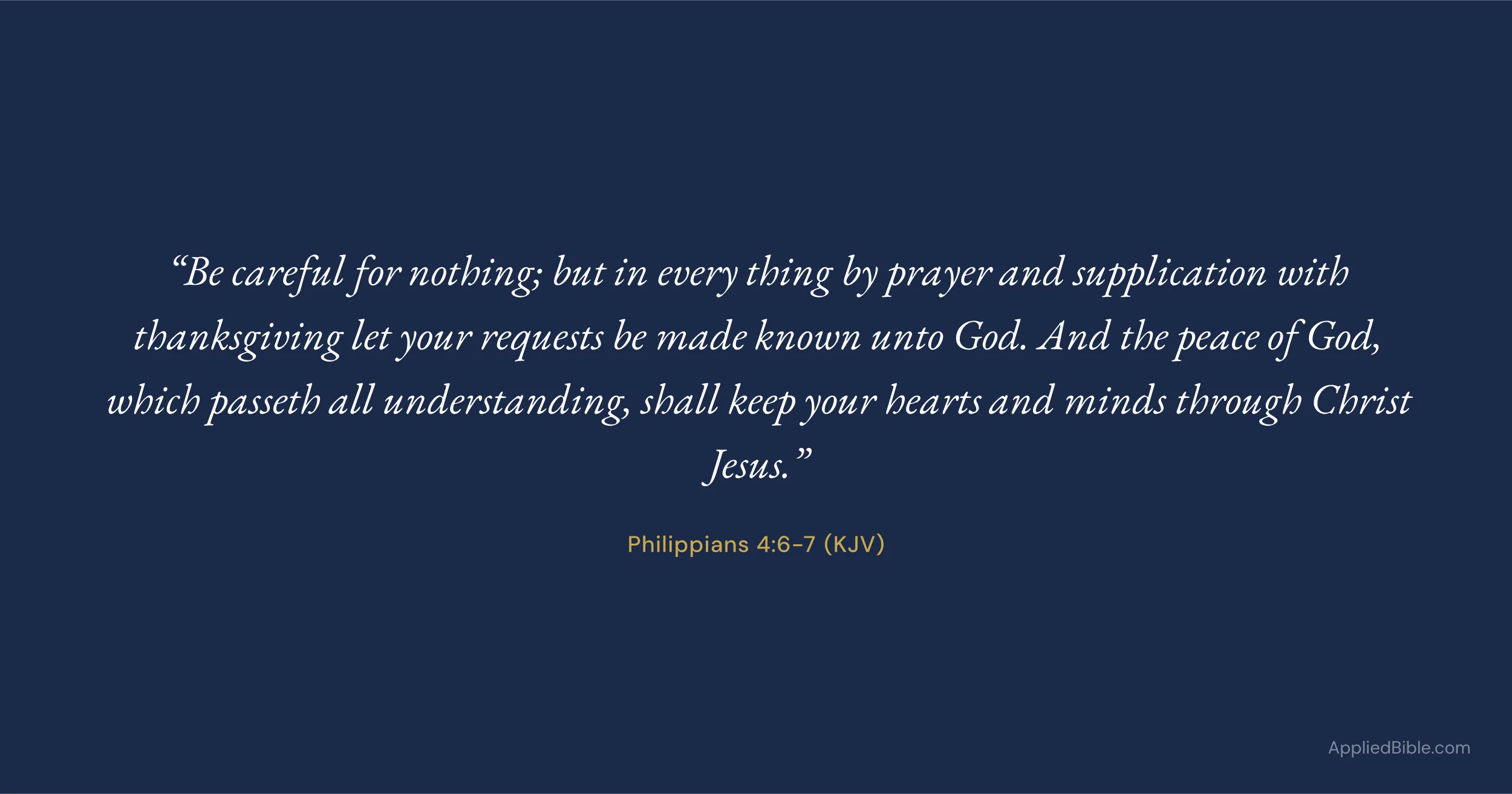
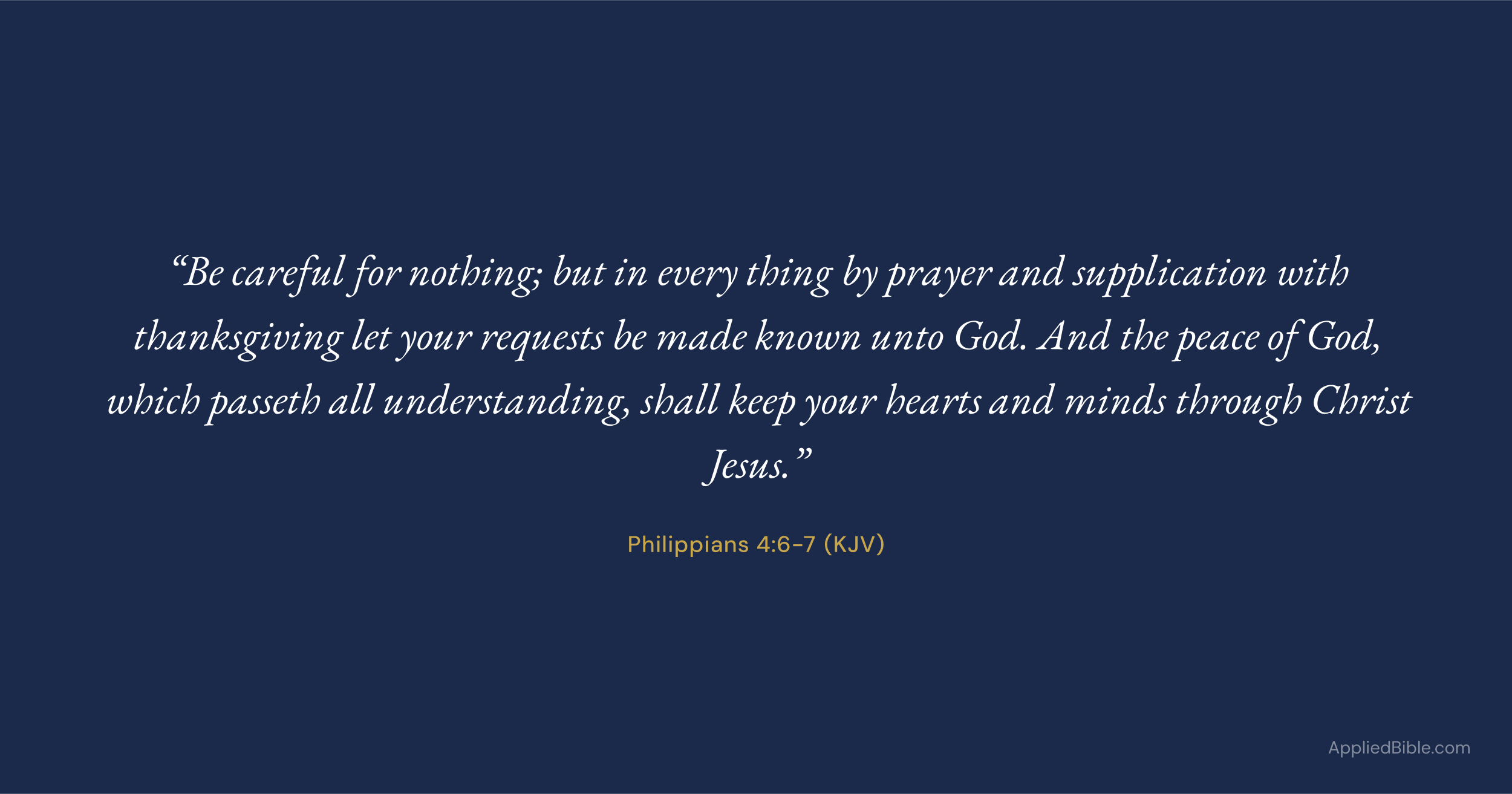
"Be careful for nothing; but in every thing by prayer and supplication with thanksgiving let your requests be made known unto God. And the peace of God, which passeth all understanding, shall keep your hearts and minds through Christ Jesus."
Philippians 4:6-7 (KJV)
What This Means: Paul says do not be anxious about anything, and gives a direct alternative: prayer about everything. Not the big things, not the spiritual things, everything. The result is not that your situation changes immediately. It is that the peace of God, which does not follow logic, keeps your heart and mind. Prayer is not just requesting. It is the exchange where anxiety leaves and peace comes in.
How to Apply This: Take the specific thing you are most anxious about right now and pray it out loud, naming it exactly. Then say: 'God, I am handing this to you.' Notice whether peace begins to come in, not because the situation changed but because you gave it to God.
2. 1 Thessalonians 5:17: "Prayer Is Meant to Be a Continuous Posture, Not a Scheduled Activity"
"Pray without ceasing."
1 Thessalonians 5:17 (KJV)
What This Means: Three words that describe an entire way of life. Paul is not saying you should be on your knees all day. He is describing an orientation of the heart where every moment is lived in awareness of and communication with God. Like breathing. You do not stop and formally breathe. You breathe as you live. Prayer without ceasing is the soul's equivalent.
How to Apply This: Throughout today, practice a simple version of this: every time you face a decision or feel anxious or notice something good, turn it into a word to God. 'Lord, what do I do here?' 'Thank you for that.' 'Help.' These are prayers. Start counting them.
3. Matthew 6:9-13: "Jesus Gave You a Framework for Every Kind of Prayer"
"After this manner therefore pray ye: Our Father which art in heaven, Hallowed be thy name. Thy kingdom come. Thy will be done in earth, as it is in heaven. Give us this day our daily bread. And forgive us our debts, as we forgive our debtors. And lead us not into temptation, but deliver us from evil: For thine is the kingdom, and the power, and the glory, for ever. Amen."
Matthew 6:9-13 (KJV)
What This Means: Jesus gave this prayer when His disciples asked how to pray. He was not giving them words to repeat forever. He was giving them a shape: start with who God is (Our Father, hallowed), then align with His kingdom and will, then bring your needs (daily bread), then address your soul (forgiveness, deliverance). This structure covers the entire range of human need.
How to Apply This: Use the Lord's Prayer as a framework this week, not as words you say but as sections you fill in. 'Our Father' - spend a moment on who He is. 'Thy will be done' - name one situation you are surrendering. 'Give us this day our daily bread' - name your real daily need. 'Forgive us our debts' - name someone you need to forgive. This is prayer with substance.
4. James 5:16: "The Sincere Prayer of a Believer Has Real Power"
"Confess your faults one to another, and pray one for another, that ye may be healed. The effectual fervent prayer of a righteous man availeth much."
James 5:16 (KJV)
What This Means: Effectual fervent prayer means working, energetic prayer. James says it has real power: it achieves something. The context is community, praying together, confessing to each other. There is an amplification that happens when believers pray honestly together that does not happen in isolation. Prayer in community is itself a practice the Bible endorses.
How to Apply This: Ask one person in your life to pray with you about something specific this week. Not to talk about it, to pray about it. Give them the real thing, not the polished version. Confess and pray together. This is what James is describing.
5. Luke 18:1: "Keep Praying and Do Not Give Up"
"And he spake a parable unto them to this end, that men ought always to pray, and not to faint;"
Luke 18:1 (KJV)
What This Means: Jesus told a parable specifically to address one temptation: quitting. The parable is about a widow who kept going back to an unjust judge until he answered her, not because he cared but because she would not stop. Jesus says if an unjust judge eventually responds to persistence, how much more will a good God respond to His people who keep asking? The lesson is to not faint, not to give up on prayer.
How to Apply This: Name one thing you have stopped praying about because the answer did not come. Start praying about it again today. Just today. Luke 18:1 says do not faint. You have not been told to stop. Pray it again.
6. Luke 11:9-10: "Ask, Seek, and Knock With Confidence That the Door Opens"
"And I say unto you, Ask, and it shall be given you; seek, and ye shall find; knock, and it shall be opened unto you. For every one that asketh receiveth; and he that seeketh findeth; and to him that knocketh it shall be opened."
Luke 11:9-10 (KJV)
What This Means: The verbs here are present tense and continuous: keep asking, keep seeking, keep knocking. Jesus does not say ask once and wait. He describes an ongoing relationship of persistent pursuit. Every one that asketh receiveth: this is a promise, not a probability. Jesus stakes His word on it.
How to Apply This: What have you been hesitant to bring to God because it seemed too small, too big, or too far gone? Bring it today. Ask. Then seek: look for how God might be moving in that area. Then knock: stay with it in prayer. All three verbs are active.
7. Jeremiah 33:3: "God Answers Prayer With Things You Would Not Have Known Otherwise"
"Call unto me, and I will answer thee, and shew thee great and mighty things, which thou knowest not."
Jeremiah 33:3 (KJV)
What This Means: The answer God promises is not just the resolution of your request. It is revelation: great and mighty things which thou knowest not. When you pray, God does not just respond to the surface request. He sometimes opens up understanding, direction, or perspective that you could not have found on your own. Prayer is not just petition. It is also receiving.
How to Apply This: Pray one specific request today, then sit in silence for two minutes afterward. Do not check your phone. Just wait. This is the 'receive' part of prayer. Notice any thought or prompting that comes. Not everything that comes in silence is God, but some of it is.
8. Hebrews 4:16: "You Can Come Boldly to God, Not Timidly"
"Let us therefore come boldly unto the throne of grace, that we may obtain mercy, and find grace to help in time of need."
Hebrews 4:16 (KJV)
What This Means: Boldly is the key word. Not tentatively, not apologetically, not wondering whether God has time for you. The throne is called a throne of grace, which means what you get when you come is not judgment but mercy and grace for your specific need. You are invited to approach with confidence because the throne is gracious, not because you deserve to be there.
How to Apply This: The next time you pray, do not open with apologies for not praying enough or not being good enough. Come boldly. Say: 'Lord, I am coming to your throne of grace because you said to. I need mercy and help today.' Start there. That is the access you have been given.
9. Romans 8:26: "When You Do Not Know What to Pray, the Spirit Prays for You"
"Likewise the Spirit also helpeth our infirmities: for we know not what we should pray for as we ought: but the Spirit itself maketh intercession for us with groanings which cannot be uttered."
Romans 8:26 (KJV)
What This Means: There are moments when words do not come. When the pain is too big for sentences, when you cannot articulate what you need, when all you have is an inarticulate ache. Paul says that is not failure. The Spirit takes over and makes intercession with groanings that cannot be uttered. You are never without a voice before God, because when yours runs out, the Spirit's does not.
How to Apply This: When words fail in prayer, do not stop praying. Sit. Bring what you have: grief, confusion, wordless need. Say out loud if you can: 'Spirit, I do not have words. You pray through me.' Then rest in the knowledge that you are still before God and being heard.
10. 1 John 5:14: "Praying According to God's Will Is the Confidence That He Hears"
"And this is the confidence that we have in him, that, if we ask any thing according to his will, he heareth us:"
1 John 5:14 (KJV)
What This Means: John gives us the basis for answered prayer: asking according to His will. This does not mean you must know His will perfectly before you pray. It means approaching prayer with the posture of wanting what He wants, not just what you want. When your prayer is shaped by His will rather than just your preference, you have the confidence that He hears.
How to Apply This: For your biggest prayer request this week, add one phrase to the end: 'but your will be done, not mine.' Not as resignation but as genuine preference. Ask God to shape what you want to line up with what He wants. Then pray with confidence.
11. Colossians 4:2: "Prayer Requires Continuing, Not Just Starting"
"Continue in prayer, and watch in the same with thanksgiving;"
Colossians 4:2 (KJV)
What This Means: Paul's word for continue here means to persevere, to hold on to, to not let go. Prayer is something you persist in, not something you try once. And he links it to watching, being alert to see how God is responding, and to thanksgiving, bringing gratitude into the posture. Prayer that continues and watches and thanks is fully alive.
How to Apply This: Set one recurring prayer appointment this week, not just a one-time prayer. Ten minutes, same time, two or three days. Then watch: keep a brief note of what you prayed and any response you observe. Continuing prayer is different from occasional prayer.
12. Matthew 26:41: "Prayer Is What Keeps You From Falling Into What You Fear"
"Watch and pray, that ye enter not into temptation: the spirit indeed is willing, but the flesh is weak."
Matthew 26:41 (KJV)
What This Means: Jesus said this in Gethsemane, to disciples who fell asleep instead of praying. His instruction was not motivational. It was practical: watch and pray is what keeps you from entering temptation. The spirit wants to be faithful. The flesh cannot sustain it alone. Prayer is the discipline that keeps the gap from growing between what you want to do and what you actually do.
How to Apply This: Name one area where you are most vulnerable right now: a pattern you keep repeating, a temptation you keep falling into. Pray specifically about that area today. Not just 'help me be better' but 'Lord, I am weak here. I need you to strengthen me right here.'
13. John 16:24: "Ask in Jesus' Name and Your Joy Is Made Full"
"Hitherto have ye asked nothing in my name: ask, and ye shall receive, that your joy may be full."
John 16:24 (KJV)
What This Means: Jesus says the disciples have not yet asked in His name and gives them permission to start. Asking in Jesus' name is not a formula you append to prayers. It is praying in alignment with His will and His character, representing His interests before the Father. The promise attached is striking: your joy may be full. Prayer answered according to Jesus' name brings fullness of joy.
How to Apply This: The next time you end a prayer with 'in Jesus' name,' pause before you say it. Ask yourself: is this request something Jesus would put His name on? Bring your request into alignment with His character, then ask. This is praying in His name.
14. John 15:7: "Abiding in Christ Changes What You Pray For"
"If ye abide in me, and my words abide in you, ye shall ask what ye will, and it shall be done unto you."
John 15:7 (KJV)
What This Means: The condition is abiding, which means staying connected to Christ, letting His words live in you. When that condition is met, you shall ask what ye will. The transformation that abiding produces means that what you will, what you want, what you desire, begins to align with what God wants. It is not that you can ask for anything and get it. It is that when you are deeply connected to Christ, what you ask for changes.
How to Apply This: How much time have you spent in Scripture this week, letting His words abide in you? Abiding comes before effective prayer in this verse. Spend ten minutes reading slowly from John 15 or any one of the Psalms before your prayer time today and notice whether your prayers feel different.
15. Psalm 145:18: "God Is Near to Everyone Who Calls on Him Honestly"
"The LORD is nigh unto all them that call upon him, to all that call upon him in truth."
Psalm 145:18 (KJV)
What This Means: The qualification is 'in truth,' meaning genuinely, sincerely, not just performing prayer. God's nearness is not reserved for people with impressive prayer lives. It is available to all them that call upon Him in truth. That is the honest, real call of a person who actually wants God rather than just checking a religious box.
How to Apply This: The next prayer you pray, check one thing: is this honest? Are you saying what you actually think and want and feel, or are you performing what you think a prayer should sound like? Pray in truth today. God is near to that.
How to Apply These Verses in Your Prayer Life
When you do not know how to start
Use the Lord's Prayer from Matthew 6:9-13 as a framework. Start with who God is. Then align with His will. Then bring your needs. Then address forgiveness. This covers the full range of prayer without requiring you to be eloquent. It is a shape, not a script. Hebrews 4:16 adds the posture: come boldly, not timidly, because the throne you are approaching is a throne of grace.
When you have been praying and nothing seems to happen
Luke 18:1 says do not faint. Jesus specifically addressed the temptation to stop when answers are delayed, and His instruction is to continue. The widow in the parable kept coming back. Luke 11:9-10 adds: keep asking, keep seeking, keep knocking. Every one that asks receives. Not always in your timing or your form, but the promise stands.
When words do not come
Romans 8:26 is the verse for wordless prayer. The Spirit intercedes for you with groanings that cannot be uttered. You can sit before God with nothing but grief or confusion or need, and still be heard. That inarticulate ache is a prayer. Bring what you have. The Spirit carries what you cannot say.
When you want to build a consistent prayer life
Colossians 4:2 says continue in prayer and watch with thanksgiving. Consistency requires a system: same time, same place, something to write in. Start with ten minutes. Watch means keep track of what you prayed so you can see how God responds. Thanksgiving is what keeps prayer from becoming a complaint list.
Frequently Asked Questions
What is prayer according to the Bible?
Prayer is communication with God. At its simplest, it is what Jeremiah 33:3 describes: calling unto God, who answers and shows great things. Jesus taught prayer as relationship, not ritual (Matthew 6:9-13). Paul describes it as a continuous posture (1 Thessalonians 5:17) and as the specific act that exchanges anxiety for peace (Philippians 4:6-7). Prayer is not primarily asking. It is relationship with a God who hears.
How do you start praying when you do not know how?
Start with honesty. Psalm 62:8 says pour out your heart before God. You do not need polished language or a specific format. Tell God exactly where you are. If you want structure, use the Lord's Prayer in Matthew 6:9-13 as a framework: start with who God is, align with His will, bring your real needs, address forgiveness. That covers everything without requiring you to have it all figured out first.
What does 'pray without ceasing' mean?
1 Thessalonians 5:17 says pray without ceasing, which does not mean you are on your knees all day. It describes an ongoing orientation of the heart where every moment of life is lived in awareness of God. Think of it like breathing: you do not formally stop and breathe. You breathe as you live. Praying without ceasing means turning your thoughts to God throughout the day, in moments of decision, gratitude, fear, and need.
What should I do when my prayers are not being answered?
Luke 18:1 is specifically for this: Jesus told a parable 'to this end, that men ought always to pray, and not to faint.' The instruction after no visible answer is not to stop praying. It is to continue. Romans 8:26 also helps: when you do not even know what to pray, the Spirit makes intercession with groanings that cannot be uttered. You are never without representation before God. Keep coming.
Try This Today
- ✓ Set a ten-minute prayer appointment today, same time tomorrow. Not a prayer intention, an actual appointment in your calendar.
- ✓ Use the Lord's Prayer from Matthew 6 as your framework this week. One section each day, filled in with your real situation.
- ✓ Write down what you prayed today. In one week, look back and note where you saw God respond.