15 Bible Verses About Rest
God rested on the seventh day and commanded rest in the Ten Commandments. Jesus invited the laboring and heavy-laden to come to Him for rest. These 15 verses show what the Bible says about why stopping matters, how to actually rest, and where true rest is found.
What Does the Bible Say About Rest?
The invitation is in Matthew 11:28-29: come to Jesus, all who are laboring and heavy laden, and He will give you rest. The rest Jesus offers is deeper than sleep. It is rest for your soul, the kind that no vacation or weekend produces.
Rest is not optional. Exodus 20:8-10 places the Sabbath alongside do not murder in the Ten Commandments. God treats the failure to rest as seriously as other commands. The remember at the beginning suggests it is easy to forget.
Psalm 127:2 names the anxiety-driven version of not-resting: rising up early, staying up late, eating the bread of sorrows. God gives sleep to His beloved. The sleep is a gift. The anxious hustle is not how the beloved live.
15 Bible Verses About Rest
1. Matthew 11:28-29: "Come to Jesus and He Will Give You Rest"
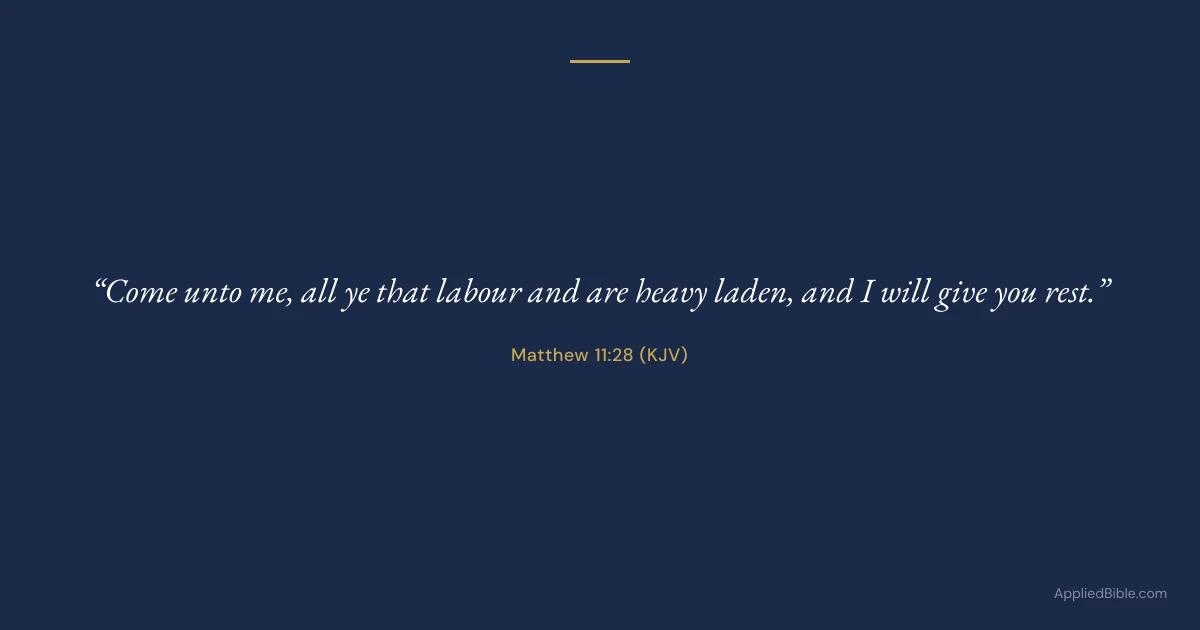
"Come unto me, all ye that labour and are heavy laden, and I will give you rest. Take my yoke upon you, and learn of me; for I am meek and lowly in heart: and ye shall find rest unto your souls."
Matthew 11:28-29 (KJV)
What This Means: Jesus does not say: stop trying harder. He says come to me. Rest is located in a relationship, not in an absence of activity. The yoke Jesus offers is easier than the yoke of religious performance, anxiety, self-sufficiency, or the constant striving to prove yourself. Learning from Him, who is meek and lowly in heart, is the path to the rest that is deeper than sleep: rest for your soul. That is the kind of rest the laboring and heavy-laden most need.
How to Apply This: What are you laboring under today? Name the specific yoke: the performance standard, the anxiety, the thing you cannot put down. Then come. Not to a technique or a sabbath practice. To Jesus. Bring the specific load to Him and ask for the rest He promises.
2. Psalm 23:2-3: "The Shepherd Makes You Lie Down in Green Pastures"
"He maketh me to lie down in green pastures: he leadeth me beside the still waters. He restoreth my soul: he leadeth me in the paths of righteousness for his name's sake."
Psalm 23:2-3 (KJV)
What This Means: Sheep do not lie down unless they feel safe. The Shepherd makes them lie down, meaning He creates the conditions that allow rest. He leads to still waters, not rushing waters. And the result: He restoreth my soul. The restoration of the soul happens in the rest the Shepherd provides, not in the rush of activity. This is God's role in your rest: He creates the conditions and leads you to them. Your role is to follow.
How to Apply This: When did you last allow yourself to truly lie down in the figurative sense: to be in a place of quietness and safety, not worried about what is being missed? What condition is God trying to lead you to for soul restoration right now? Follow where He is leading.
3. Genesis 2:2: "God Rested on the Seventh Day and Set a Pattern"
"And on the seventh day God ended his work which he had made; and he rested on the seventh day from all his work which he had made."
Genesis 2:2 (KJV)
What This Means: God did not rest because He was tired. He rested because the work was complete, because completeness was worth marking, and because He was setting a pattern for all of creation to follow. Rest is not a concession to human weakness. It is built into the fabric of how God designed time and work. The God who does not grow weary chose to rest. That choice was not accidental. It was instructive.
How to Apply This: Do you treat rest as a sign of weakness or inefficiency? God's rest on the seventh day reframes it as the mark of completeness, the right response to finished work. What does finished-work rest look like for you in the next seven days? Plan it.
4. Exodus 20:8-10: "The Sabbath Is Commanded, Not Suggested"
"Remember the sabbath day, to keep it holy. Six days shalt thou labour, and do all thy work: But the seventh day is the sabbath of the LORD thy God: in it thou shalt not do any work, thou, nor thy son, nor thy daughter, thy manservant, nor thy maidservant, nor thy cattle, nor thy stranger that is within thy gates:"
Exodus 20:8-10 (KJV)
What This Means: The Sabbath is one of the Ten Commandments. It sits alongside do not murder and do not steal. Its placement signals that God treats the failure to rest as seriously as other sins. The six days of labor are also commanded. This is not a command to be lazy. It is a structured rhythm: six days of full work, one day of full rest. The remember is significant: the Sabbath had to be remembered, which implies it was regularly forgotten.
How to Apply This: Do you have a regular, genuine day of rest each week? Not a day where you catch up on things at home while telling yourself you are resting. An actual day of not working. If not, what is preventing it? The commandment is clear. What would one day of genuine rest require you to change?
5. Mark 6:31: "Jesus Told His Disciples to Come Apart and Rest"
"And he said unto them, Come ye yourselves apart into a desert place, and rest a while: for there were many coming and going, and they had no leisure so much as to eat."
Mark 6:31 (KJV)
What This Means: Jesus gave this instruction in the middle of active ministry. The disciples had returned from their first mission. People were crowding in. There was more work to do. And Jesus said: come apart and rest. This is significant: the need for rest did not override the compassion that followed when the crowd appeared. But Jesus recognized the need before it reached crisis. He initiated the rest. He did not wait for the disciples to collapse first.
How to Apply This: Are you waiting until you are depleted before you rest, or are you building in rest before you need it the way Jesus proposed? Name one time in the next week when you can come apart from the demands and rest deliberately. Not waiting until you collapse. Planning it now.
6. Psalm 127:2: "God Gives Sleep to His Beloved"
"It is vain for you to rise up early, to sit up late, to eat the bread of sorrows: for so he giveth his beloved sleep."
Psalm 127:2 (KJV)
What This Means: The psalmist is critiquing a specific kind of anxiety-driven busyness: rising before necessary, staying up past what is useful, eating the bread of sorrows, meaning subsisting on anxious effort. And the contrast: God gives His beloved sleep. Sleep is a gift from God, not something you earn by working long enough. The person who cannot sleep because they are too anxious may be trusting their labor more than their God.
How to Apply This: How is your sleep right now? If it is disrupted by anxiety or by staying up too late trying to accomplish more, ask what it means that God gives sleep to His beloved. You are His beloved. The sleep is a gift. Receive it. Make one change tonight toward better rest.
7. Hebrews 4:9-10: "There Remains a Sabbath Rest for the People of God"
"There remaineth therefore a rest to the people of God. For he that is entered into his rest, he also hath ceased from his own works, as God did from his."
Hebrews 4:9-10 (KJV)
What This Means: The writer of Hebrews identifies a deeper rest than weekly Sabbath: the rest that comes from ceasing from your own works the way God ceased from His. This is salvation rest, the rest that comes from trusting in what Christ did rather than in what you do. It is also the pattern for all rest: entering in means stopping your own striving and trusting the One who has already completed the work. Physical rest and spiritual rest are rooted in the same posture.
How to Apply This: Is there an area of your life where you are still working as if everything depends on your effort rather than resting in what God has already done? Enter into His rest means you have ceased from your own works in that area. Name the specific effort you can hand over.
8. Isaiah 30:15: "Quietness and Confidence Are Your Strength"
"For thus saith the Lord GOD, the Holy One of Israel; In returning and rest shall ye be saved: in quietness and in confidence shall be your strength: and ye would not."
Isaiah 30:15 (KJV)
What This Means: God speaks to Israel who was scrambling for military alliances to solve their problems. His prescription: return, rest, quietness, confidence. These are postures of trust. The and ye would not at the end is sobering: He offered this rest and they refused it, preferring to keep scrambling. The strength God offers, the kind that is real and lasting, comes from quietness and confidence. Most people choose the alternative and call it strength.
How to Apply This: In what situation right now are you scrambling when God is offering quietness and confidence? Name the situation. Then try the Isaiah 30:15 approach: return to God, rest in what He has said, quiet the noise, trust in who He is. Even for one day. See what happens to your sense of strength.
9. Psalm 62:1: "The Soul Finds Rest in God Alone"
"Truly my soul waiteth upon God: from him cometh my salvation."
Psalm 62:1 (KJV)
What This Means: David identifies the only source of true soul rest: God alone. Waiteth is the Hebrew damam, meaning to be silent, to cease, to rest. The soul that rests silently in God is not passive but positioned: looking to God and not to any other source. From Him cometh my salvation. Not from my strategy, not from my relationships, not from my success. From Him. The soul that knows this can rest.
How to Apply This: Set aside five minutes today for Psalm 62:1 in practice. Not to ask anything, not to say anything. Just to wait on God: silent, still, looking to Him. Let your soul rest in Him rather than in its activity. If five minutes feels impossible, start with two. That is the condition of the soul that most needs this rest.
10. Psalm 4:8: "God Makes You Dwell in Safety So You Can Sleep"
"I will both lay me down in peace, and sleep: for thou, LORD, only makest me dwell in safety."
Psalm 4:8 (KJV)
What This Means: David can sleep because of one reason: the LORD makes him dwell in safety. Not because everything is fine. Not because the threats have been resolved. But because the LORD is his safety. This is physical rest grounded in spiritual trust. The ability to sleep is a statement of faith: I am trusting God with what I cannot control while I am unconscious. Every night you go to sleep is an act of trust.
How to Apply This: Tonight, say Psalm 4:8 before you sleep: 'I will lay me down in peace and sleep, for thou LORD only makest me dwell in safety.' Say it as a genuine statement of trust, not just a bedtime verse. Name whatever is making you anxious and then deliberately place it in God's keeping.
11. Proverbs 3:24: "When You Trust God, Your Sleep Will Be Sweet"
"When thou liest down, thou shalt not be afraid: yea, thou shalt lie down, and thy sleep shall be sweet."
Proverbs 3:24 (KJV)
What This Means: Solomon places this promise in the context of trusting God and fearing Him (Proverbs 3:5-7 precede this). The person who trusts God fully does not fear when they lie down. Their sleep is sweet. Disrupted, fearful sleep is often a signal of trust that has not been fully transferred to God. This is not a technique for sleeping better. It is the result of genuine, practiced trust in a God who is watching while you rest.
How to Apply This: Is there something specific you are afraid of when you lie down: a health issue, a financial problem, a relationship, the unknown? Name it. Then read Proverbs 3:5-6 and 3:24 as a pair: trust in the Lord with all your heart, and your sleep shall be sweet. The sweet sleep is the fruit of the trust. Work on the trust.
12. John 14:27: "Jesus Gives a Peace That the World Cannot Give"
"Peace I leave with you, my peace I give unto you: not as the world giveth, give I unto you. Let not your heart be troubled, neither let it be afraid."
John 14:27 (KJV)
What This Means: Jesus distinguishes His peace from what the world offers. The world's peace is circumstantial: things are okay when conditions are favorable. Jesus' peace is not dependent on conditions. It is a gift He leaves with you that does not change with circumstances. Let not your heart be troubled: this is a command, not just an encouragement. You have been given the peace to not be troubled. The question is whether you are living in it.
How to Apply This: In the area where your heart is most troubled right now, hear Jesus say: 'Peace I give unto you. Let not your heart be troubled.' Not once the situation resolves. Now. Before the resolution. The peace is already given. Receive it today and let it produce rest in the troubled area.
13. Matthew 6:27: "Worry Cannot Add a Single Hour to Your Life"
"Which of you by taking thought can add one cubit unto his stature?"
Matthew 6:27 (KJV)
What This Means: Jesus asks a rhetorical question whose answer is obvious: no one. Taking anxious thought cannot add one cubit to your height, or one hour to your life, or one inch to the thing you are worrying about. The worry is not producing anything. It is consuming your present and giving nothing in return. Jesus invites you to notice this: the anxious thought is not working. It is not solving the problem. It is just costing you rest.
How to Apply This: Name the worry you are carrying most heavily right now. Then ask Jesus' question: has this worrying added anything to the situation? If not, what would it look like to put it down today? Not to stop caring about the situation. To stop carrying the worry about it. Let that be your rest assignment.
14. Isaiah 40:31: "Those Who Wait on the LORD Renew Their Strength"
"But they that wait upon the LORD shall renew their strength; they shall mount up with wings as eagles; they shall run, and not be weary; and they shall walk, and not faint."
Isaiah 40:31 (KJV)
What This Means: Isaiah's famous promise connects strength renewal to waiting on the LORD. The three images cover every pace of life: soaring, running, walking. The renewal is not produced by more effort. It is produced by waiting, by active, expectant trust in the LORD. Rest that renews is not the absence of activity. It is the presence of God in the stillness. You come away from genuine rest in God stronger than when you entered.
How to Apply This: Schedule fifteen minutes today to wait on the LORD. Not to pray through a list. To wait: to be still, to be expectant, to set your mind on God and let everything else quiet. Then notice whether you feel more renewed after those fifteen minutes than after fifteen minutes of busyness.
15. Revelation 14:13: "The Ultimate Rest Is Coming"
"And I heard a voice from heaven saying unto me, Write, Blessed are the dead which die in the Lord from henceforth: Yea, saith the Spirit, that they may rest from their labours; and their works do follow them."
Revelation 14:13 (KJV)
What This Means: The final word on rest in the Bible is eschatological: the ultimate rest is coming. Those who die in the Lord rest from their labors, and their works follow them. This is the completion of all labor and the beginning of perfect rest. The toil that resulted from sin (Genesis 3:17-19) will be over. The rest that God designed and the rest that Jesus promised will be fully realized. Every earthly rest you take is a small foretaste of what is coming.
How to Apply This: Does the promise of ultimate rest change how you hold the labor and the pressure of today? Your works will follow you. The work done faithfully has a destination. The rest is coming. Let that eternal perspective make today's work and today's rest both more meaningful.
How to Apply These Verses When Rest Feels Impossible
When you cannot stop because there is too much to do
Matthew 6:27 is the question to sit with: has your taking thought added anything? If not, the effort is not producing what you think it is. Psalm 127:2 calls the anxious labor vain. Mark 6:31 shows Jesus initiating rest for His disciples even in the middle of active ministry. Rest is not something you find when the work is done. It is something you choose before you collapse.
When rest does not actually restore you
Matthew 11:28-29 points to the source: rest is located in Jesus, not in the absence of activity. Isaiah 30:15 gives the elements: returning, quietness, confidence. Psalm 62:1 describes the posture: soul-waiting on God. Physical rest without spiritual rest does not restore the soul.
When anxiety keeps you awake
Psalm 4:8 is the bedtime declaration: I will lay down in peace because You make me dwell in safety. Proverbs 3:24 is the promise: trust in God produces sweet sleep. John 14:27 gives the gift: His peace, not the world's peace, is what you have. Let not your heart be troubled.
Frequently Asked Questions
What does the Bible say about rest?
Rest is woven through the entire Bible, from God resting on the seventh day (Genesis 2:2) to the promise of ultimate rest in Revelation 14:13. The Sabbath commandment in Exodus 20:8-10 makes weekly rest one of the Ten Commandments. Jesus offers rest to the laboring and heavy-laden (Matthew 11:28). Psalm 127:2 says God gives sleep to His beloved. Hebrews 4:9-10 points to a deep spiritual rest that comes from ceasing from your own works and trusting in God. Rest is not a luxury or a sign of weakness. It is a command, a gift, and a spiritual discipline.
Why does God command rest?
God commands rest for several reasons. First, it reflects His own pattern: He rested on the seventh day (Genesis 2:2), setting a template for creation to follow. Second, it is a test of trust: the Israelites were told to rest on the Sabbath even during harvest, when work was most pressing. Resting meant trusting God to provide without their seventh-day effort. Third, rest is necessary for human flourishing: Psalm 127:2 says perpetual anxious labor is vain and that God gives sleep to His beloved. Fourth, physical rest is tied to spiritual rest: the Sabbath points to the deeper rest of trusting in God rather than in your own works.
How do you find rest in God?
Matthew 11:28-29 gives the direct path: come to Jesus. Bring the specific burden to Him and take His yoke. Psalm 62:1 describes the posture: silently waiting on God, looking to Him alone. Isaiah 30:15 gives the prescription: returning, rest, quietness, confidence. Practically: regular time in God's presence without an agenda, bringing specific anxieties to God and leaving them there (1 Peter 5:7), observing a regular day of Sabbath, and sleeping as a deliberate act of trust (Psalm 4:8). Rest in God is a combination of posture, practice, and trust.
Is the Sabbath still required for Christians?
Christians hold varying views on this. The Sabbath was given as one of the Ten Commandments (Exodus 20:8-10) and Jesus observed it while also reinterpreting its intent (Mark 2:27: the Sabbath was made for man, not man for the Sabbath). Hebrews 4 points to Christ as the fulfillment of the Sabbath rest. Colossians 2:16-17 says no one should judge you regarding a Sabbath day, as these are shadows pointing to Christ. Most Christian traditions agree that the principle of regular rest, one day in seven, reflects both God's design and wisdom for human flourishing, even if views on strict Sabbath observance differ.
Try This Today
- ✓ Tonight, say Psalm 4:8 before you sleep: 'I will lay me down in peace and sleep, for thou LORD only makest me dwell in safety.' Name the thing making you anxious. Then deliberately place it in God's keeping. That is what it means to sleep in peace.
- ✓ Schedule one genuine rest period in the next seven days. Not leisure with a to-do list running in the background. Actual rest: an activity or a stillness that does not produce anything. Mark it in your calendar. Protect it.
- ✓ Bring the specific burden you are laboring under to Jesus today (Matthew 11:28). Name it specifically to Him. Ask for His rest, not just relief from the situation. The rest He gives is for the soul, and it is available before the circumstance changes.