Bible Verses for a Wedding Ceremony
A wedding is one of those rare moments where heaven and earth feel close together. If you are looking for words that match the weight of what is happening, Scripture has them. Whether you are planning your own wedding or helping someone else plan theirs, the right Scripture reading can turn a beautiful moment into an unforgettable one. These 12 verses have been read at weddings for generations because they capture what marriage is really about: a covenant of love, sacrifice, and commitment that God Himself designed.
Choosing the Right Verses for Your Ceremony
A wedding ceremony is more than a party. It is the moment two people stand before God and their community and say: I choose you, for life. The verses you include in that moment matter. They are not just decoration. They are the foundation you are building on.
Some of these verses are perfect for a reading during the ceremony. Others work better woven into personal vows or printed on your program. A few are the kind you frame and hang in your first home together. As you read through them, pay attention to which ones make you stop and think, "That is what I want our marriage to be." Those are the ones for you.
Every verse below includes a practical idea for how to use it, not just on your wedding day, but in the marriage that follows. Because a good wedding lasts a day. A good marriage lasts a lifetime.
12 Bible Verses for Wedding Readings, Vows, and Ceremonies
1. 1 Corinthians 13:4-7: "The Definition of Love"
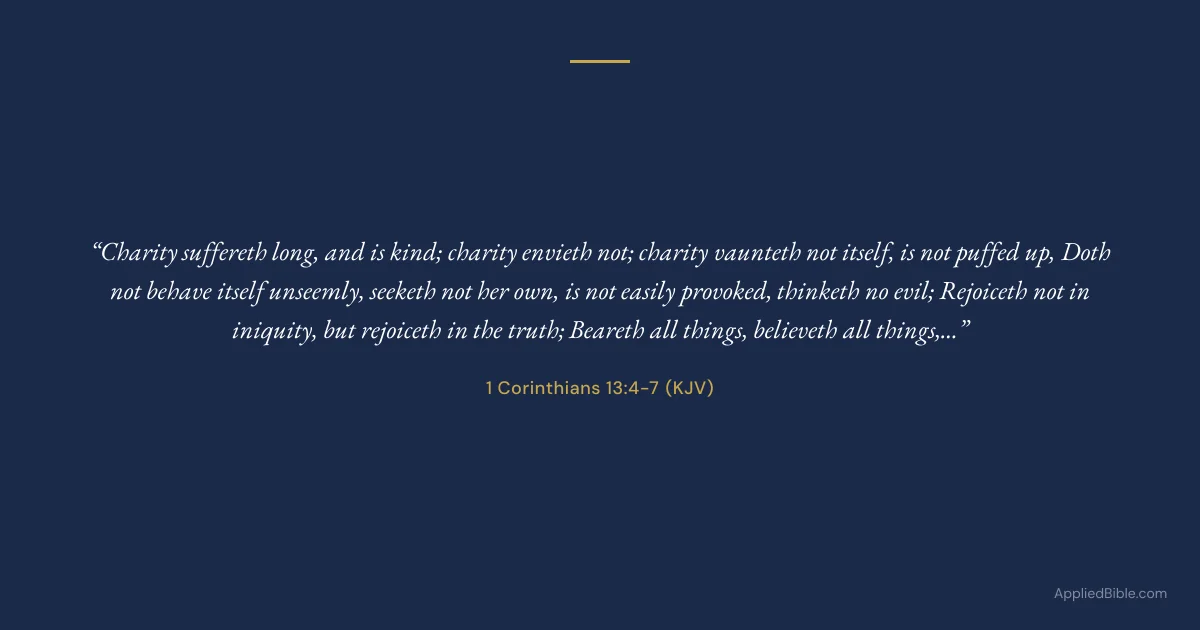
"Charity suffereth long, and is kind; charity envieth not; charity vaunteth not itself, is not puffed up, doth not behave itself unseemly, seeketh not her own, is not easily provoked, thinketh no evil; rejoiceth not in iniquity, but rejoiceth in the truth; beareth all things, believeth all things, hopeth all things, endureth all things."
1 Corinthians 13:4-7 (KJV)
What This Means: This is the most read passage at weddings for a reason. Paul is not describing a feeling. He is describing a way of living. Love is patient when your spouse is running late again. Love is kind when you are both exhausted. Love does not keep score. This is not a Hallmark definition. It is a daily choice.
How to Apply This: Print this passage and read it together on the morning of your wedding. Then put it somewhere you will both see it every day, on the fridge, the bathroom mirror, or inside a kitchen cabinet. When marriage gets hard (and it will), come back to these words and ask: which one do I need to practice today?
2. Genesis 2:24: "Two Become One"
"Therefore shall a man leave his father and his mother, and shall cleave unto his wife: and they shall be one flesh."
Genesis 2:24 (KJV)
What This Means: This is the first marriage in all of Scripture. Before there was a temple, a church, or a wedding planner, God created a covenant between two people. The word 'cleave' means to cling, to hold fast, to refuse to let go. Marriage is not just a ceremony. It is a permanent bond designed by God Himself.
How to Apply This: Before your wedding, sit down with your partner and talk about what 'leaving and cleaving' looks like for your family. What boundaries will you set to protect your marriage? What does it mean to put each other first? Write your answers down and keep them where you can revisit them in your first year.
3. Ecclesiastes 4:9-12: "A Threefold Cord"
"Two are better than one; because they have a good reward for their labour. For if they fall, the one will lift up his fellow: but woe to him that is alone when he falleth; for he hath not another to help him up. Again, if two lie together, then they have heat: but how can one be warm alone? And if one prevail against him, two shall withstand him; and a threefold cord is not quickly broken."
Ecclesiastes 4:9-12 (KJV)
What This Means: Solomon paints a picture of partnership that every married couple needs to hear. Two are better than one because they lift each other up when they fall. But the real power is in the last line: a threefold cord. Two people plus God. That is the cord that does not break, not when the job is lost, not when the diagnosis comes, not when the hard season hits.
How to Apply This: At your wedding ceremony, consider a cord-braiding unity ritual. Three cords (one for each spouse and one for God) braided together during the service. Then keep the braid somewhere visible in your home as a reminder that your marriage is built on three.
4. Song of Solomon 8:6-7: "Love That Cannot Be Quenched"
"Set me as a seal upon thine heart, as a seal upon thine arm: for love is strong as death; jealousy is cruel as the grave: the coals thereof are coals of fire, which hath a most vehement flame. Many waters cannot quench love, neither can the floods drown it: if a man would give all the substance of his house for love, it would utterly be contemned."
Song of Solomon 8:6-7 (KJV)
What This Means: This is one of the most passionate declarations in all of Scripture. Love is strong as death. Many waters cannot quench it. No amount of money can buy it. The Song of Solomon reminds us that romantic love is not something the Bible ignores. God designed it, He celebrates it, and He intended it to burn bright within the covenant of marriage.
How to Apply This: Read this passage together the night before your wedding. Let the weight of it settle in. Then write each other a letter about what your love means to you, not what you will promise, but what you have already seen God do in your relationship. Exchange the letters on your wedding morning.
5. Ruth 1:16-17: "Where You Go, I Will Go"
"And Ruth said, Intreat me not to leave thee, or to return from following after thee: for whither thou goest, I will go; and where thou lodgest, I will lodge: thy people shall be my people, and thy God my God: Where thou diest, will I die, and there will I be buried: the LORD do so to me, and more also, if ought but death part thee and me."
Ruth 1:16-17 (KJV)
What This Means: Ruth spoke these words to her mother-in-law, but they have become one of the most beloved wedding readings of all time. Why? Because they capture what covenant love really looks like: choosing to stay when leaving would be easier. Ruth gave up her homeland, her people, and her future security to follow someone she loved. That is the kind of commitment marriage asks for.
How to Apply This: Use Ruth's words as inspiration for your own vows. Write a version that reflects your specific story: the places you will go together, the family you are joining, the future you are choosing. Personal vows rooted in Scripture hit different than generic ones.
6. Colossians 3:14: "Love Binds Everything Together"
"And above all these things put on charity, which is the bond of perfectness."
Colossians 3:14 (KJV)
What This Means: Paul has just listed virtues every believer needs: compassion, kindness, humility, patience, forgiveness. Then he says: above all of those, put on love. It is the thing that holds everything together. In marriage, you will need patience. You will need forgiveness. But love is what ties them all into one unbreakable package.
How to Apply This: During your wedding reception, ask each table to write down one piece of marriage advice on a card. Collect them in a box and read one together each week for your first year. You will be amazed at the wisdom your community carries.
7. Ephesians 5:25: "Love That Gives Everything"
"Husbands, love your wives, even as Christ also loved the church, and gave himself for it;"
Ephesians 5:25 (KJV)
What This Means: The standard Paul sets here is staggering. Love your wife the way Christ loved the church: sacrificially, completely, without holding anything back. This is not about authority or control. It is about a love that lays itself down. Christ gave everything for the church. That is the model for marriage.
How to Apply This: If you are the groom, write down three specific ways you can lay down your preferences for your spouse this week. Not grand gestures, but daily ones: doing the dishes without being asked, listening when you would rather scroll your phone, choosing her needs before your comfort. Start practicing before the wedding day.
8. Proverbs 18:22: "Marriage Is a Gift from God"
"Whoso findeth a wife findeth a good thing, and obtaineth favour of the LORD."
Proverbs 18:22 (KJV)
What This Means: Short, simple, and powerful. Finding a spouse is a good thing. Not just a nice thing or a convenient thing, but a good thing that comes with the favor of the Lord. If you are about to get married, know this: God is not just allowing your marriage. He is smiling over it.
How to Apply This: On your wedding day, take sixty seconds alone together before the reception starts. Look at each other and say out loud: 'This is a good thing. God's favor is on us.' Let that be the first words you speak as a married couple before the noise of the celebration begins.
9. Mark 10:9: "What God Has Joined Together"
"What therefore God hath joined together, let not man put asunder."
Mark 10:9 (KJV)
What This Means: Jesus spoke these words directly. Marriage is not just a social contract or a legal agreement. It is something God joins together. When you stand at the altar, you are not just making a promise to each other. You are entering a covenant that God Himself is sealing. That changes everything about how you protect it.
How to Apply This: Make a commitment together before the wedding: we will never use the word 'divorce' as a threat in an argument. Take it off the table completely. When that word is removed, you are forced to work through problems instead of running from them. Protect what God has joined.
10. 1 John 4:19: "We Love Because He Loved First"
"We love him, because he first loved us."
1 John 4:19 (KJV)
What This Means: Every love story starts with God. You do not love your spouse out of your own strength or goodness. You love because God loved you first and filled you with the capacity to love someone else. On the days when loving feels hard (and those days will come), remember: you are drawing from a well that never runs dry.
How to Apply This: Start a wedding day tradition: before you walk down the aisle, spend five minutes alone with God. Thank Him for loving you first. Ask Him to fill you so completely that your love for your spouse overflows from His love for you. Do this every anniversary, too.
11. Psalm 37:4: "Delight in the Lord Together"
"Delight thyself also in the LORD; and he shall give thee the desires of thine heart."
Psalm 37:4 (KJV)
What This Means: This verse is not a vending machine promise. It is an invitation. When you delight in God, your desires begin to align with His. A marriage built on delighting in the Lord together will naturally produce the things your heart longs for: closeness, purpose, joy, and a love that grows deeper with every year.
How to Apply This: Choose one spiritual practice to do together in your first week of marriage. Read a Psalm out loud before bed. Pray together before meals. Listen to a worship song on your morning commute. It does not have to be complicated. Just start. Couples who seek God together stay rooted together.
12. Romans 12:10: "Outdo Each Other in Showing Honor"
"Be kindly affectioned one to another with brotherly love; in honour preferring one another;"
Romans 12:10 (KJV)
What This Means: Paul is describing a love that competes in one direction: who can honor the other person more? Imagine a marriage where both people wake up asking, 'How can I put you first today?' That is not a fairy tale. That is what Romans 12:10 looks like in a home. It is love that prefers the other person, not out of obligation, but out of genuine affection.
How to Apply This: Start a 'first year' challenge: each week, do one unexpected thing that puts your spouse first. Make their coffee before yours. Fill their gas tank. Write a note in their lunch bag. Keep a list of what you did, and read it together on your first anniversary. You will be amazed at how small acts of honor add up.
How to Use These Verses in Your Wedding
For a ceremony reading
Choose one longer passage like 1 Corinthians 13:4-7, Ecclesiastes 4:9-12, or Song of Solomon 8:6-7. Ask a family member or close friend to read it during the ceremony. Give them the passage at least two weeks early so they can practice reading it with confidence and emotion. A well-read Scripture passage can be the most memorable part of the entire service.
For personal vows
Use a verse as your starting point and build your personal promises around it. Ruth 1:16-17 gives you a natural framework: where you go, I go. What you face, I face. Romans 12:10 gives you another: I will honor you above myself. Root your vows in Scripture and they will carry weight long after the ceremony ends.
For your wedding program or signage
Short verses like Mark 10:9, Proverbs 18:22, or 1 John 4:19 are perfect for printing on programs, welcome signs, or table cards. They set the tone for the day and give your guests something meaningful to carry home with them.
For your first home together
Pick your favorite verse from this list and frame it. Hang it somewhere you will both see it every single day. On the hard days (and there will be hard days), that verse will remind you why you chose each other and who is holding your marriage together. Genesis 2:24 and Colossians 3:14 are especially powerful for this.
Building a Marriage That Lasts Beyond the Wedding Day
The wedding is one day. The marriage is every day after that. These verses are not just for the ceremony. They are a blueprint for how to love someone for thirty, forty, fifty years. When the flowers wilt and the dress goes into storage, these words remain.
The strongest marriages are not the ones with the best weddings. They are the ones where both people keep choosing each other, keep forgiving, keep honoring, keep showing up. That is what 1 Corinthians 13 is really about. That is what "leaving and cleaving" looks like in real life. If you build your marriage on the foundation these verses describe, you are building on something that will not break.
Frequently Asked Questions
What is the most popular Bible verse for weddings?
1 Corinthians 13:4-7 is the most commonly read passage at wedding ceremonies. It defines love as patient, kind, not envious or boastful, and describes love that bears, believes, hopes, and endures all things. It works beautifully as a ceremony reading, in vows, or printed on a wedding program.
Can you use Bible verses in non-church wedding ceremonies?
Yes. Bible verses can be included in any wedding ceremony regardless of the venue. They work as readings, vow inspirations, or printed on programs and signage. Many couples choose to have a family member or friend read a passage during an outdoor or non-traditional ceremony. The words carry the same weight wherever they are spoken.
How many Bible verses should I include in a wedding ceremony?
Most ceremonies include one or two readings. One longer passage like 1 Corinthians 13:4-7 or Ecclesiastes 4:9-12 works well as a main reading. A shorter verse like Mark 10:9 or Genesis 2:24 is perfect for the officiant to quote during the message. You want the verses to feel meaningful, not rushed, so less is often more.
What Bible verse is best for wedding vows?
Ruth 1:16-17 ('Where thou goest, I will go') is a beautiful foundation for personal vows because it captures total commitment in simple language. Romans 12:10 ('in honour preferring one another') is also a strong choice if you want vows centered on serving each other. Song of Solomon 8:6-7 works well for vows that celebrate the passion and permanence of love.
Try This Today
- ✓ Pick one verse from this list for your ceremony. Read it out loud together with your partner tonight and talk about why it resonates with you.
- ✓ Write it on a card and put it in the pocket of your wedding outfit or tuck it into your bouquet. Let it be your anchor for the day.
- ✓ After the wedding, frame that verse and hang it in your bedroom. Read it together on the first of every month for your entire first year of marriage.
Get daily encouragement in your inbox
Free, always. No spam. Unsubscribe anytime.