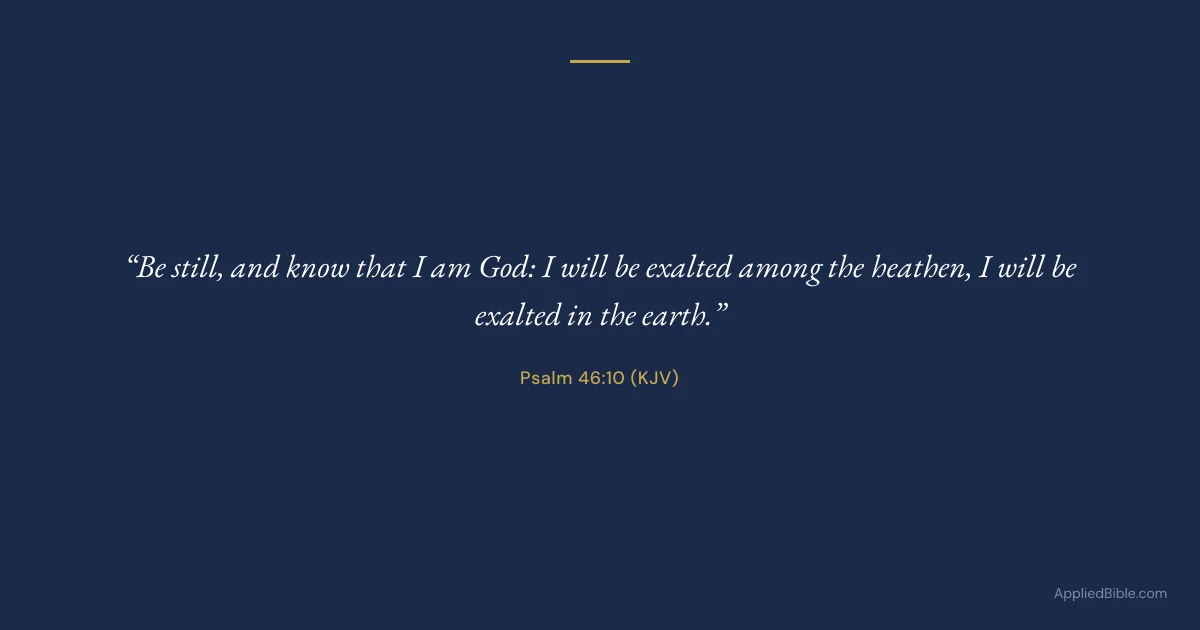
“Be still, and know that I am God: I will be exalted among the heathen, I will be exalted in the earth.”
Psalm 46:10 (KJV) |
Stop fighting for control. God is God, and you are not.
Psalm 46:10 Meaning: What "Be Still and Know" Really Means
Where This Verse Comes From
Psalm 46 was written by the sons of Korah, a family of Levite worship leaders who served in the temple. The psalm is not a quiet meditation. It opens with catastrophe: mountains shaking, waters roaring, the earth giving way. Everything that should feel solid is falling apart. And right in the middle of all that destruction, the psalmist declares: God is our refuge and strength.
By the time you reach verse 10, the scene has shifted from natural disasters to human wars. God has broken bows, cut spears in half, and burned chariots with fire. Then He speaks directly. Not through a prophet, not through a priest. God Himself says: "Be still, and know that I am God." It is a command given in the middle of chaos, not after it.
The verses around it complete the picture. Verse 9 says, "He maketh wars to cease unto the end of the earth; he breaketh the bow, and cutteth the spear in sunder; he burneth the chariot in the fire." And verse 11 adds, "The LORD of hosts is with us; the God of Jacob is our refuge. Selah." God ends wars. God stands with His people. Your job is to stop striving long enough to see it.
What Does Psalm 46:10 Mean?
What does "be still" actually mean?
The Hebrew word is raphah, and it does not mean "be quiet" or "sit down." It means "let go, cease striving, release your grip." Picture yourself gripping the edge of a cliff with white knuckles, convinced that if you let go, everything falls apart. Raphah is God saying: open your hands. I have this. You are not the one holding the world together. I am. This is not a call to passivity. It is a call to surrender the illusion that your striving is what keeps things from falling apart.
What does "know that I am God" mean?
The word "know" here is not about information. You already know God exists. This is about experiential trust. It is the difference between knowing a bridge can hold 10,000 pounds and actually walking across it. "Know that I am God" means to stop long enough to remember who you are dealing with. He is the one who just ended wars and broke weapons. He does not need your help running the universe. When you stop striving, you create space to remember that truth.
Who is God speaking to in this verse?
The immediate audience is the nations, the warring kingdoms who think they are in control. God tells them to stop and recognize His sovereignty. But the psalm is also written for God's people, for you. When you read this verse in the middle of a hard season, God is speaking directly to you: stop striving. Stop trying to control what you were never meant to carry. I am God. You are not. And that is the best news you will hear today.
Is this verse about being passive or being active?
Neither passive nor lazy. Surrendering control to God is one of the hardest things you will ever do. It takes more strength to open your grip than to keep holding on. "Be still" is an active choice to trust God when every instinct screams at you to fix, plan, worry, and manage. You are not doing nothing. You are doing the one thing that matters most: choosing to believe that God is who He says He is.
3 Ways to Apply Psalm 46:10 Today
1. Name the thing you are white-knuckling
You know what it is. The situation you check on constantly, the problem you replay at 2 AM, the outcome you are trying to control through sheer willpower. Write it down on a piece of paper. Just one thing. Then hold that paper in your open hands and pray: "God, I am releasing my grip on this. You are God, and I am not. I trust You with this outcome." Put the paper somewhere you will see it tomorrow. Every time you see it, open your hands again.
2. Build a five-minute stillness habit
Before you check your phone in the morning, before you open your email, before you start your to-do list, sit for five minutes in silence. Not to empty your mind, but to fill it. Say out loud: "God, You are God. I am not. Today belongs to You." That is it. Five minutes. No music, no podcast, no prayer list. Just you and the truth that God is sovereign over whatever this day holds. Do this for one week and notice what changes.
3. Replace one anxious action with one trusting action
Today, you will be tempted to do something driven by anxiety. Send that fourth follow-up email. Check your bank account for the tenth time. Rehearse that conversation one more time in your head. When you catch yourself, stop. Replace that anxious action with a trusting one. Instead of checking your account again, pray: "God, You are my provider." Instead of rehearsing that conversation, pray: "God, You will give me the words." One swap. That is raphah in real life.
Try This Today
- ✓ Write down the one thing you are gripping tightest right now. Hold the paper in open hands and say out loud: 'God, You are God. I release my grip on this.'
- ✓ Set a timer for five minutes tomorrow morning before you touch your phone. Sit in silence and repeat: 'Be still. Know that He is God.' Nothing else.
- ✓ Pick one anxious habit you will catch yourself doing today, checking, worrying, replanning, and replace it with a single sentence prayer of trust.
Related Verses
"God is our refuge and strength, a very present help in trouble."
The opening verse of the same psalm sets the stage. God is not distant. He is a present help, right here, right now, in the middle of your trouble.
"The LORD shall fight for you, and ye shall hold your peace."
Moses told the Israelites at the Red Sea what Psalm 46:10 tells you: stop striving. God will fight this battle. Your job is to let Him.
"For thus saith the Lord GOD, the Holy One of Israel; In returning and rest shall ye be saved; in quietness and in confidence shall be your strength."
Isaiah echoes the same truth. Your strength does not come from hustling harder. It comes from quieting yourself and trusting the One who holds everything together.
"Rest in the LORD, and wait patiently for him: fret not thyself because of him who prospereth in his way, because of the man who bringeth wicked devices to pass."
David uses a different word but the same idea: rest. Stop fretting. Stop comparing. Let God handle the timing and the outcome.
"Fear thou not; for I am with thee: be not dismayed; for I am thy God: I will strengthen thee; yea, I will help thee; yea, I will uphold thee with the right hand of my righteousness."
God speaks directly, just like in Psalm 46:10. The message is the same: stop being afraid. I am God. I am with you. I will hold you up.
"Be careful for nothing; but in every thing by prayer and supplication with thanksgiving let your requests be made known unto God. And the peace of God, which passeth all understanding, shall keep your hearts and minds through Christ Jesus."
Paul gives the New Testament version of 'be still.' Stop anxious striving. Bring it to God in prayer. And His peace will guard your heart.
Frequently Asked Questions
What does 'be still' mean in the original Hebrew?
The Hebrew word is raphah, and it means 'let go, cease striving, release your grip, slacken.' It is not about sitting quietly in a room. It is a command to stop fighting for control. Picture someone white-knuckling a steering wheel during a storm. Raphah means open your hands and let God drive. It is an active choice to surrender, not a passive retreat into silence.
Is Psalm 46:10 about meditation?
Not in the modern sense of emptying your mind. The verse is about redirecting your focus. 'Be still' means stop striving, and 'know that I am God' means fill that space with trust in who God is. Biblical stillness is not about clearing your thoughts. It is about replacing anxious thoughts with the truth that God is sovereign and present. You are not emptying your mind. You are filling it with God.
How do you 'be still' when life is chaotic?
The psalm was written for chaos, not comfort. Psalm 46 describes mountains crumbling and oceans roaring. 'Be still' is not advice for a quiet afternoon. It is a command for the worst day of your life. Practically, it means pausing before you react, praying before you plan, and choosing to trust God's power over your own ability to fix things. Even five minutes of silence before God in the middle of a hard day is an act of obedience to this verse.
What is the context of Psalm 46?
Psalm 46 was written by the sons of Korah, a family of Levite worship leaders in the temple. The psalm is structured in three sections: God is our refuge when nature collapses (verses 1-3), God is present in His city (verses 4-7), and God is sovereign over all nations (verses 8-11). Verse 10 comes in the final section, where God Himself speaks. After describing wars ending and weapons being destroyed, God says: stop. Know that I am God. It is a declaration of total authority.